
Table of contents8 sections
I wanted to answer what sounds like a simple question:
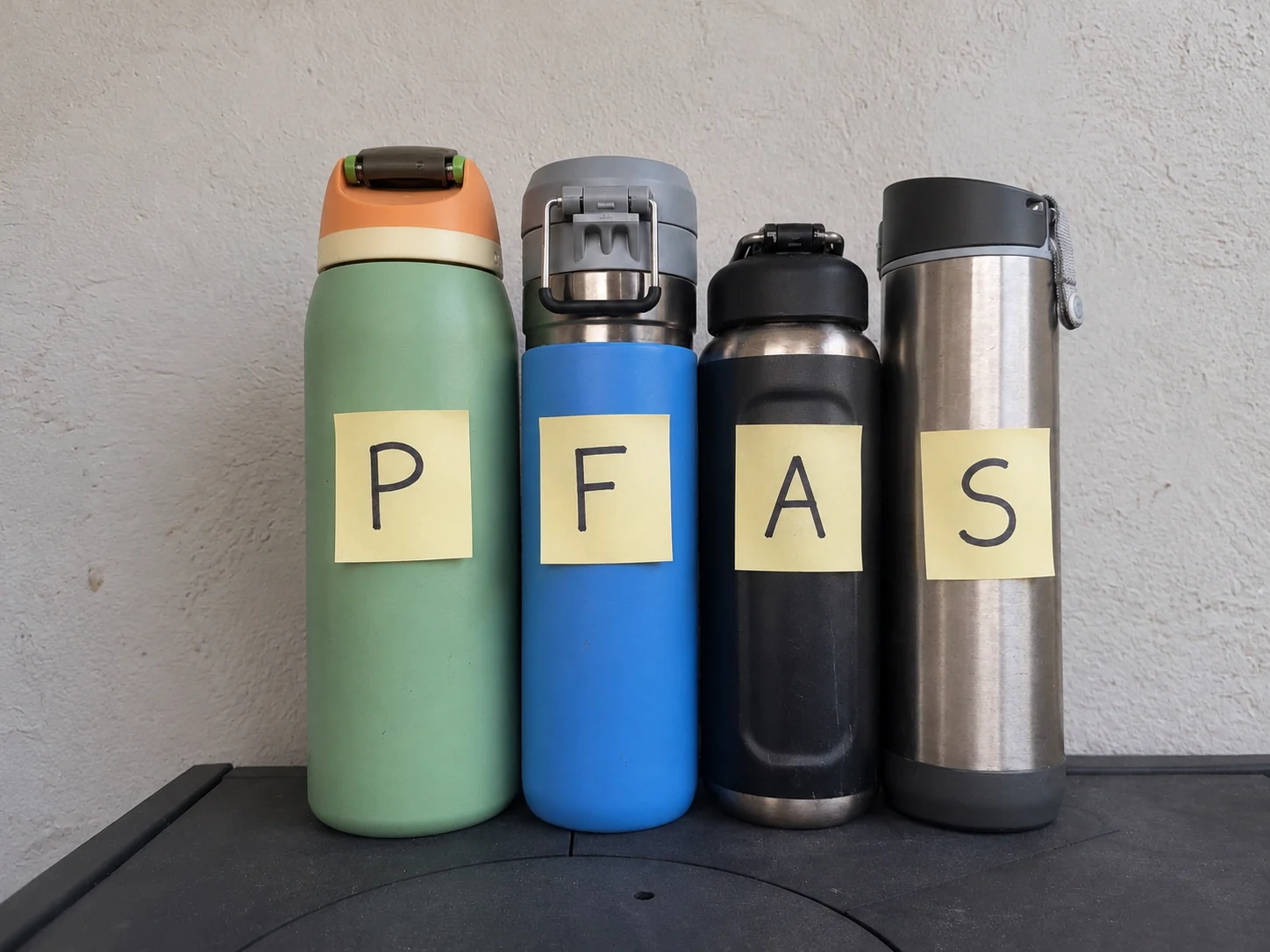
Can a reusable water bottle put PFAS into the water you drink?
The first study I looked for was obvious. Take ordinary reusable bottles, fill them with clean water, wait, test the water for PFAS, and compare it with the starting water.
I couldn’t find that study.
As of October 27, 2026, I did not locate a peer-reviewed study directly measuring PFAS in ordinary reusable drinking bottles or showing PFAS migrating from their water-contact parts into drinking water.
That does not prove your bottle is PFAS-free. It means one of the most basic questions about PFAS and reusable bottles has barely been studied directly.
There is still plenty we do know. PFAS can be present in drinking water, they can migrate from some food-contact materials, and fluorinated materials are used in some drinkware products.
The important part is not turning those facts into a bigger claim than the evidence supports.
The direct evidence is surprisingly thin
PFAS is not one chemical. It is a huge family of fluorinated substances, which is why PFAS-free, PFOA-free, PFOS-free and no intentionally added PFAS are not interchangeable claims.
PFOA and PFOS are individual PFAS. A bottle can be PFOA-free without the claim covering the rest of the PFAS family.
I searched specifically for studies testing ordinary reusable bottles, including their lids, gaskets, coatings, straws and valves. I still did not locate a peer-reviewed study directly showing PFAS migrating from a normal reusable drinking bottle into its contents.
Researchers have tested reusable bottles for other chemicals. One 2026 study tested 21 reusable PET and polypropylene bottles for a broad range of substances, but PFAS were not part of the targeted panel.
“PFAS were not tested” cannot become “PFAS were not found.”
At the same time, “I did not locate a direct bottle study” cannot become “reusable bottles are PFAS-free.” The evidence simply is not that complete yet.
PFAS in the water does not prove the bottle caused it
This is one of the easiest mistakes to make.
PFAS have been detected in tap water, groundwater and bottled water. If you test water from a bottle and find PFAS, they may have come from the bottle, but they may also have been in the water before it ever touched the bottle.
That is why source attribution matters.
I found studies comparing PFAS across bottled-water products that initially looked useful for answering whether packaging mattered. Once I followed the citations, they were not clean experiments using the same water in different containers.
So I would not use them to claim plastic packaging caused the PFAS. I also would not use them to claim packaging never matters.
Sometimes the evidence really does stop in the middle.
Where bottle-related PFAS could matter
We do know PFAS can migrate from some food-contact materials.
Researchers have measured PFAS moving from certain food-contact packaging into food or food simulants. That makes migration a real mechanism, but a paper food container is not a reusable water bottle.
The clearest container example I found came from fluorinated HDPE. The EPA investigated certain fluorinated polyethylene pesticide containers and found PFAS in liquid stored inside some of them.
That is genuine container-to-liquid migration. It is also not evidence that ordinary HDPE water bottles release PFAS.
What it shows is more useful: the name of the base material does not always tell you the whole story. How a material is processed can matter too.
Real drinkware also gives us reasons to look beyond the bottle body.
Zojirushi openly describes fluororesin coatings in some stainless-steel bottles and mugs. OXO’s official disclosures identify multiple Strive 16 oz insulated water bottle SKUs with the statement “Product contains PFAS.”
Those disclosures matter, but they still do not tell us whether PFAS migrate into the drink.
A fluorinated material existing in a product and that product exposing you to PFAS are two very different claims.
The bottle body is not the whole bottle
After years of testing bottles, I have become increasingly skeptical of reducing the whole product to whatever the body is made from.
“18/8 stainless steel” sounds simple. The finished bottle usually is not.
You may also have:
- a plastic lid
- silicone gaskets
- a straw or valve
- an interior coating
- paint, adhesives and tiny molded parts
I already pay a lot of attention to lids and gaskets because they are often the parts that leak, smell, trap dirt or eventually fail. PFAS research gives me another reason to look past the body.
For stainless steel, I did not locate direct evidence showing PFAS migrating from an ordinary reusable stainless-steel bottle into drinking water.
For ordinary reusable Tritan, PET and polypropylene bottles, I also did not locate direct PFAS migration evidence.
And I did not find direct reusable-bottle evidence showing ordinary silicone gaskets are a demonstrated PFAS source.
None of that proves every product is PFAS-free. It means direct evidence is missing.
The same caution applies to heat and dishwashing. Some PFAS migration studies involving other food-contact materials found temperature mattered, but I found no direct reusable-bottle PFAS dishwasher study.
I hand-wash most of my bottles anyway because I have more control over cleaning and I want finishes to last. This research does not give me a PFAS-specific reason to tell everyone to stop using a dishwasher.
Only 5 of 150 brand profiles met my strict PFAS-free rule
I reviewed PFAS-related safety claims across 150 reusable-water-bottle brand profiles.
For the strict count, I required three things:
- the source had to come from the brand itself
- the claim had to cover PFAS as a class
- the claim had to apply to a reusable water bottle or bottle range
Only 5 of 150 profiles met all three requirements:
- 24Bottles
- Asobu
- Bentgo
- Dopper
- Tatonka
That is a transparency result, not a laboratory result.
It does not mean I independently proved that every bottle from those brands contains zero PFAS. It means those five profiles had a first-party, full-class PFAS-free claim that clearly applied to a reusable water bottle or bottle range.
The wording matters here.
“No intentionally added PFAS” is useful information, but it is not the same claim as PFAS-free. Bivo is a good example of that distinction.
PFOA-free and PFOS-free are narrower again. PFOA and PFOS are individual PFAS, not the entire family.
When I compare safety claims, I give much more weight to a clearly scoped PFAS-free statement than to a vague “safe materials” sentence.
Should you worry about PFAS in a reusable bottle?
Based on the evidence I found, I do not see a scientific basis for telling people to throw away ordinary reusable bottles because of PFAS.
I found no direct evidence establishing a typical reusable water bottle as a meaningful PFAS exposure source.
I also would not go to the opposite extreme and call every stainless-steel, glass or plastic bottle PFAS-free.
PFAS can already be present in drinking water. They can migrate from some food-contact materials. Fluorinated materials exist in some drinkware products. Some bottle manufacturers disclose PFAS.
All of those things are real. They still do not add up to “your reusable bottle is contaminating your water.”
If minimizing uncertainty matters to you, I would look for:
- an explicit PFAS-free statement rather than only PFOA-free or PFOS-free
- clear scope showing the claim applies to the bottle or bottle range
- detailed disclosure of coatings, lids, gaskets and other materials
- actual test data when a company makes strong chemical-safety claims
The water itself may matter more than switching between two ordinary reusable bottles. If PFAS are already present before the water enters the bottle, changing bottles may do very little to change your exposure.
The study I would most like to see is straightforward: start with very low-PFAS water, test popular reusable bottles before and after realistic contact, then repeat after washing, aging and heat exposure. Ideally, the body, lid, gasket and coating would be tested separately.
That would answer far more practical questions than another indirect comparison.
Methodology & Sources
Methodology
Research cutoff
This review was current through October 27, 2026. The goal was narrow: to find out what evidence exists that an ordinary reusable water bottle, or a component that touches the drink, can contribute PFAS to the liquid inside it.
What I searched for
I searched peer-reviewed research, government and regulatory sources, and first-party manufacturer documentation. Searches were repeated from different angles rather than relying on one phrase.
The search concepts combined PFAS, PFOA, PFOS, fluorotelomers, fluorinated materials and fluoropolymers with terms including reusable water bottle, drinkware, hydration bottle, stainless steel, Tritan, PET, polypropylene, HDPE and silicone.
I also searched individual bottle components and use conditions, including lids, caps, gaskets, straws, valves, coatings, liners, paint, adhesives, migration, leaching, extractables, heat, hot water, dishwashing, aging and storage.
Because direct bottle evidence was sparse, I separately reviewed bottled-water studies, fluorinated HDPE container research and PFAS migration studies involving other food-contact materials. Those adjacent studies were used only to understand possible mechanisms. I did not treat them as proof that reusable bottles behave the same way.
What counted as direct reusable-bottle evidence
For this article, a direct study needed to measure PFAS in an ordinary reusable drinking bottle or its water-contact components, or measure PFAS in liquid after contact with that bottle or component in a way that could support source attribution.
A study detecting PFAS in bottled water did not automatically count as evidence that the packaging caused it. Without a measured starting-water level, a matched same-water comparison, or another design capable of separating water contamination from packaging contamination, I treated source attribution as unresolved.
The same rule applied to materials. Evidence that PFAS can migrate from a paper food container, a fluorinated pesticide container or another food-contact article was treated as mechanistic or supporting evidence, not as direct evidence about a reusable hydration bottle.
How I handled the absence of direct studies
I use the wording “I did not locate” deliberately. A literature search cannot prove that no relevant study exists anywhere. It can only describe what was found after a defined search.
The final research set reached strong saturation: repeated searches were returning the same studies, reviews and citations rather than new direct reusable-bottle evidence. The working research archive contained 174 evidence records representing 160 study families. No unresolved scientific lead remained that was material to the article’s main conclusion at the review cutoff.
Manufacturer disclosures
Manufacturer pages were used for product-specific facts such as material descriptions, PFAS wording and disclosed coatings. They were not treated as independent laboratory evidence unless the manufacturer provided test data.
A statement such as “contains PFAS” was therefore treated as evidence of a disclosure, not evidence that PFAS migrate into drinking water. Likewise, a PFAS-free claim was treated as a transparency claim unless independent analytical evidence established more.
How the 5 of 150 transparency figure was calculated
I reviewed PFAS-related claims across 150 reusable-water-bottle brand profiles in the WBA chemical-safety transparency audit.
A brand counted in the strict PFAS-free figure only when all of the following were true:
1. The source was first-party, meaning it came from the brand or an official brand-controlled product/support surface.
2. The claim covered PFAS as a class, rather than only an individual substance such as PFOA or PFOS.
3. The claim applied to a reusable water bottle or bottle range.
4. The WBA claim status was a full free-from statement rather than a narrower “no intentionally added” category.
Each brand could count only once.
The strict result was 5 of 150: 24Bottles, Asobu, Bentgo, Dopper and Tatonka.
I excluded narrower or differently scoped statements from this strict count, including “no intentionally added PFAS,” PFOA-only or PFOS-only claims, tumbler-only claims, secondary-source-only claims and PFAS policies applying only to unrelated product categories.
This figure measures public chemical-safety transparency. It does not mean WBA independently laboratory-tested all 150 brands for PFAS, and it does not prove that the five qualifying brands contain zero PFAS.
Limitations
PFAS is a very large chemical class, and analytical studies test different subsets of compounds. A non-detect result for a targeted panel does not prove the absence of every PFAS.
Total fluorine or organic fluorine screening can also indicate fluorine without identifying which PFAS, if any, are present. I did not treat fluorine alone as interchangeable with a confirmed PFAS identification.
Manufacturer pages can change, claims can be reformulated, and new studies can be published. This article is therefore a snapshot of the evidence available through the review cutoff, not a permanent statement that the evidence base cannot change.
This article is a literature and documentation review. WBA did not perform its own PFAS migration laboratory test on reusable bottles for this article.
Sources
Scientific and regulatory sources
1. U.S. Food and Drug Administration. “FDA Shares Testing Results for PFAS in Bottled Water.” April 14, 2025. FDA tested 197 bottled-water samples for 18 PFAS and detected PFAS in 10 samples.
https://www.fda.gov/food/hfp-constituent-updates/fda-shares-testing-results-pfas-bottled-water
2. U.S. Environmental Protection Agency. “EPA Releases Data on Leaching of PFAS in Fluorinated Packaging.” September 8, 2022. EPA reported PFAS leaching from certain fluorinated HDPE container walls into water and methanol test liquids.
https://www.epa.gov/pesticides/epa-releases-data-leaching-pfas-fluorinated-packaging
3. U.S. Food and Drug Administration. “FDA Issues Letter to Industry on Fluorinated Polyethylene Food Contact Containers.” August 5, 2021. FDA discusses PFAS formation and migration from certain noncompliant fluorination processes and notes that the EPA containers were pesticide containers, not ordinary food containers.
4. U.S. Food and Drug Administration. “Authorized Uses of PFAS in Food Contact Applications.” FDA overview of PFAS-containing food-contact applications, migration potential, polymerized coatings and gaskets.
https://www.fda.gov/food/process-contaminants-food/authorized-uses-pfas-food-contact-applications
5. Vázquez Loureiro P, et al. “Identification and quantification of per- and polyfluorinated alkyl substances (PFAS) migrating from food contact materials (FCM).” Chemosphere. 2024;360:142360. DOI: 10.1016/j.chemosphere.2024.142360.
https://pubmed.ncbi.nlm.nih.gov/38761829/
6. Stroski KM, Sapozhnikova Y, Taylor RB, Harron A. “Non-targeted analysis of per- and polyfluorinated substances in consumer food packaging.” Chemosphere. 2024;360:142436. DOI: 10.1016/j.chemosphere.2024.142436.
https://pubmed.ncbi.nlm.nih.gov/38797214/
7. “Targeted and non-targeted analysis of chemical contaminants in recycled plastics for food packaging.” Food Additives & Contaminants, 2026. DOI: 10.1080/19440049.2026.2720470. The study included 21 reusable water bottles made from PET/PP-related plastics; its targeted analyte panel was used here only to show that reusable bottles are being studied for other chemicals, not as a PFAS absence study.
https://www.tandfonline.com/doi/full/10.1080/19440049.2026.2720470
Product and manufacturer sources
8. OXO. “Required Material Disclosures.” The page lists multiple Strive 16 oz insulated water bottle SKUs with the wording “Product contains PFAS.”
https://www.oxo.com/required-material-disclosures
9. Zojirushi. SM-WH48 / SM-WM48 product information. Zojirushi describes an internal fluororesin coating and states that the coating meets applicable Japanese food-sanitation requirements.
https://www.zojirushi.co.jp/syohin/bottle_tumbler/bottle/smwh-smwm/
10. 24Bottles. Urban Bottle Brushed Steel 500 ml. Official product specifications list the bottle as PFAS-free.
https://uk.24bottles.com/products/urban-bottle-brushed-steel-500-ml
11. Asobu. Pastel Teal Orb Bottle. Official product page states that Asobu drinkware is free from PFAS.
https://asobubottle.com/products/pastel-teal-orb
12. Bentgo. Flip 2-in-1 Water Bottle. Official product page states that the bottle uses BPA- and PFAS-free materials.
https://bentgo.com/collections/new-arrivals/products/bentgo-flip-leak-proof-water-bottle
13. Dopper. “Is my Dopper product made from safe materials?” Official support page states that Dopper products are free from PFAS and that coatings use a PFAS-free formulation.
https://help.dopper.com/en/is-my-dopper-bottle-made-from-safe-materials
14. Tatonka. Stainless Steel Bottle 0.6 L. Official product page lists the bottle as “PFC/PFAS-frei.”
https://shop.tatonka.com/Stainless-Steel-Bottle-0-6l-Edelstahl-Trinkflasche/4182.000
15. Bivo. “Our Impact” and Bivo chemical-testing materials. Reviewed for manufacturer PFAS wording and testing context.
https://drinkbivo.com/pages/sustainability
WBA source
16. Water Bottle Advisor. “How Transparent Are Water Bottle Brands About Chemical Safety?” The 150-brand transparency audit used for the strict 5-of-150 PFAS claim analysis.
https://waterbottleadvisor.com/water-bottle-brands-chemical-safety-transparency
Additional bottled-water studies reviewed for source attribution
17. Chow SJ, Ojeda N, Jacangelo JG, Schwab KJ. “Detection of ultrashort-chain and other per- and polyfluoroalkyl substances (PFAS) in U.S. bottled water.” Water Research. 2021;201:117292. DOI: 10.1016/j.watres.2021.117292. This study surveyed 101 uniquely labelled bottled-water products; it was not a matched same-water packaging experiment.
https://pubmed.ncbi.nlm.nih.gov/34118648/
18. Ünlü Endirlik B, et al. “Assessment of perfluoroalkyl substances levels in tap and bottled water samples from Turkey.” Chemosphere. 2019;235:1162-1171. DOI: 10.1016/j.chemosphere.2019.06.228. The study measured PFAS in tap water and 26 brands of plastic- and glass-bottled water; it did not isolate packaging as the source.
About the author
Jeremiah Kowalski
Jeremiah Kowalski founded Water Bottle Advisor to make drinkware reviews more useful and less dependent on manufacturer claims. He has personally tested 50+ products, putting them through measuring, cleaning, leak testing, durability testing, and everyday use before sharing his conclusions. It also means occasionally explaining why yet another large box of bottles has arrived at his door.
Leave a Reply