
Table of contents12 sections
I still remember thinking about buying my first hydrogen water bottle a few years ago.
Before hydrogen concentration or any of the technical details, the first question was much simpler: Is this thing actually safe to drink from?
Short answer: Hydrogen-rich water looks mostly reassuring in short-term human studies, but that does not automatically mean every hydrogen water bottle is well tested. In my audit of 100 current bottles, only 15 had public testing of the water or substances produced after the bottle ran.
That is the gap this article focuses on.
I reviewed the human evidence, electrolysis research and real product lab reports to see what we know, what we still do not know and what I would look for before buying one.
Key Takeaways
- Short-term human research is mostly reassuring. I did not find a consistent pattern of common side effects from drinking hydrogen-rich water.
- Long-term daily use is still uncertain. Most studies were short, and we do not have strong evidence about drinking hydrogen water every day for many years.
- The bottle itself is the bigger question. Electrolysis changes the water, so I want to know what is actually in it after the cycle finishes.
- Public testing is limited. In my audit of 100 current hydrogen bottles, only 15 had public tests looking at the water or substances produced after the bottle ran. A real report for the exact model tells me far more than a generic “third-party tested” badge.
What human studies tell us
One of the strongest short-term safety comparisons I found came from the 2024 Hydro-COVID phase 3 trial. I am using it here not because it was about COVID, but because it was large, placebo-controlled and reported side effects and other medical problems clearly.
It included 337 people receiving hydrogen-rich water and 338 receiving placebo.
At least one adverse event – meaning any medical problem reported during the study – occurred in 27.0% of the hydrogen-water group and 26.2% of the placebo group. Problems the researchers classified as treatment-related were also very similar: 17.8% versus 17.5%.
Participants had COVID-19 and the intervention lasted 21 days, so I see this as short-term safety evidence, not proof of long-term safety in healthy people.
The trial reported 21 serious medical events in the hydrogen-water group and 27 in the placebo group. Researchers classified only one serious event in the hydrogen-water group as treatment-related, and I did not find evidence showing that molecular hydrogen itself clearly caused it.
This is why I would describe the human evidence as reassuring, but not definitive.
Only 21 studies in my evidence map clearly described active monitoring for side effects or other medical problems. Many studies were designed to see whether hydrogen water helped with a condition, not to search carefully for uncommon problems.
Long-term evidence is thinner still. I did not find a study designed specifically to answer what happens when otherwise healthy people drink hydrogen-rich water every day for many years.
I also found one small 2023 eye-pressure study that deserves follow-up. Twenty-four healthy adults drank 1.26 liters within 15 minutes. Eye-pressure increases that met the study’s clinical threshold were reported more often after hydrogen-rich water than after placebo, 58% versus 25%.
That sounds alarming at first, but the study did not show a clear overall difference between the hydrogen-water and placebo groups.
Plain water also increased eye pressure, the study involved only 24 people, and the test was unusually acute. I do not see it as proof of harm, but I would like to see the finding repeated in a larger study.
Evidence is also limited for children, pregnancy and some people with significant medical conditions. For those groups, the research is too thin for strong reassurance.
Can you safely use a hydrogen water bottle every day?
Based on the human evidence I reviewed, I did not find a clear pattern of common short-term side effects from drinking hydrogen-rich water. But that is not the same as proving that years of daily use are risk-free.
If I were using a hydrogen bottle every day, I would also think about the device itself.
I would use the type of water the manufacturer recommends, clean the bottle normally, follow any pressure guidance and stop using it if the seals, generator or other parts are damaged or behaving unusually.
For children, pregnancy and people with significant medical conditions, the evidence is too thin for me to give the same level of reassurance.
The bottle itself is a separate safety question
Most hydrogen bottles use electrolysis. You fill the bottle, press a button and the device uses electricity to produce dissolved hydrogen in the water.
Terms such as SPE and PEM describe parts of that system. The membrane helps keep different reactions separated inside the generator, but its presence alone does not tell me what is in the water after the cycle finishes.
That is why I care much more about finished-water testing.
A 2021 experiment helps explain why. Researchers tested several bottle-type hydrogen generators with tap water.
One device did not show an increase in chlorine left in the water during the main test, while some of the other devices produced higher chlorine readings as electrolysis continued.
That does not mean hydrogen bottles normally fill water with chlorine. It shows that different electrolysis systems can behave differently.
So when a company says a bottle is “third-party tested,” my next question is simple: tested for what?
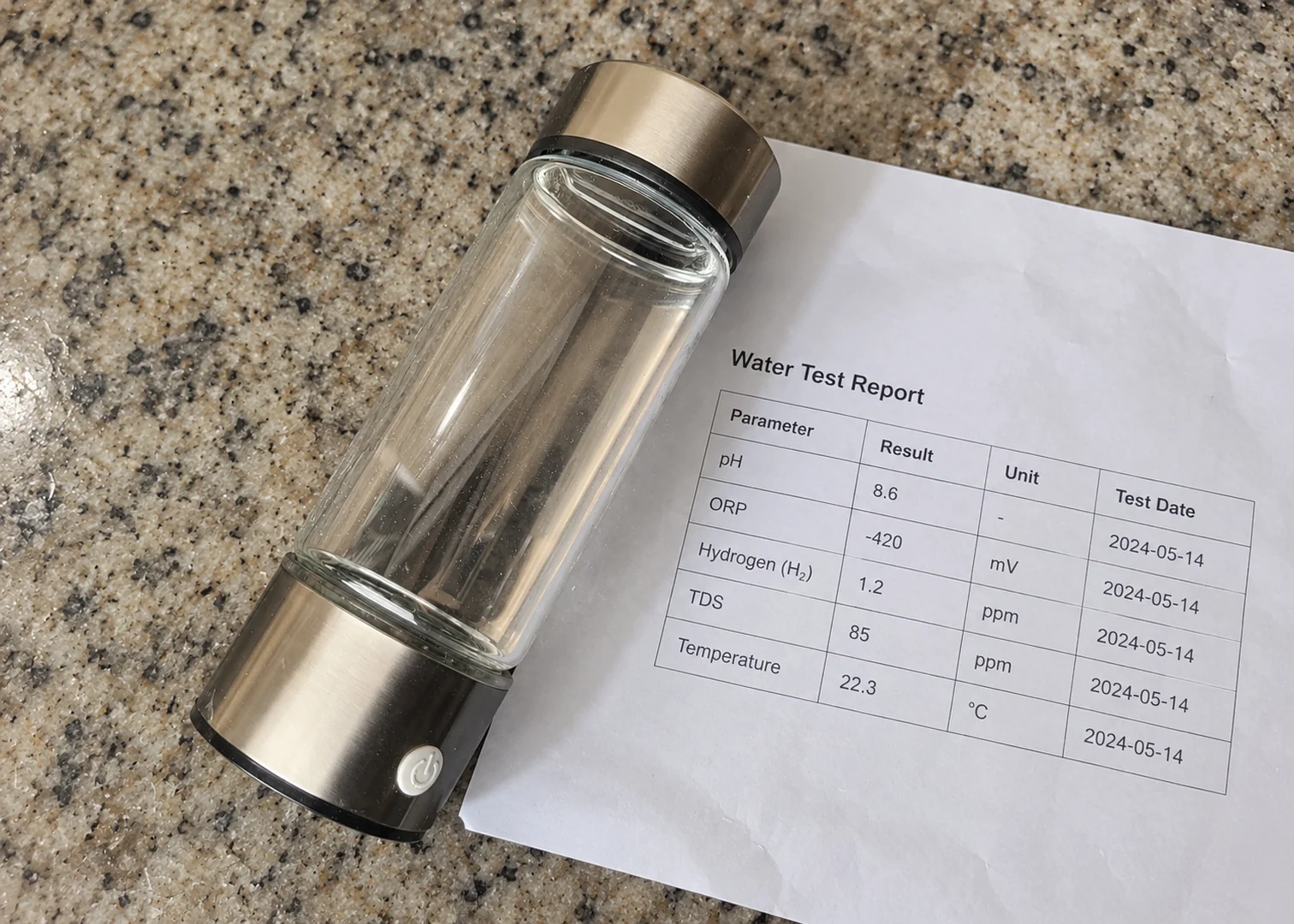
A report showing 5 ppm of hydrogen is useful performance evidence. It does not tell me whether the finished water was also checked for chlorine, ozone, PFAS, heavy metals or other substances.
What I found after auditing 100 current hydrogen bottles
I audited 100 current hydrogen water bottles to see what public evidence a shopper could actually inspect for the exact model they were considering.
The transparency gap was larger than I expected.
How much public evidence could I actually verify?
The deeper I looked, the fewer hydrogen bottles had public documentation a consumer could inspect.
Categories can overlap. Each ring uses its own 0-100 scale. A missing public report does not mean a manufacturer never tested the product privately.
These numbers describe my 100-model audit, not the entire hydrogen-bottle market. The cohort was not a random sample, and a missing public report does not prove that a manufacturer never tested a product privately.
I also found 14 models making an explicit third-party testing claim. For six of those 14, I could not find a public supporting model-specific report that a consumer could inspect.
The public evidence is often much thinner than the marketing language suggests.
I have seen the same broader problem outside the hydrogen category. In my separate audit of 150 reusable water bottle brands, safety claims were common while the underlying evidence was much less consistently public.
With hydrogen bottles, that matters even more because the bottle is not just storing water. It is actively changing it.
The 7 bottles with the most public testing documentation I found
This is not a safety ranking.
More documentation does not automatically mean a bottle is safer. It means I have more model-specific evidence to inspect.
Based on the breadth of public documentation, exact-model matching and whether the finished water was actually tested, these seven stood out most:
The main difference between these products is breadth. Some have one strong post-electrolysis report. Others also publish PFAS, metals or broader water-quality testing.
The biggest limitation in the lab reports
Reading the full reports changed how I interpret a clean-looking laboratory result.
Most of these reports tell us what was found in the water after the bottle ran. What they usually do not show is the exact same source water tested before the cycle and then tested again afterward.
That difference matters.
One H2yunshen X5 finished-water report detected chromium and manganese in the finished sample. Lead was reported below 1.0 µg/L.
That result does not show that the bottle added either metal.
They may already have been present in the source water. Because the report did not test the same water before electrolysis, I cannot tell whether the bottle changed those levels at all.
The same rule applies when the final sample looks very clean. A finished-water test tells me what was in that tested sample. It does not always tell me what the bottle itself changed.
For a consumer, the ideal test is much easier to understand:
Test the water. Run the bottle. Test the same water again.
That would let us see what actually changed.
Make sure the report matches the bottle you are buying
I found another problem that is easy to miss: a product can keep the same name while its capacity or configuration changes.
For example, public H2 Nano testing covers a 210 mL configuration, while the current product is listed with a 280 mL container.
That does not mean the newer bottle is unsafe. It means I would not automatically treat a test on one configuration as proof for every version sold under the same name.
For me, a strong match means the exact model, version or generation, capacity and tested sample line up as closely as possible.
What we still do not know
The biggest unanswered product question for me is aging.
A new bottle can test well. What I want to know is what happens after the same electrodes, membrane and seals have gone through hundreds or thousands of real-world cycles.
The ideal experiment is simple: test a new bottle, use it for a long time, then test the finished water again. I found very little public evidence like that.
PFAS is another area where the wording matters.
Some PEM systems use Nafion, a fluorinated membrane material inside the generator. Its chemistry is why it comes up in PFAS discussions, but that is not evidence that PFAS are leaking from the membrane into drinking water.
I did not find evidence showing that consumer hydrogen bottles using Nafion contaminate drinking water with PFAS. In my 100-bottle audit, only four models had public PFAS testing that met my criteria.
But even “PFAS tested” does not always mean the same thing. The Echo Flask and H2yunshen X5 reports covered 18 PFAS chemicals, while the Ocemida Omni and Nexis reports covered 11.
The laboratories also used different reporting or detection limits.
In plain English, a result marked “not detected” means the lab did not find that chemical above the amount its test could reliably measure. It does not mean scientists proved that the water contained literally zero molecules of it.
I still see those results as useful and reassuring evidence about the tested samples. I just would not turn them into a stronger claim than the reports support.
Overall, PFAS remains an evidence gap rather than evidence of harm.
Electrode claims are similar. Brands often advertise platinum-coated titanium, but only one model in my final 100 met my threshold for public electrode or material verification.
A few practical things matter too.
Higher-output bottles may intentionally build pressure, so seals and pressure management matter. Water instructions also vary by model, and minerals or other dissolved substances can affect how the electrolysis system behaves.
I would follow the manual for the exact bottle rather than assume every hydrogen generator should use the same water. I would also avoid juice, sports drinks, supplements or carbonated drinks unless the manufacturer explicitly says they are allowed.
And this is still a reusable bottle. Lids, seals and drinking surfaces need normal cleaning.
I would not assume a hydrogen cycle or “self-cleaning” function sterilizes every part of the bottle unless there is evidence supporting that claim.
How I would check a hydrogen bottle before buying it
• Match the report to the exact bottle. Check the model, version or generation and capacity.
• Check what was actually tested. A hydrogen-output number alone is not a safety test. I want to see the finished water tested after the bottle runs.
• Prefer a before-and-after test when one exists. The clearest setup tests the same source water before and after the bottle runs.
• Read the actual result, not just the badge. “Not detected” means the lab did not find the substance above the amount its test could reliably measure. It does not mean absolute zero.
• Check the instructions for water, cleaning and pressure. Different bottles can have different requirements.
• Check the warranty and customer support. These bottles contain membranes, seals, batteries and electronics, so support matters if something fails.
For me, good documentation is part of the product. If a company makes strong safety or testing claims, I want to be able to see the evidence behind them.
Bottom line
The human evidence I reviewed is mostly reassuring in the short term, but it is not strong enough to prove that daily hydrogen-water use is risk-free for many years.
The product side is where I see the bigger transparency problem. Only 15 of the 100 bottles in my audit had public post-electrolysis water or byproduct testing I could inspect.
That does not make the other 85 unsafe. It means I have much less evidence to judge them.
If I were buying a hydrogen bottle today, I would care less about the biggest ppm claim and more about whether I can inspect real testing for the exact model and see what happened to the water after electrolysis.
Methodology – how I researched this article
Methodology – how I researched this article
Human safety evidence
I built a provisional evidence map of 73 human research records available through October 29, 2026. Sixty-nine records involved oral hydrogen-rich water, while four involved electrolyzed hydrogen water and were kept separately classified.
The PubMed search screened 230 records. A supplementary Crossref search was used as a discovery check, not as an exhaustive second screen.
Across the oral HRW records, the studies reported 1,872 group or exposure denominators.
I do not describe these as 1,872 unique people because crossover trials, unresolved cohort overlap and differences between randomized, evaluable and exposed denominators prevent reliable person-level deduplication. Receipt of the assigned water also could not be verified for every participant.
This dataset is a provisional evidence map, not a completed systematic review, and it does not establish that hydrogen-rich water is proven safe.
How I handled adverse events
For every record, I checked whether researchers explicitly described adverse-event monitoring, symptom collection, safety testing or another stated method of looking for harms.
Twenty-one HRW records clearly met that threshold.
I did not treat the absence of adverse-event reporting as evidence that no adverse events occurred. Silence was kept separate from an explicit report of zero intervention-related events.
I also distinguished between events that occurred during a study and events that researchers categorized as potentially or probably related to the intervention.
Study duration
The longest exposure identified was 504 days, or 72 weeks, but that study was an efficacy trial rather than a dedicated long-term safety study.
For that reason, I do not use the existence of a 72-week study as proof that long-term daily safety has been established.
Serious adverse events
I checked study reports for serious adverse events as well as ordinary side effects.
No definite product-specific serious adverse event attribution to HRW was established in the evidence map. One large trial categorized one serious adverse event in its HRW arm as treatment-related, but product-specific causality remains uncertain.
I retained that finding rather than simplifying the literature into “no serious adverse events.”
Special populations
I specifically looked for published evidence involving children, adolescents and pregnancy. I did not identify published pediatric or adolescent safety outcomes in the evidence map, and I did not identify a published pregnancy outcome study.
One pregnancy registry record was found, but no published outcome data were located.
These are treated as evidence gaps, not evidence of either safety or harm.
Product and electrolysis evidence
The second part of the research focused on the device.
I reviewed research involving bottle-type electrolysis systems as well as broader electrochemistry relevant to PEM/SPE systems, chloride reactions and possible electrolysis byproducts.
I distinguish between evidence that something is chemically possible and evidence that it was actually measured in a consumer bottle.
A laboratory measurement of chlorine after electrolysis is direct product-relevant evidence. A paper explaining that chlorine formation can occur under certain electrochemical conditions is useful mechanistic context, but it does not prove that a particular bottle produces chlorine.
How I built the 100-bottle market audit
I first built a larger candidate pool, resolved duplicates and obvious OEM/rebrand issues, and audited complete lineups from major hydrogen-bottle brands. After exclusions, 121 models remained eligible.
I assigned a popularity score to all 121 eligible models using multiple signals including current availability, search visibility, retail presence, editorial visibility, community visibility and brand strength.
The final cohort contains the top 100 current consumer bottle models after a top-25 sanity check and manual review for cohort distortion.
Every final model has a model-specific product URL, an availability classification and a completed transparency record. The final cohort contains 100 unique IDs and ranks 1 through 100.
For transparency, I published a reader-facing version of the full 100-model audit with model-level evidence for hydrogen performance, post-electrolysis water testing, chlorine, ozone, metals, platinum, PFAS and document matching.
You can inspect the full 100-model audit here.
How I searched for certificates and lab reports
The first certificate pass was followed by a second dedicated recall audit after I found that an earlier search had missed real public reports.
That second pass kept the 100-product cohort locked and searched every model again using exact model names, model numbers, brand domains, PDF searches and third-party testing sources such as H2HUBB, H2 Analytics, SGS and Eurofins.
Across the final cohort, the research log contains four certificate/report search passes per model. I also audited whether each official product page claimed third-party testing.
A missing report in my dataset means I did not find a public model-linked report after these searches. It does not prove that a brand never tested the product privately.
What counted as a public product report
I separated manufacturer claims, hydrogen-performance tests, compliance certificates and finished-water tests.
A hydrogen-output report counted as performance evidence.
A CE, FCC or RoHS document counted as compliance evidence. Neither was treated as proof that the finished drinking water had been tested for contaminants.
For `public_post_electrolysis_water_test = YES`, I required public evidence that water or electrolysis byproducts were actually measured after the bottle ran. Hydrogen concentration alone was not enough.
Reports could be PDFs, public report images or other inspectable documents. Pure marketing text without an underlying report did not count as laboratory evidence.
Model matching
A report for one bottle was not automatically assigned to every product from that brand.
Every registry row received a model-match classification based on the exact model, variant or generation, capacity and sample information available in the document.
This is why, for example, a report for the Echo Flask is evidence about the tested Flask sample, not automatically every Echo hydrogen bottle. The same rule applies to Piurify variants, Ocemida models and every other brand in the dataset.
How I calculated the 100-model transparency numbers
All percentages in the article come from the locked final cohort of 100 products after the second-pass evidence audit. They describe this cohort, not a random market-wide prevalence estimate.
A model was counted only once per evidence category even if several reports covered the same category. Shared reports were assigned to multiple models only when the document itself identified those models.
The second-pass audit found 21 models with at least one public model-linked report or technical document, 20 with independent H2 performance testing and 15 with post-electrolysis water or byproduct testing.
It also found 4 models with PFAS testing, 6 with heavy-metal testing, 12 with chlorine/ozone testing, 1 with electrode/material verification and none meeting my threshold for public membrane verification.
Fourteen models made an explicit third-party testing claim. For six of those 14, I did not find a public supporting model-specific report that I could inspect.
How I handle uncertainty
If a test reports “not detected,” I report not detected, not “contains none.” If one laboratory tests one product sample, I treat the findings as evidence about that tested sample rather than every unit ever produced.
I also preserve qualifiers and detections instead of converting a mixed laboratory report into a simple “passed” label.
A report can be valuable precisely because it shows the underlying measurements rather than a marketing summary.
If evidence cannot answer a question, I report the uncertainty instead of filling the gap with reassurance or fear.
Research cutoff: October 29, 2026.
Sources and research papers
Sources and research papers
Human safety
Hydro-COVID phase 3 trial
Gaboreau et al. Molecular Hydrogen for Outpatients with COVID-19 (Hydro-COVID): A Phase 3 Randomised, Triple-Blinded, Pragmatic, Placebo-Controlled, Multicentre Trial. Journal of Clinical Medicine, 2024.
337 HRW participants and 338 placebo participants received at least one dose. During treatment, any adverse event occurred in 27.0% versus 26.2%, while treatment-related adverse events occurred in 17.8% versus 17.5%.
https://pmc.ncbi.nlm.nih.gov/articles/PMC11313273/
Acute hydrogen-rich water and intraocular pressure
Najmanová et al. Effect of acute hydrogen-rich water intake on intraocular pressure in healthy subjects. Česká a slovenská oftalmologie, 2023.
Randomized double-blind crossover study of 24 healthy adults. Clinically significant individual IOP increases were reported more often after HRW than placebo, while the overall group comparison was not significant.
https://pubmed.ncbi.nlm.nih.gov/37567773/
Full paper:
https://www.cs-ophthalmology.cz/en/journal/4/articles/287/dl/967
2025 metabolic-syndrome trial
The updated evidence map records one mild transient diarrhea event in a 12-week metabolic-syndrome trial. The paper did not assign causality, and five of 40 participants were lost to follow-up.
https://www.nchpjournals.com/journal/index.php/ctnr/article/download/29/15/140
Radiotherapy interim conference abstract
An interim ASTRO conference abstract describes active side-effect checks but does not report complete adverse-event results beyond mucositis. Six of 24 enrolled participants were not evaluable.
https://am25.astro.org/sessions/pqa-04-21638/a-randomized-prospective-trial-of-hydrogen-rich-water-hrw-to-mitigate-acute-mucositis-during-107812
Electrolysis and water chemistry
PEM electrolysis and chloride chemistry
Review covering impurities and electrochemical reactions relevant to PEM water electrolysis, including chloride and chlorine evolution.
https://pubs.rsc.org/en/content/articlehtml/2023/se/d2se01517j
Bottle-type hydrogen generators and residual chlorine
2021 experimental study evaluating bottle-type hydrogen-generating devices using tap water, including residual chlorine and ozone measurements.
https://pmc.ncbi.nlm.nih.gov/articles/PMC8130662/
Consumer product testing
Echo Water ECHO Flask
Echo’s public testing hub includes H2 performance, SGS water-quality, PFAS and compliance documents for the Flask.
https://support.echowater.com/hc/en-us/articles/36050770326164-Echo-Flask-SGS-Water-Quality-PFAS-Testing-Results
Ocemida Omni and Nexis v3
Ocemida’s certification page links model-specific H2 testing, PFAS reports and the Nexis H2HUBB evaluation. The Nexis report includes chlorine and ozone measurements after electrolysis.
https://ocemida.com/pages/certifications
https://h2hubb.com/wp-content/uploads/2024/10/H2HUBB-Official-Test-Report-Ocemida-Nexis-Professional-Hydrogen-Water-Bottle-1192026-2-1.pdf
H2yunshen X5
The official certification page links H2 performance, SGS water-quality and PFAS documentation. The PFAS report identifies the sample matrix as drinking water.
https://www.h2yunshen.com/h2yunshen-brand-official-certifications
https://www.h2yunshen.com/image/catalog/cert/H2yunshen_X5_Bottle_SGS_PFAS_Report_25030731.pdf
https://www.h2yunshen.com/image/catalog/cert/H2yunshen%20SGS%20Water%20Quality%20Test%20Report.pdf
Hydrogen For Health H2 Nano V3
The model-specific H2HUBB report covers H2 performance plus chlorine and ozone testing. A separate H2 Analytics report covers the H2-2R tested configuration.
https://h2hubb.com/wp-content/uploads/2024/08/H2HUBB-Official-Test-Report-H2Nano-V3-Hydrogen-Water-Bottle-7192024-2.pdf
H2 Nano V3 Hydrogen Water Bottle Review, Test Results & Discount
Piurify Hydrogenator
The H2HUBB report for the 280 mL Hydrogenator covers H2 performance plus chlorine and ozone testing. Piurify also publishes model-specific H2 Analytics reports for individual bottle variants.
https://h2hubb.com/wp-content/uploads/2024/12/H2HUBB_Official_Test_Report_Piurify__Hydrogen_Water_Bottle_10242024_1_1.pdf
EVOLV H2GO
The H2HUBB report covers the 230 mL H2GO, including H2 measurements and chlorine/ozone testing after electrolysis.
https://h2hubb.com/wp-content/uploads/2024/06/H2HUBB-Official-Test-Report-Evolv-H2Go-Hydrogen-Water-Bottle-652024-2.pdf
Broader water-bottle transparency research
My separate audit of 150 reusable water bottle brands looks at public chemical-safety claims, evidence and documentation across the wider bottle market.
How Transparent Are Water Bottle Brands About Chemical Safety?
WBA research files
The human-safety analysis behind this article includes a study-level evidence map, methodology file, inclusion/exclusion log, source ledger, reproducible statistics, findings report and evidence-gap analysis.
The product research includes the final 100-bottle cohort, the 121-model eligible pool, the model-level certificate and report registry, the second-pass certificate recall audit, the finished-water testing summary and the major-brand lineup audit.
Research cutoff: October 29, 2026.
About the author
Jeremiah Kowalski
Jeremiah Kowalski founded Water Bottle Advisor to make drinkware reviews more useful and less dependent on manufacturer claims. He has personally tested 50+ products, putting them through measuring, cleaning, leak testing, durability testing, and everyday use before sharing his conclusions. It also means occasionally explaining why yet another large box of bottles has arrived at his door.
Leave a Reply