
Table of contents7 sections
I kept seeing the same reactions to hydrogen water bottles online:
“Not worth the price”. “Overpriced gimmicks”. “Cheap Chinese bottles with huge markups”.
I get it.
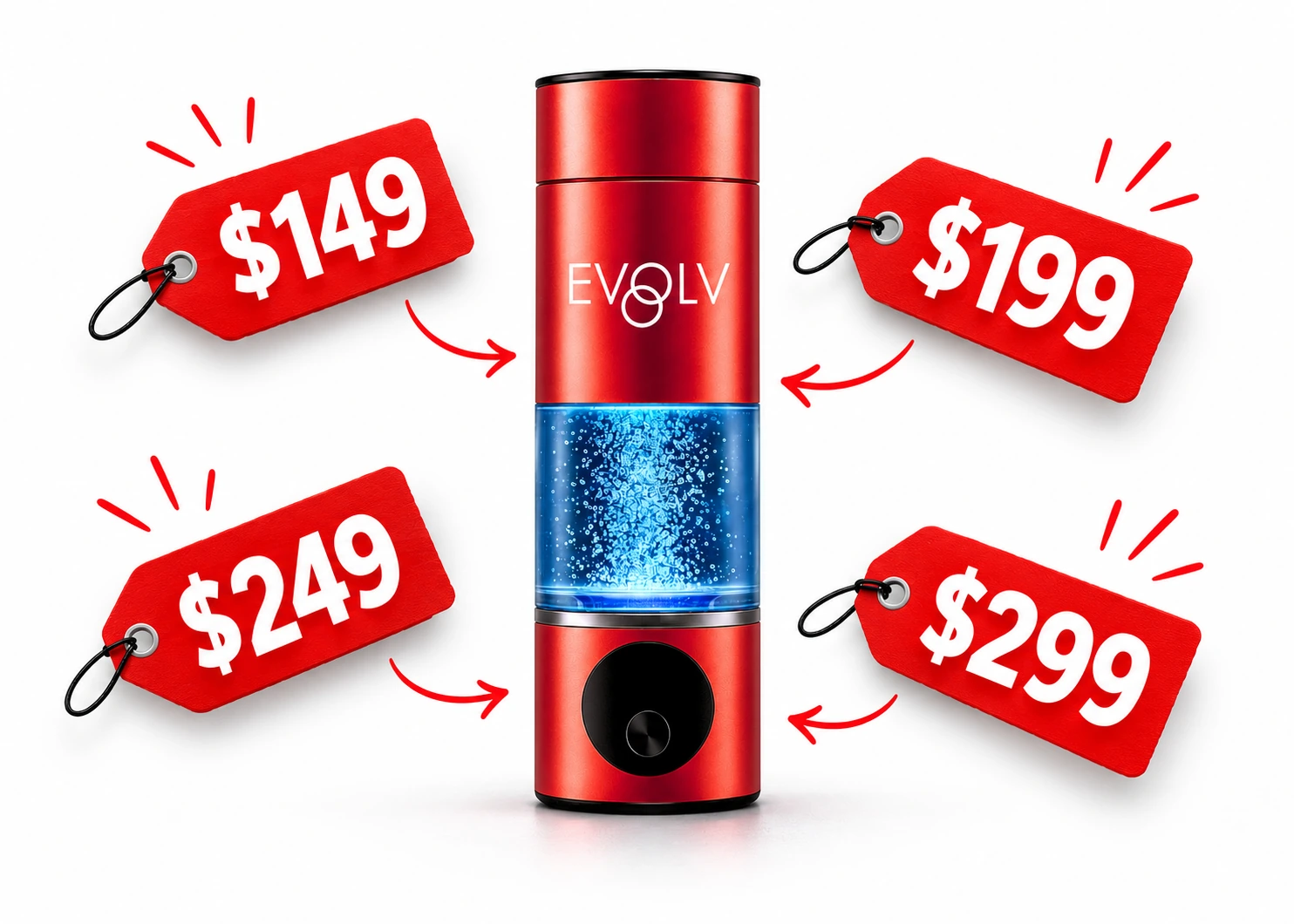
In my strict U.S. price sample, the median was $139.99, and some premium hydrogen bottles sell for $200 or more.
I've spent more than $1,000 testing them myself, and until recently I also assumed many brands were simply putting enormous markups on cheap Chinese hardware.
Then I investigated the economics.
And my opinion changed.
I expected to find brands selling roughly $40 hardware at ridiculous margins, but I don't think that is what the numbers show in most cases.
I'm not here to defend hydrogen bottle companies. I'm here to follow the numbers.
Here is how a factory-side product around $40 can plausibly become a $150, $200, or even more expensive retail product.
Short answer
Most hydrogen bottles are expensive, but after looking at the economics, I don't think most are obviously overpriced.
A bottle that starts around the $40 mark at the supplier can become much more expensive once you add importing, fulfillment, returns, warranty, support, testing, marketing, payment fees, and overhead.
That does not mean every $200 bottle is worth $200.
It just means this math is wrong:
$199 retail - $40 factory price = $159 profit.
Where does $199 actually go?
I wanted to see this in actual dollars, not vague business language.
So I built an illustrative model for a hydrogen bottle sold directly to a U.S. customer for $199 and asked a simple question:
Where does the money actually go?
Here is the result.
The $55 product and landed import bundle covers the product plus the modeled cost of getting it into the U.S.
Customer acquisition is what it costs to find a buyer. Think advertising, affiliates, influencers, and other marketing.
In this scenario, that is $45 for one customer. It is a model assumption, not an industry average.
The model also sets aside $13.44 for expected returns. That is a modeled reserve, not a known return cost for every brand.
The remaining $23.53 represents the smaller modeled costs, including fulfillment, payment processing, warranty, customer support, testing, and related selling costs.
I grouped those smaller lines here because not every estimate has the same level of certainty.
The point is to show how quickly the money starts disappearing.
For every $1 you spend
The graphic below shows the same model as a share of every retail dollar.
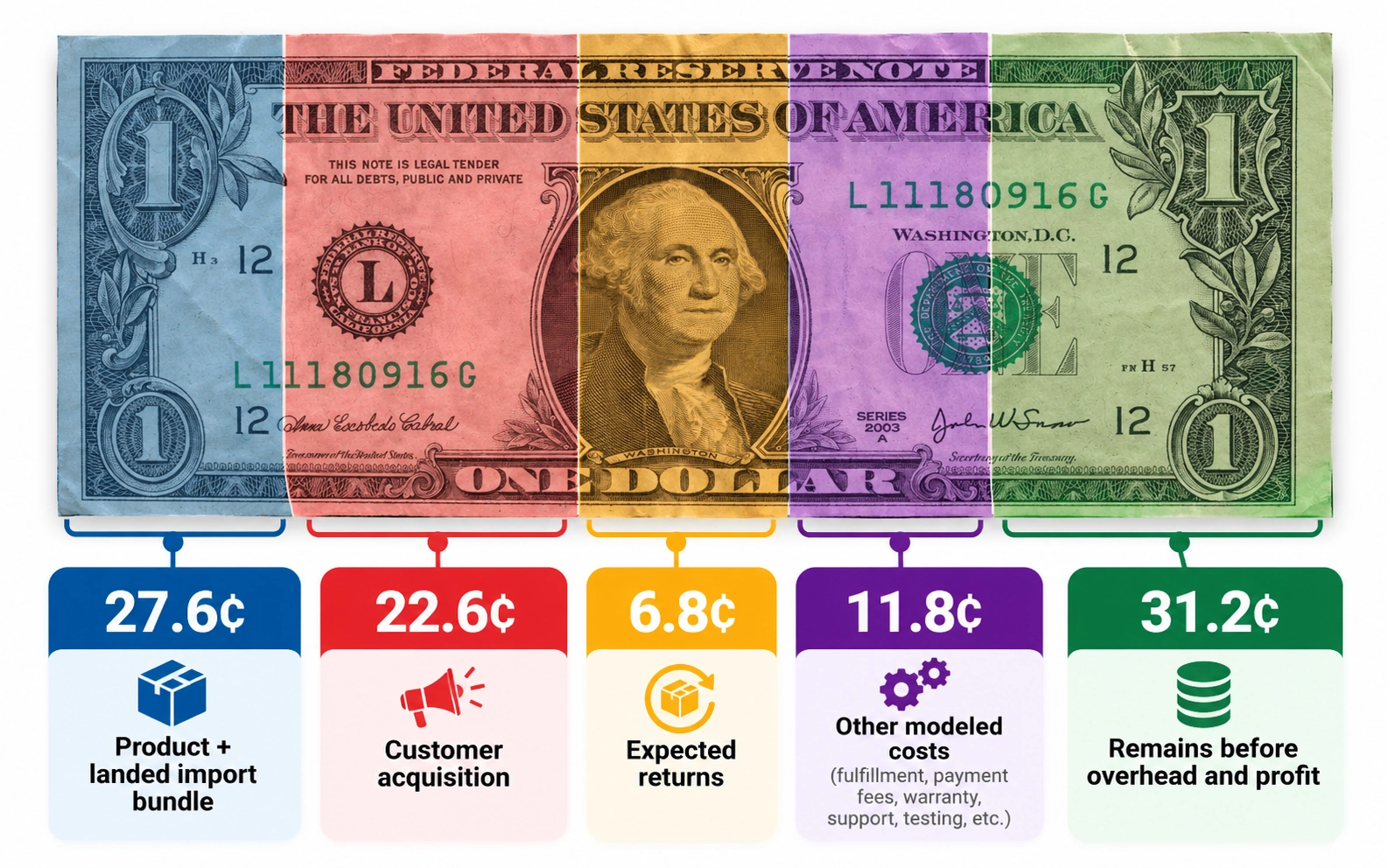
Only about 31 cents of each retail dollar remains after the costs included in this model.
And even that is not profit.
That $62.03 still has to help pay for things like salaries, software, insurance, administration, product development, unsold inventory, taxes, and other business expenses that are not included in this variable-cost model.
A $40 bottle does not mean $159 profit
I found public supplier listings offering complete hydrogen bottles for roughly $32 to $48 each.
These are asking prices, not confirmed prices paid by specific brands.
But they show something important:
a bottle selling for $199 can start as a roughly $40 product on the supplier side.
That does not mean the remaining $159 is profit.
Between the supplier and the customer come importing, fulfillment, marketing, returns, warranty, support, payment fees, and other costs.
Which leads to the obvious question:
“Why don't I just buy the same bottle from China?”
I know what you're probably thinking now.
“Why don't I just buy the same bottle directly from China?”
Fair question.
You can go on marketplaces such as AliExpress or Temu and find hydrogen bottles that look extremely similar, and sometimes almost identical on the outside, to much more expensive branded products.
I tried buying directly from China myself.
And personally, I don't plan to do it again.
The lower price can come with trade-offs that are easy to ignore when you're comparing product photos.
There is shipping. There can be import costs. And when something goes wrong, solving the problem can be less convenient than dealing with a seller or brand closer to home.
I once ordered a hydrogen bottle directly from China and ended up paying roughly $40 in customs charges alone.
That cheap price suddenly did not look quite as cheap.
Then there is the part I care about even more now: what happens when the bottle breaks?
I've had a hydrogen product fail after around three months. Because it was covered by a warranty, I was able to return it.
If I had paid for it and then simply been stuck with a dead bottle three months later, I would have been pretty annoyed.
Experiences like that are why I no longer treat warranty and customer support as boring extras.
When I buy from a seller with accessible U.S. support, I know there is someone I can contact and a warranty process I can actually use.
Trying to explain a technical problem to an overseas marketplace seller, potentially across a language barrier, is not my favorite way to spend an afternoon.
So yes, you may save money buying directly from China.
You may also get a perfectly good bottle.
But personally, I would rather pay more for predictable delivery, a useful warranty, accessible customer support, and someone else dealing with the importing.
Testing and documentation
This is another area where I am willing to pay more, and one of the first things I check when choosing a hydrogen water bottle.
A product page can claim 5,000, 8,000, or 10,000 ppb of hydrogen.
Typing that number costs nothing. Actually testing the product properly, documenting the result, and paying for independent laboratory work costs money.
I would rather pay more for evidence than more for a bigger number printed on the box.
Fairly priced does not mean worth buying
This distinction matters.
A hydrogen bottle can be fairly priced and still be a bad buy.
A company may genuinely have enough costs behind a $199 product to make the price economically reasonable.
That does not mean the bottle performs well, has good documentation, or would make my list of the best hydrogen water bottles I've tested.
Price fairness and product quality are two different questions.
Where I think people really can overpay
I once bought three generic-looking hydrogen bottles for $70, $57, and $12.
They looked remarkably similar.
They had similar glass bodies, similar charging behavior, similar construction, and all produced similarly weak hydrogen levels of around 300 to 500 ppb in my testing.
I cannot prove those three bottles came from the same factory.
Visual similarity alone is not enough.
But seeing products that looked and performed so similarly while selling at wildly different prices taught me something.
A different logo does not automatically mean a different product.
If one bottle costs $80 and another costs $200, I want to know what changed.
Did I get better hardware?
Better quality control?
Independent testing?
A stronger warranty?
Real customer support?
Better long-term performance?
If the answer is yes, the higher price may be justified.
If the main difference is branding, packaging, and bigger marketing claims, then I think you are probably overpaying.
So is a $200 hydrogen bottle overpriced?
After doing this investigation, I would not say that automatically anymore.
I went into this expecting to find that the market was mostly charging ridiculous prices for cheap hardware.
I don't think that is what the evidence shows.
There are overpriced products in this category. Branding can inflate prices. Some sellers charge premium money without giving you premium evidence, support, or performance.
But I do not think most hydrogen bottles are simply $40 products with $160 of easy profit stacked on top.
In my illustrative $199 model, about $137 is already gone before general company overhead and profit are even considered.
That does not make $199 cheap.
It does make the economics more understandable.
So my question is no longer:
“Why does this bottle cost $200?”
It is:
“What am I getting for that $200?”
If the answer is a bottle that actually produces meaningful hydrogen, backed by real evidence, good support, and a warranty that actually means something, I can live with the price.
If the answer is mostly a logo and marketing claims, then yes, I think you're overpaying.
About the author
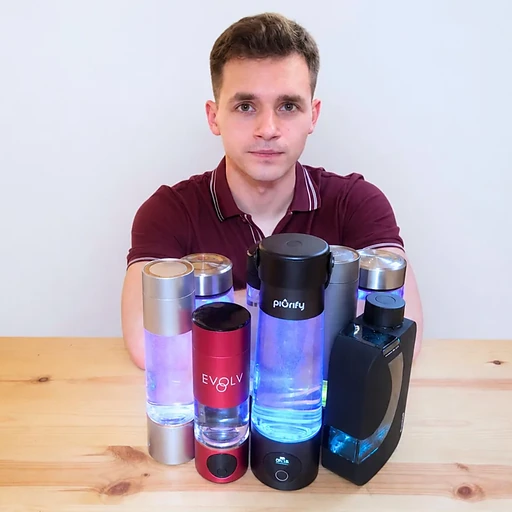
Jeremiah Kowalski
Jeremiah Kowalski founded Water Bottle Advisor to make drinkware reviews more useful and less dependent on manufacturer claims. He has personally tested 50+ products, putting them through measuring, cleaning, leak testing, durability testing, and everyday use before sharing his conclusions. It also means occasionally explaining why yet another large box of bottles has arrived at his door.
Leave a Reply