
Table of contents13 sections
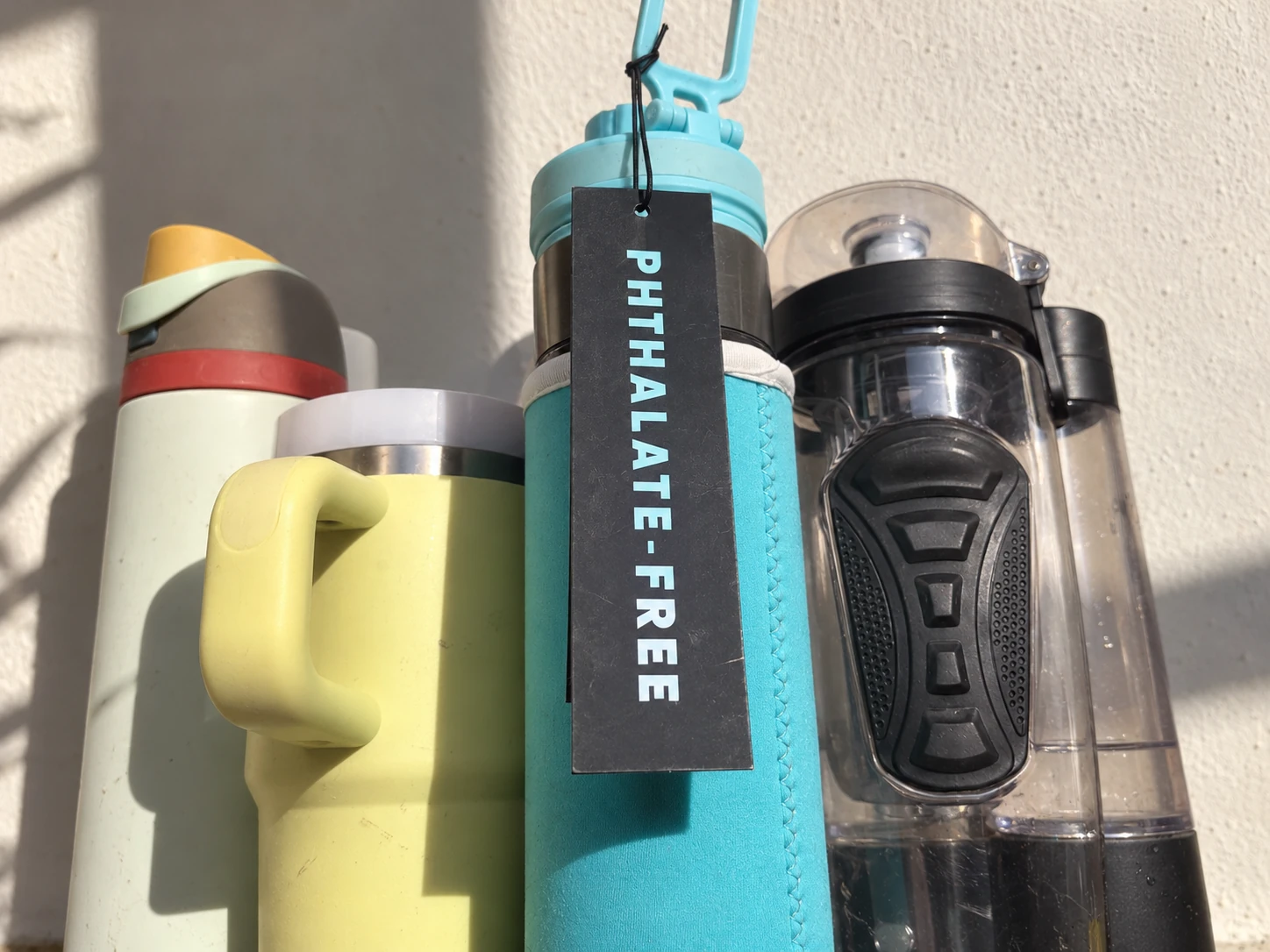
If you’ve started checking what your water bottle is made of, you’ve probably seen the words BPA-free everywhere. Phthalates? Much less often.
So I went looking.
I reviewed the available reusable-bottle research, worked through a much larger body of supporting evidence, and used my separate 150-brand chemical safety transparency audit to see what bottle companies publicly say about phthalates.
My conclusion is reassuring, but not perfectly neat: I found no good evidence that reusable water bottles, as a category, are a major source of phthalate exposure. But I also found enough product-specific detections that I wouldn’t call every bottle phthalate-free.
If you want the simple version, keep reading. The interesting part is not whether phthalates are “good” or “bad.” It is whether your bottle is likely to add meaningful exposure in the first place.
First, what are phthalates?
Phthalates are a family of chemicals commonly used as plasticizers. In simple terms, plasticizers can make certain plastics softer, more flexible, or easier to work with.
They are not the same thing as BPA.
That matters because BPA-free does not mean phthalate-free. In my separate 150-brand chemical safety transparency audit, 118 brands used BPA-related free-from wording, while only 34 had a bottle-relevant first-party statement about phthalates. Just 2 made an explicit full-class phthalate-free claim, while 29 used narrower or named free-from wording.
If phthalates specifically are what you care about, look for the word phthalate. “BPA-free” answers a different question.
Why are phthalates a health concern?
There is a reason phthalates get attention. They are not one single chemical, and different phthalates have different toxicology profiles. Some have raised concern because research has found reproductive, developmental, or hormone-related effects under certain conditions.
You may also see cancer mentioned. In 2026, IARC classified BBzP, DBP and DINP as Group 2B, “possibly carcinogenic to humans.” That sounds alarming until you understand the label: IARC is describing hazard, not the risk from drinking from a water bottle. For those three compounds, evidence for cancer in humans was considered inadequate.
That distinction matters throughout this article. Detecting a phthalate in a laboratory migration test is not the same as showing that the amount causes harm to someone using the bottle.
I did not find direct reusable-bottle studies showing measurable health effects in users. The bottle research is mainly about whether chemicals migrate and at what levels.
So the useful question here is simpler: how much exposure, if any, does a reusable bottle actually add under realistic use?
Do reusable water bottles contain or release phthalates?
Sometimes researchers detect them. Sometimes they don’t.
We found 10 publications with phthalate-relevant direct bottle evidence, although they do not represent 10 completely independent experiments. Some papers use the same bottle cohort, and a few others may overlap.
Across the direct studies where a clear physical count was available, researchers tested at least 316 bottles or product units. That sounds substantial, but the studies are too different to calculate a defensible “X% of reusable bottles contain phthalates” number.
A few findings are especially useful.
Astolfi et al. 2021 tested 20 reusable bottle types during four weeks of simulated normal use. None of the six target phthalates were detected above the study’s detection limits. To me, this is the most reassuring real-use result in the dataset.
Tisler et al. 2024 screened 16 reusable plastic bottle types. Several phthalate-related compounds were associated with one tested silicone bottle. Important, yes. Evidence against silicone as a whole? No.
Tian et al. 2025 and the related report tested 39 reusable bottle types after dishwasher conditioning and contact with 3% acetic acid, an acidic food simulant. Trace DiBP appeared in some bottles. Useful stress-test evidence, but not the same as water sitting in your bottle at your desk.
Guart et al. 2013 detected BBP from tested Tritan containers under controlled migration conditions. Again, useful product-level evidence, not a verdict on every Tritan bottle.
The pattern is pretty clear: phthalate release does not look like a universal feature of reusable bottles. Results depend on the product, the compounds tested, and the test conditions.
Why do studies sometimes disagree?
Because “water bottle test” can mean wildly different things.
In one experiment, researchers may fill a bottle with water, use it normally, rinse it, refill it, and repeat that for weeks.
In another, they may use an acidic food simulant, hold the bottle at 40°C for days, or extract the material with a solvent designed to pull chemicals out of it.
Both can be scientifically useful. They are just answering different questions.
A detection after ten days in an aggressive migration test does not automatically tell me what ends up in the cold water I drink on a normal Tuesday afternoon.
The reverse is also true. A nondetection in normal water does not prove that a chemical can never be extracted from that product under harsher conditions.
Context matters a lot.
The bottle body is not the whole story
A stainless steel bottle may still have a plastic lid, silicone gasket, straw, mouthpiece, valve, coating, or other small components. The body material does not describe every material that can touch your drink.
The research on these individual components is surprisingly thin. We found supporting evidence involving caps, seals, straws, gaskets and silicone products, but very little direct work isolating the exact components used in modern reusable bottles.
One direct study did find several phthalate-related compounds associated with one silicone bottle. I would not turn that into “silicone leaches phthalates.” It was one tested product, not every silicone formulation on Earth.
For the same reason, I would not call every stainless steel bottle automatically phthalate-free. Stainless steel can reduce how much plastic contacts your drink, but the lid system still matters.
Personally, I care more about product-level transparency than trying to crown one material as chemically perfect.
Do heat, dishwashing and reuse matter?
They can.
Supporting studies on PET and other food-contact materials often find higher migration under warmer or longer storage conditions. Other studies find weak effects, mixed effects, or no clear temperature pattern.
Dishwashing is also worth mentioning because one reusable-bottle cohort showed trace DiBP after repeated dishwasher treatment. But the follow-up migration test used 3% acetic acid, not normal drinking water.
So I would not read that study and conclude that putting your bottle in the dishwasher fills tomorrow’s water with phthalates.
My practical rule is much less dramatic: use the bottle the way it was designed to be used. If a bottle is meant for cold drinks, don’t pour boiling liquid into it. If a part is not dishwasher-safe, don’t repeatedly run it through the dishwasher and assume nothing changes.
That advice makes sense even without turning phthalates into the villain of the week.
What does “phthalate-free” actually mean?
This is where the 150-brand chemical safety transparency audit helps.
Across the fixed panel of 150 reusable water bottle brands, 34 had a bottle-relevant first-party statement about phthalates. Only 2 made an explicit full-class phthalate-free claim, while 29 used narrower or named free-from wording. The remaining bottle-relevant statements were different kinds of public phthalate communication rather than broad free-from claims.
That distinction matters. “Phthalate-free” can sound broad, but the actual wording may apply to one product, one family, one component or a narrower named scope. I do not turn a product-specific statement into a brand-wide promise.
And a manufacturer saying “phthalate-free” is still a manufacturer claim. It is not automatically an independent migration study or proof that every component has been tested.
If you want to check a specific company, I keep the current wording, scope and source in my 150-brand chemical safety transparency audit rather than repeating a long brand list here.
I treat “phthalate-free” as a useful screening signal, not the finish line. A better claim tells you exactly what it covers. Better still, the company publishes what it tested, how it tested it and who did the testing.
Should you worry about your current bottle?
Based on this research, I would not panic.
I found nothing that would make me look at a normal, intact reusable bottle on my desk and suddenly treat it like hazardous waste. The direct evidence is simply not pointing that way.
If phthalates are something you especially want to avoid, the conservative choice is straightforward: look for an explicit first-party phthalate-free claim that applies to the exact product you are buying, and give extra credit to brands that publish meaningful testing documentation.
Then use the bottle within its intended temperature and cleaning instructions.
My take
After going through this evidence, phthalates would not be near the top of my worries when choosing a modern reusable water bottle.
That is not the same as saying they never appear. Researchers have detected phthalates or related compounds in some products and under some test conditions.
But other direct testing, including a four-week simulation involving 20 bottle types, found none of the target phthalates above the study’s detection limits.
The strongest conclusion I can defend is simple: reusable water bottles do not appear to be a proven major source of phthalate exposure as a category.
The biggest evidence gap is product-level testing under realistic use, especially for lids, gaskets, straws, valves and ageing.
If your current bottle is in good condition and you use it as intended, I found no convincing reason here to panic about it.
How I researched this
For this project, I built an evidence database containing 288 publication records and kept direct reusable-bottle evidence separate from bottled-water studies, food-contact research, material studies and regulatory sources.
For manufacturer claims, I now use the separate fixed 150-brand chemical safety transparency audit, which keeps claim wording, scope and sources consistent across BPA, bisphenols, phthalates, PFAS, lead and other topics.
I did not combine incompatible studies into a made-up prevalence statistic, and I did not count a manufacturer claim as laboratory evidence.
The full methodology, study database, brand-level sources, limitations, regulatory context and bibliography are below.
Methodology
About this review & methodology
Full research methodology
Research question
I set out to answer three related questions: Can reusable water bottles release phthalates under tested conditions? Under what materials, components, temperatures, washing or reuse scenarios have researchers reported detections or nondetections? And how common are public phthalate-free claims among visible reusable water bottle brands?
I did not start with the assumption that reusable bottles are dangerous or that they are phthalate-free. The goal was to follow the evidence in either direction.
Research date and final dataset
The research phase was closed on October 26, 2026 after repeated searches and citation chasing stopped producing new independent reusable-bottle or closely related drinking-container evidence families.
The final evidence master contains 288 publication/source records: 5 Tier A, 4 hybrid Tier A/B, 164 Tier B, 86 Tier C, and 29 Tier D records. The separate exclusion ledger contains 64 entries, but those include duplicate candidates, audit traces and records retained elsewhere, so they must not be added to the 288 as 64 additional unique studies.
Ten master records are PAE-relevant direct-bottle evidence, but ten publications do not equal ten independent experiments. For example, A11 and A12 report the same 39-type, 195-bottle cohort. Across direct studies with explicit physical denominators, at least 316 bottle or product units are represented after the shared A11/A12 cohort is counted once. This is a minimum physical-unit count, not a count of unique commercial models and not a prevalence estimate.
Evidence hierarchy
Tier A: Direct studies of reusable drinking bottles or their contact materials under bottle-relevant testing conditions.
Tier A/B: Studies that include direct reusable-bottle evidence but also use mixed container sets, refillable formats or protocols that make them partly adjacent evidence.
Tier B: Closely related drinking-container evidence, including reused PET beverage bottles, bottled-water storage, children’s drinking or feeding bottles, hydration systems, caps, seals and other drinking-contact products.
Tier C: Supporting food-contact and migration research used to understand mechanisms, materials and components. This includes studies of silicone, rubber, PVC gaskets, tubing, adhesives, paper/cardboard packaging and other food-contact materials. These studies are supporting evidence only and are not treated as proof about reusable water bottles.
Tier D: Health, exposure, regulatory, review and evidence-mapping sources. These provide context but are not direct bottle experiments.
Search terms and scope
Searches used both broad class terms and individual compounds. Core terms included phthalate, phthalic acid ester, PAE, plasticizer, ortho-phthalate, DEHP, DBP, BBP, DIBP, DINP, DIDP, DNOP/DnOP, DEP, DMP, DCHP, DAP, MHP and MEHP.
Bottle and material searches covered reusable bottles, sports bottles, children’s bottles, feeding bottles, hydration reservoirs, PET and PET reuse, PP, PE, HDPE, LDPE, silicone, Tritan, copolyesters, PETG/PCTG, caps, lids, gaskets, seals, straws, mouthpieces, valves, tubing, coatings and adhesives. Use-condition searches included heat, storage time, washing, dishwasher cycles, ageing, repeated use and UV exposure.
Sources searched
Discovery used primary publisher pages, PubMed and PubMed Central, DOI/Crossref records, institutional repositories, government and regulator sources, report PDFs and broader scholarly/web searches. Systematic reviews and narrative reviews were used primarily as discovery maps to locate underlying primary studies rather than as substitutes for the original research.
Primary sources were preferred whenever they could be retrieved. Where only an abstract, conference proceeding, report, repository copy or secondary source was available, that limitation was recorded and confidence was reduced where appropriate.
Citation chasing and saturation
Important seed studies were followed backward through their reference lists and forward through citing papers. Author and terminology searches were also used when a research group, compound name or material appeared likely to uncover related work.
The final closure pass screened 122 works citing A10 and A16 and 64 works citing A14 without finding a new independent reusable-bottle cohort. Earlier forward and backward searches around other major seeds similarly began returning known studies, adjacent food-contact work or duplicates rather than new bottle-relevant evidence families.
Saturation was assessed separately rather than by chasing an arbitrary study count. Tier A and Tier B were judged saturated within the defined bottle/drinking-container scope. Bottle-component discovery was closed for the identified PAE-specific evidence, although component-level testing remains sparse. Tier C was stopped at diminishing returns because general food-contact literature can expand almost indefinitely without materially changing the reusable-bottle conclusion. The U.S./EU regulatory review was substantially closed for the scoped question, not presented as a global regulatory survey.
Deduplication and cohort handling
Records were reconciled using DOI, PMID, title, authors, year and, where possible, sample or cohort identity. Duplicate publication records were merged or logged in the exclusion ledger. Related publications were not automatically treated as independent replications.
This matters especially for A11/A12, which share one 39-type cohort, and for other pairs where sample overlap is plausible or probable but cannot be fully verified from public records. Publication counts and independent-study populations are therefore kept separate.
How results were interpreted
A detection was not treated as proof of health risk. A nondetection was not treated as proof that a product contains absolutely no phthalates. Nondetection only applies to the analytes tested, the method sensitivity, the tested product and the conditions used.
Material content, solvent extraction, migration into a food simulant, migration into drinking water, human exposure and health effects are different endpoints. They were kept separate.
A signal from an aggressive solvent or acidic food simulant was not translated into an ordinary drinking-water dose. Likewise, detecting a phthalate in bottled water was not automatically attributed to the bottle wall unless the study design included enough source-water, blank, package or component controls to support that conclusion.
Non-target screening features were not called confirmed phthalates unless the study provided adequate identification evidence. Findings below or close to reported LOD/LOQ values were flagged rather than treated as robust quantitative results.
The direct studies were too heterogeneous to calculate a scientifically defensible percentage of reusable bottles that contain or release phthalates. I therefore did not pool them into a prevalence statistic.
Brand claims methodology
Current manufacturer-claim statistics come from the separate fixed WBA panel of 150 prominent and relevant reusable water bottle brands. The same panel and claim rules are used across BPA, BPS, BPF, broader bisphenols, phthalates, PFAS, lead and the other tracked topics.
For phthalates, 34 of 150 brands had a bottle-relevant first-party statement. Only 2 made an explicit full-class phthalate-free claim, while 29 used narrower or named free-from wording. The remaining bottle-relevant statements were other types of public phthalate communication rather than broad free-from claims.
A product-specific statement is not upgraded into a brand-wide claim. A manufacturer claim is also not treated as independent laboratory evidence. And no qualifying public claim found does not mean a bottle contains phthalates.
The current wording, scope and source for each brand are kept in the 150-brand chemical safety transparency audit rather than duplicated here.
How to read the evidence
There are three different kinds of evidence throughout this article and appendix, and I keep them separate:
1. Laboratory evidence – a product or material was actually tested under stated conditions.
2. Manufacturer evidence – a brand publicly says a product or range is phthalate-free, or publishes a chemical policy.
3. Regulatory evidence – a law, authorization, migration limit or product-content restriction applies under a defined jurisdiction and scope.
None automatically substitutes for the other two.
A few rules are especially important: BPA-free does not mean phthalate-free. Phthalate-free does not necessarily mean plasticizer-free. A regulatory limit does not mean zero presence. A public brand claim does not prove independent migration testing. And no public claim found does not mean a bottle contains phthalates.
Sources & bibliography
Sources, study database & bibliography
Direct reusable-bottle studies and PAE-relevant evidence
A01. Reusable Water Bottles: Release of Inorganic Elements, Phthalates, and Bisphenol A in a Real Use Simulation Experiment (2021). Separations 8(8):126. DOI 10.3390/separations8080126.
Main finding: No release of any of six targeted phthalates or BPA was detected in water from the 20 reusable bottle types during the four-week room-temperature simulation. Various inorganic elements were released; phthalate/BPA result is a method-bounded nondetection.
Key limitation: 20 bottle types selected from Italian best-sellers in 2019; only six phthalates; organics-free deionized water; room-temperature four-week protocol; nondetection constrained by method sensitivity (analyte LODs 0.1–1.2 µg/L). Does not represent all brands, use conditions, or bottle-component ageing/dishwashing.
Source: https://www.mdpi.com/2297-8739/8/8/126
A06. Chemical migration from reusable plastic bottles: Silicone, polyethylene, and polypropylene show highest hazard potential in LC-HRMS analysis (2024). Journal of Hazardous Materials 480:136391. DOI 10.1016/j.jhazmat.2024.136391.
Main finding: Six named phthalate-related compounds (MMP, DMP, DEP, DAP, MHP, MEHP) were reported migrating from one blue silicone bottle type into tap water; DnPP identification inconclusive. Quantified concentrations: DMP 0.20, MMP 0.35, DEP 0.06 µg/L; remaining four not quantified. Lids were excluded.
Key limitation: Only one silicone product type (three replicates); unused bottles; 48 h tap-water contact; lids excluded; several compounds detected only in ESI− and therefore not quantified by the ESI+ prediction model; DnPP identification inconclusive; non-target identification confidence varies; hazard-potential ranking is not human health risk assessment.
Source: https://doi.org/10.1016/j.jhazmat.2024.136391
A10. A method validation for simultaneous determination of phthalates and bisphenol A released from plastic water containers (2019). Applied Sciences 9(14):2945. DOI 10.3390/app9142945.
Main finding: Targeted testing reported low-level PAEs from two of 15 water-container samples, including one sports bottle.
Key limitation: Mixed container set; only one positive sports bottle expressly identified; second positive sample is called bottle in results/caption and sport bottle in abstract. Exact values are plotted but not text-extracted. Abstract says DHEP once; results/conclusion use DEHP. DOP in full text versus DnOP in methods/abstract. Reported <1.2 ng/mL values require reconciliation with compound-specific LOD 1–8 and LOQ 5–14 ng/mL; do not treat as robustly quantified. Cohort overlap with A07 is plausible and materially strengthened by matching category counts and timing, but cannot be confirmed from available A07 records.
Source: https://www.mdpi.com/2076-3417/9/14/2945
A11. Chemical migration from reusable plastic drinking bottles for children (2024). NGO/academic commissioned report; not peer-reviewed journal article.
Main finding: Final report methods tested 36 targets; only DiBP was detected. DIBP was found in 22/39 types after 20 dishwasher cycles (13 PP, 9 PE) and one unwashed PE type; concentrations increased from 24 hours to day 10. This is 3% acetic-acid simulant, not ordinary water use.
Key limitation: Non-peer-reviewed consortium report; acidic simulant; child-oriented European products; caps and associated parts excluded; method report LOQ for DiBP 0.6 ng/mL; duplicate RPD averaged 30%; only two replicate bottles per wash condition and sample type; no typical-use exposure assessment. Final journal abstract reports a 32-compound target panel versus 36 in report; underlying explanation unavailable.
Source: https://taenk.dk/system/files/2024-09/report_plastic_drinking_bottles_2024%20%281%29.pdf
A12. Impact of dishwashing on the chemical mixtures leaching from reusable plastic bottles (2025). Journal of Food Composition and Analysis 148 (2025), 108371. DOI 10.1016/j.jfca.2025.108371.
Main finding: Final peer-reviewed abstract: DiBP confirmed at trace levels in 16/39 washed bottle types after 1 day and 22/39 after 10 days in 3% acetic acid. Same 39-type cohort as A11; not an independent population.
Key limitation: Same cohort as A11; acidic simulant rather than water; final abstract reports 32 target compounds versus 36 in consortium report; older SSRN preprint abstract reports 1/39 at day 1 versus final 16/39; reason for version change and quantitative concordance unavailable in public journal text.
Source: https://www.sciencedirect.com/science/article/pii/S0889157525011871
A13. Targeted and non-targeted analysis of chemical contaminants in recycled plastics for food packaging (2026). Food Additives & Contaminants: Part A (online ahead of print). DOI 10.1080/19440049.2026.2720470.
Main finding: Targeted extraction found no detectable target phthalates in beverage bottles. Five named chemicals (DEP, DiBP, DBP, DEHA adipate, DEHP) collectively occurred at low levels in a few reusable-water-bottle and pellet samples (0.92–37.42 ng/g combined; exact sample attribution inaccessible). By contrast, four recycled PE/PP pellets from one supplier had elevated material-extract concentrations. These are extractable-material results under acetonitrile screening, not water migration or consumer exposure.
Key limitation: Accelerated acetonitrile extraction at 40 °C for 10 days is not ordinary water-use migration; no consumer exposure assessment; 21 reusable bottles/four brands; material composition claims not independently verified; Table 4 reports low-level results across a few reusable bottles and pellets without accessible bottle-by-analyte row mapping; no component attribution because bottle and closure were extracted together. Non-target GC-MS scan MDLs (15 ng/g VOC; 40 ng/g semi-volatiles) must not be applied to targeted SIM phthalate nondetections. Pellet count conflict: 13 itemized samples in S3 versus 12 described as analyzed in abstract. Publisher-indexed full text reports 14 of 15 phthalates in four Company N PE/PP pellet samples, while supplement S5 identifies a 14-phthalate target panel; reconcile denominator before quoting a pellet detection percentage.
Source: https://pubmed.ncbi.nlm.nih.gov/42627196/
A14. Non-target screening for the identification of migrating compounds from reusable plastic bottles into drinking water (2022). Journal of Hazardous Materials 429:128331. DOI 10.1016/j.jhazmat.2022.128331.
Main finding: NTS identified hundreds of plastic-related compounds and thousands of dishwasher-related compounds in 24-hour tap-water migrations. Dishwashing increased migration of plastic-related compounds; five additional rinses reduced but did not eliminate dishwasher-related signal. No named phthalate appears in the abstract or Table 2, but this was not a targeted PAE test.
Key limitation: Only three plastic bottle types (duplicate units) and two glass controls; compound-identification confidence varied, many features were not fully identified, and NTS was not a validated targeted PAE analysis. Results are not quantitative PAE occurrence estimates.
A15. Levels of Phthalate Acid Esters in Drinking Water Bottled in PET and PC Bottles Stored under Different Storage Conditions in Mwanza City, Tanzania (2024). Chemical Science International Journal 33(2):11–24. DOI 10.9734/CSJI/2024/v33i2886.
Main finding: DMP reported in all samples, with higher levels over storage in PET groups; no matched source-water or package controls establish container migration.
Key limitation: Very low confidence: HPLC-UV retention-time identification has limited specificity; sample-basis LOD 0.005 µg/mL conflicts with claimed DEHP at 0.004 µg/mL; internal-standard recovery 60–160%; no matched source-water baseline, procedural blank, or packaging control; DMP present in controls; unclear replicate allocation; calibration stock units conflict (100 mg/mL vs 100 µg/mL); abstract/tables/statistical interpretation inconsistent. Storage study does not test repeated refill/wash cycles.
Source: https://journalcsij.com/index.php/CSIJ/article/download/886/1758/1660
A16. Migration of plasticisers from Tritan™ and polycarbonate bottles and toxicological evaluation (2013). Food Chemistry 141(1):373–380. DOI 10.1016/j.foodchem.2013.02.129.
Main finding: BBP and DMIP detected in Tritan migration tests; during the third migration period these were the only detected compounds and were well below specific migration limits. PC samples had BPA only.
Key limitation: Accelerated standardized migration at 40 °C, not ordinary-use exposure; few product types and prototypes; BBP identification and migration results are material/product-specific; study partly industry-funded.
Source: https://pubmed.ncbi.nlm.nih.gov/23768370/
B80. The Analysis of Water for BPA and Phthalates in Laboratory & Consumer Water Sources, and Commercial Reusable Drinking Containers (2016). National Environmental Monitoring Conference presentation (SPEX CertiPrep).
Main finding: The slide deck reports detectable PAEs in bottle-contact water, with contrasting results across bottle types and experimental conditions. It reports the largest displayed value for the squeeze bottle after a room-temperature rinse (42 ppb total), while heating and rinsing reduced values in some but not all displayed comparisons. Protocol/table mapping and background contamination prevent robust attribution.
Key limitation: Industry application-science conference presentation, not peer reviewed; exact sample number, replicate design, bottle identity/material, blanks, recovery, calibration, LOD/LOQ and data processing are insufficiently documented. Slide tables include surprising condition reversals (e.g., 42 ppb squeeze bottle rinsed at RT vs 0.06 unrinsed; 13.11 ppb heated BPA-free panel vs 0.43 rinsed RT), while other summary slides say washing increases and heating has little effect. Presentation documents widespread laboratory/reagent contamination (1–91 ppb across lab-water sources and contamination from lab materials). Results are exploratory and cannot estimate prevalence or establish consumer exposure.
Source: https://nemc.us/docs/2016/presentations/pdf/Mon-Topics%20in%20Drinking%20Water-7.2-Atkins.pdf
Current brand-claim source
The current brand-level wording, scope and manufacturer source URLs are maintained in my 150-brand chemical safety transparency audit. I no longer repeat a static brand list here because those claims can change and the central database is the version I keep updated.
Regulatory timeline and primary sources
2008-08-14 | United States | DEHP, DBP, BBP; interim restrictions on DINP, DIDP, DNOP | CPSIA section 108 enacted permanent >0.1% limits for DEHP, DBP, BBP in children’s toys and child-care articles, with interim restrictions also covering DINP, DIDP, DNOP for specified product categories. Child-care articles include products designed to facilitate feeding children age 3 and younger. | https://www.cpsc.gov/FAQ/Phthalates
2017-10-20 | United States | DEHP, DBP, BBP, DINP, DIBP, DPENP, DHEXP, DCHP | CPSC final rule expanded permanent >0.1% prohibition for listed phthalates in children’s toys and child-care articles; current CPSC FAQ identifies these eight regulated substances and testing/certification expectations. | https://www.cpsc.gov/Newsroom/News-Releases/2018/CPSC-Prohibits-Certain-Phthalates-in-Childrens-Toys-and-Child-Care-Products; https://www.cpsc.gov/FAQ/Phthalates
2018-02-07 | European Union | DEHP, DBP, BBP, DIBP | REACH Annex XVII Entry 51 restriction; articles with >=0.1% by weight individually or combined in plasticised material restricted, with derogations. | https://single-market-economy.ec.europa.eu/sectors/chemicals/reach/restrictions_en
2019-05-15 | European Union | DBP, BBP, DEHP, DINP, DIDP | EFSA updated food-contact risk assessment; temporary group TDI for DBP, BBP, DEHP and DINP. | https://efsa.onlinelibrary.wiley.com/doi/full/10.2903/j.efsa.2019.5838
2022-05-20 | United States | 23 phthalates plus two other substances | FDA revoked specified food-contact authorizations after petition indicated uses were abandoned; not a blanket prohibition on all phthalate uses. | https://www.fda.gov/food/hfp-constituent-updates/fda-limits-use-certain-phthalates-food-packaging-and-issues-request-information-about-current-food
2023-07-11 | European Union | DBP, DIBP, BBP, DEHP; separately DINP/DIDP | Commission Regulation (EU) 2023/1442 amended Regulation 10/2011. From 2025-02-01, individual SMLs include DBP 0.12 mg/kg, BBP 6 mg/kg, and DEHP 0.6 mg/kg; group restriction 36 imposes 0.6 mg/kg as DEHP equivalents for DBP*5 + DIBP*4 + BBP*0.1 + DEHP. DINP cannot be used in combination with DBP, BBP, DEHP or DIBP; DINP/DIDP retain a separate combined restriction. | https://eur-lex.europa.eu/legal-content/EN/ALL/?uri=celex%3A32023R1442; https://food.ec.europa.eu/food-safety/chemical-safety/food-contact-materials/legislation_en
2026-02-25 | United States/Canada (binational voluntary consensus standard) | Phthalates among restricted chemicals/groups | PR3/CSA published RES-001:26/CSA R304:26 for container design/performance in reusable packaging systems; standard contains chemical-group restrictions, recycled-content controls and disclosure provisions. This is a consensus standard, not a general statute. | https://www.pr3standards.org/pr3-containers-standard; https://webstore.ansi.org/standards/csa/CSARES00126R3042026
2026-05-27 | United States | Eight currently authorized ortho-phthalates; proposed CPR grouping for DEHP, DCHP, DIOP, DINP | FDA published a scientific evaluation proposing that DEHP, DCHP, DIOP and DINP be considered chemically or pharmacologically related for a future cumulative risk assessment. This is an assessment framework proposal, not a new authorization, ban, or migration limit. FDA extended the public-comment deadline to 2026-07-26. | https://www.fda.gov/food/food-additives-and-gras-ingredients-information-consumers/phthalates-food-packaging-and-food-contact-applications ; https://www.fda.gov/food/hfp-constituent-updates/fda-advances-post-market-review-phthalates-used-food-contact-materials
2026-10-26 | European Union | Food-contact plastics; phthalate-specific provisions in Regulation 2023/1442 remain relevant | Current-law cross-check: Commission lists Regulations 2025/351, 2025/2240 and 2026/245 after the phthalate-specific 2023/1442; no new general phthalate ban identified in these amendments. | https://food.ec.europa.eu/food-safety/chemical-safety/food-contact-materials/legislation_en; https://eur-lex.europa.eu/eli/reg/2011/10/2026-07-14/eng; https://eur-lex.europa.eu/eli/reg/2026/245/oj; https://eur-lex.europa.eu/legal-content/EN/ALL/?uri=celex%3A32023R1442
2026-10-26 | United States | Eight phthalates still authorized as food-contact plasticizers | Post-comment-period status check: FDA still lists phthalates at the Scientific Assessment stage. Its May 2026 CPR grouping evaluation supports a future cumulative risk assessment for DEHP, DCHP, DIOP and DINP; no final risk assessment or new regulatory restriction was located. | https://www.fda.gov/food/food-chemical-safety/list-select-chemicals-food-supply-under-fda-review; https://www.fda.gov/food/hfp-constituent-updates/fda-advances-post-market-review-phthalates-used-food-contact-materials; https://www.fda.gov/food/food-additives-and-gras-ingredients-information-consumers/phthalates-food-packaging-and-food-contact-applications
Full scientific source list – 288 records
The complete final evidence master is listed below. Tier labels show how directly each source answers the reusable-bottle question.
A01 [Tier A] Reusable Water Bottles: Release of Inorganic Elements, Phthalates, and Bisphenol A in a Real Use Simulation Experiment (2021) | DOI 10.3390/separations8080126 | https://www.mdpi.com/2297-8739/8/8/126
B01 [Tier B] Phthalate Esters and Their Potential Risk in PET Bottled Water Stored under Common Conditions (2019) | DOI 10.3390/ijerph17010141 | https://pmc.ncbi.nlm.nih.gov/articles/PMC6982309/
B04 [Tier B] Effect of bottling and storage on the migration of plastic constituents in Spanish bottled waters (2014) | DOI 10.1016/j.foodchem.2014.01.075 | https://pubmed.ncbi.nlm.nih.gov/24629940/
B05 [Tier B] Occurrence, migration and health risks of fluorescent whitening agents and phthalates in bottled water (2024) | DOI 10.1016/j.jhazmat.2024.134631 | https://doi.org/10.1016/j.jhazmat.2024.134631
B06 [Tier B] Migration of Phthalates and Bisphenol A from Polyethylene Terephthalate Bottles into Beer During Storage at Controlled Temperatures (2025) | DOI 10.3390/foods14152689 | https://pmc.ncbi.nlm.nih.gov/articles/PMC12346225/
B07 [Tier B] Migration of Plasticizers from Polyethylene Terephthalate and Low-Density Polyethylene Casing into Bottled Water: A Case Study From India (2022) | DOI 10.1007/s00128-022-03474-x | https://pubmed.ncbi.nlm.nih.gov/35230452/
B09 [Tier B] Improved method for rapid detection of phthalates in bottled water by gas chromatography-mass spectrometry (2015) | DOI 10.1016/j.jchromb.2015.05.036 | https://www.sciencedirect.com/science/article/pii/S1570023215300313
D01 [Tier D] Update of the risk assessment of DBP, BBP, DEHP, DINP and DIDP for use in food contact materials (2019) | DOI 10.2903/j.efsa.2019.5838 | https://doi.org/10.2903/j.efsa.2019.5838
D02 [Tier D] ToxFAQs for Di(2-ethylhexyl)phthalate (DEHP) (2022) | https://wwwn.cdc.gov/TSp/ToxFAQs/ToxFAQsDetails.aspx?faqid=377&toxid=65
D03 [Tier D] IARC Monographs evaluation of the carcinogenicity of butyl benzyl phthalate, dibutyl phthalate, and diisononyl phthalate (2026) | DOI 10.1016/S1470-2045(26)00334-7 | https://www.iarc.who.int/news-events/iarc-monographs-evaluation-of-the-carcinogenicity-of-butyl-benzyl-phthalate-dibutyl-phthalate-and-diisononyl-phthalate/
D04 [Tier D] National Report on Human Exposure to Environmental Chemicals (2024) | https://www.cdc.gov/biomonitoring/resources/national-exposure-report.html
A06 [Tier A] Chemical migration from reusable plastic bottles: Silicone, polyethylene, and polypropylene show highest hazard potential in LC-HRMS analysis (2024) | DOI 10.1016/j.jhazmat.2024.136391 | https://doi.org/10.1016/j.jhazmat.2024.136391
A07 [Tier A/B] Phthalates and Bisphenol-A Determination and Release from Different Beverage Plastic Containers by Dispersive Liquid-Liquid Microextraction and GC-IT/MS Analysis (2019) | DOI 10.1007/s12161-019-01602-8 | https://link.springer.com/article/10.1007/s12161-019-01602-8
A08 [Tier B] Migration of phthalates from PET water bottle in events of repeated uses and associated risk assessment (2020) | DOI 10.1007/s11356-020-09925-4 | https://doi.org/10.1007/s11356-020-09925-4
A09 [Tier B] Migration of Phthalic Acid Esters from PET Water Bottles: Implications of Reusing Empty Bottles for Storing Ambient and Warm Water for Subsequent Consumption (2018) | https://journals.sjp.ac.lk/index.php/fesympo/article/view/3733
B10 [Tier C] The Effect of Storage Time, Temperature and Type of Packaging on the Release of Phthalate Esters into Packed Acidic Liquids (2017) | DOI 10.17113/ftb.55.04.17.5128 | https://pmc.ncbi.nlm.nih.gov/articles/PMC5848201/
A10 [Tier A/B] A method validation for simultaneous determination of phthalates and bisphenol A released from plastic water containers (2019) | DOI 10.3390/app9142945 | https://www.mdpi.com/2076-3417/9/14/2945
A11 [Tier B] Chemical migration from reusable plastic drinking bottles for children (2024) | https://taenk.dk/system/files/2024-09/report_plastic_drinking_bottles_2024%20%281%29.pdf
A12 [Tier A] Impact of dishwashing on the chemical mixtures leaching from reusable plastic bottles (2025) | DOI 10.1016/j.jfca.2025.108371 | https://www.sciencedirect.com/science/article/pii/S0889157525011871
B11 [Tier B] Does the reuse of PET bottles during solar water disinfection pose a health risk due to the migration of plasticisers and other chemicals into the water? (2008) | DOI 10.1016/j.watres.2008.09.025 | https://pubmed.ncbi.nlm.nih.gov/18929387/
A13 [Tier A] Targeted and non-targeted analysis of chemical contaminants in recycled plastics for food packaging (2026) | DOI 10.1080/19440049.2026.2720470 | https://pubmed.ncbi.nlm.nih.gov/42627196/
A14 [Tier A] Non-target screening for the identification of migrating compounds from reusable plastic bottles into drinking water (2022) | DOI 10.1016/j.jhazmat.2022.128331 | https://researchprofiles.ku.dk/en/publications/non-target-screening-for-the-identification-of-migrating-compound/
B12 [Tier B] Detection of phthalates migration from disposable tablewares to drinking water using hexafluoroisopropanol-induced catanionic surfactant coacervate extraction (2016) | DOI 10.1016/j.jpha.2016.04.002 | https://pmc.ncbi.nlm.nih.gov/articles/PMC5762623/
B13 [Tier B] Green Sorptive Sampling Coupled With UHPLC–IMS–MS and GC×GC–TOFMS for Characterization of Migrating Substances From Plastic Food Contact Materials (2026) | DOI 10.1002/jssc.70549 | https://pubmed.ncbi.nlm.nih.gov/42850913/
B14 [Tier B] Time Serial Concentration of Phthalate Esters and Bisphenol-A Contaminated from Spring Water Container's Cap and Seal Film (2005) | https://www.kci.go.kr/kciportal/ci/sereArticleSearch/ciSereArtiView.kci?sereArticleSearchBean.artiId=ART001189516
B15 [Tier B] Identification and quantification of the migration of chemicals from plastic baby bottles used as substitutes for polycarbonate (2012) | DOI 10.1080/19440049.2011.644588 | https://pubmed.ncbi.nlm.nih.gov/22257226/
B16 [Tier B] Development and application of a non-targeted extraction method for the analysis of migrating compounds from plastic baby bottles by GC-MS (2014) | DOI 10.1080/19440049.2014.979372 | https://pubmed.ncbi.nlm.nih.gov/25407881/
B17 [Tier B] Evaluation of the migration of chemicals from baby bottles under standardised and duration testing conditions (2016) | DOI 10.1080/19440049.2016.1171914 | https://pubmed.ncbi.nlm.nih.gov/27043734/
C02 [Tier C] Optimization of the post-acquisition data processing for the non-targeted screening of trace leachable residues from reusable plastic bottles by high performance liquid chromatography coupled to hybrid quadrupole time of flight mass spectrometry (2019) | DOI 10.1016/j.talanta.2018.09.070 | https://pubmed.ncbi.nlm.nih.gov/30368300/
B18 [Tier B] Contents of plasticizers in cap-sealing for bottled food and their migration into food (2002) | DOI 10.3358/shokueishi.43.377 | https://pubmed.ncbi.nlm.nih.gov/12635342/
B19 [Tier B] Green and Rapid Determination of Phthalates in Mineral Water From Virgin and Recycled PET Bottles (2026) | DOI 10.1002/jms.70089 | https://pubmed.ncbi.nlm.nih.gov/42463441/
B20 [Tier B] Assessing the effect of sunlight exposure and reuse of polyethylene terephthalate bottles on phthalate migration (2025) | DOI 10.1016/j.scitotenv.2025.178480 | https://doi.org/10.1016/j.scitotenv.2025.178480
B21 [Tier B] The effects of storage temperature and time on the levels of phthalates in commercial PET-bottled water (2021) | https://mjas.analis.com.my/mjas/v25_n3/pdf/Syazwan_25_3_12.pdf
B26 [Tier B] Human health risk assessment of phthalate esters and antimony levels in beverages packaged in polyethylene terephthalate under different storage conditions (2024) | DOI 10.1016/j.jfca.2023.105922 | https://avesis.atauni.edu.tr/yayin/23916eb3-7bb4-435b-9338-3ca0da9b89ca/human-health-risk-assessment-of-phthalate-esters-and-antimony-levels-in-beverages-packaged-in-polyethylene-terephthalate-under-different-storage-conditions
D05 [Tier D] Migration of Antimony and Phthalate Esters from Plastic Food Packaging: A Systematic Review of Reported Levels, Food Matrix Effects and Influencing Factors (2025) | DOI 10.12944/CRNFSJ.13.3.4 | https://www.foodandnutritionjournal.org/volume13number3/migration-of-antimony-and-phthalate-esters-from-plastic-food-packaging-a-systematic-review-of-reported-levels-food-matrix-effects-and-influencing-factors/
B27 [Tier B] Migration of phthalates and per- and polyfluoroalkyl substances from paper and plastic drinking straws immersed in human saliva: a pilot migration study (2026) | DOI 10.35371/aoem.2026.38.e39 | https://www.aoemj.org/journal/view.php?number=1581
C03 [Tier C] Assessing human exposure to phthalate esters in drinking water migrated from various pipe materials and water filter elements during water treatments and storage (2023) | DOI 10.1007/s11356-023-25633-1 | https://pubmed.ncbi.nlm.nih.gov/36749517/
B22 [Tier B] Evaluation of DEHP in the PET Bottled Mineral Water of Different Brands and Impact of Heat by GC-MS/MS (2022) | DOI 10.1007/s42250-022-00385-6 | https://doi.org/10.1007/s42250-022-00385-6
B23 [Tier B] Estimation of Physico-Chemical, Trace Metals, Microbiological and Phthalate in PET Bottled Water (2021) | DOI 10.1007/s42250-021-00267-3 | https://doi.org/10.1007/s42250-021-00267-3
B24 [Tier B] Ultrasensitive detection and risk assessment of DEHP migrated from daily-use plastic products using a nanostructured electrochemical aptasensor (2022) | DOI 10.1016/j.snb.2022.131381 | https://doi.org/10.1016/j.snb.2022.131381
B25 [Tier B] Toxicological and hygienic assessment of phthalate content in bottled drinking water (2023) | DOI 10.47470/0869-7922-2023-31-3-178-184 | https://doi.org/10.47470/0869-7922-2023-31-3-178-184
B28 [Tier B] Phthalates residues in plastic bottled waters (2011) | DOI 10.2131/jts.36.469 | https://pubmed.ncbi.nlm.nih.gov/21804311/
B29 [Tier B] Occurrence, migration and health risk of phthalates in tap water, barreled water and bottled water in Tianjin, China (2021) | DOI 10.1016/j.jhazmat.2020.124891 | https://pubmed.ncbi.nlm.nih.gov/33360700/
B30 [Tier B] Effect of storage on the levels of phthalates in high-density polyethylene (HDPE) film-packaged drinking water (2022) | DOI 10.1016/j.scitotenv.2022.157347 | https://pubmed.ncbi.nlm.nih.gov/35842145/
B31 [Tier B] Assessment of endocrine-disrupting chemicals in bottled water: A cross-sectional study in Algiers and risk assessment in pregnant women (2025) | DOI 10.1016/j.watres.2025.124301 | https://pubmed.ncbi.nlm.nih.gov/40752387/
B32 [Tier B] Study on the leaching of phthalates from polyethylene terephthalate bottles into mineral water (2013) | DOI 10.1016/j.scitotenv.2013.04.056 | https://hero.epa.gov/reference/1639221/
B33 [Tier B] Concentrations of phthalates in bottled water under common storage conditions: Do they pose a health risk to children? (2015) | DOI 10.1016/j.foodres.2014.11.057 | https://doi.org/10.1016/j.foodres.2014.11.057
B34 [Tier B] Preliminary toxicological assessment of phthalate esters from drinking water consumed in Portugal (2014) | DOI 10.1007/s11356-013-2020-3 | https://pubmed.ncbi.nlm.nih.gov/23900955/
B35 [Tier B] Alkylphenols and phthalates in bottled waters (2011) | DOI 10.1016/j.jhazmat.2010.09.031 | https://pubmed.ncbi.nlm.nih.gov/20933324/
B36 [Tier B] Initial phthalates fingerprint and hydrochemical signature as key factors controlling phthalates concentration trends in PET-bottled waters during long storage times (2022) | DOI 10.1016/j.foodchem.2021.131248 | https://pubmed.ncbi.nlm.nih.gov/34619525/
B37 [Tier B] Migration of PAHs and Phthalates from Package Materials during Water Storage: Glass or Plastic? (2020) | DOI 10.1080/10406638.2020.1734033 | https://www.tandfonline.com/doi/full/10.1080/10406638.2020.1734033
A15 [Tier A/B] Levels of Phthalate Acid Esters in Drinking Water Bottled in PET and PC Bottles Stored under Different Storage Conditions in Mwanza City, Tanzania (2024) | DOI 10.9734/CSJI/2024/v33i2886 | https://journalcsij.com/index.php/CSIJ/article/download/886/1758/1660
B38 [Tier B] Determination of phthalates in bottled waters using solid-phase microextraction and gas chromatography tandem mass spectrometry (2022) | DOI 10.1016/j.chemosphere.2022.135214 | https://pubmed.ncbi.nlm.nih.gov/35671816/
B39 [Tier B] Concentrations of several phthalates contaminants in Egyptian bottled water: Effects of storage conditions and estimate of human exposure (2018) | DOI 10.1016/j.scitotenv.2017.10.337 | https://pubmed.ncbi.nlm.nih.gov/29127870/
A16 [Tier A/B] Migration of plasticisers from Tritan™ and polycarbonate bottles and toxicological evaluation (2013) | DOI 10.1016/j.foodchem.2013.02.129 | https://pubmed.ncbi.nlm.nih.gov/23768370/
B40 [Tier B] Leaching of phthalate esters from different drinking stuffs and their subsequent biodegradation (2017) | DOI 10.1007/s11356-017-9470-y | https://pubmed.ncbi.nlm.nih.gov/28647882/
B41 [Tier B] Mutagenicity and phthalate level of bottled water under different storage conditions (2018) | DOI 10.1007/s12403-017-0246-x | https://hero.epa.gov/reference/4728626/
B42 [Tier B] Presence and Release of Phthalic Esters and Other Endocrine Disrupting Compounds in Drinking Water (2003) | DOI 10.1007/BF02491744 | https://doi.org/10.1007/BF02491744
B43 [Tier B] Assessing human exposure to phthalic acid and phthalate esters from mineral water stored in polyethylene terephthalate and glass bottles (2008) | DOI 10.1080/02652030701551800 | https://doi.org/10.1080/02652030701551800
B44 [Tier B] Evaluation of the migration of mutagens/carcinogens from PET bottles into mineral water by Tradescantia/micronuclei test, Comet assay on leukocytes and GC/MS (2003) | DOI 10.1016/S0048-9697(02)00349-2 | https://pubmed.ncbi.nlm.nih.gov/12526902/
C04 [Tier C] Determination of potential migrants from commercial amber polyethylene terephthalate bottle wall (1990) | DOI 10.1023/A:1015884920237 | https://pubmed.ncbi.nlm.nih.gov/2137912/
B45 [Tier B] Diethylhexyl phthalate as a current problem of hygienic safety of packaging and packaged drinking water (2022) | DOI 10.47470/0016-9900-2022-101-1-30-34 | https://journals.eco-vector.com/0016-9900/article/view/639533
B46 [Tier B] Migration of Bisphenol A and several phthalate acid contaminants into bottled drinking water: influence of storage conditions and their health risks (2024) | DOI 10.1080/03067319.2023.2209869 | https://www.tandfonline.com/doi/full/10.1080/03067319.2023.2209869
B47 [Tier B] Migration of Phthalates from Plastic Containers into Soft Drinks and Mineral Water (2007) | https://hrcak.srce.hr/en/clanak/48175
B48 [Tier B] Determination of phthalate esters in water samples by solid-phase microextraction and gas chromatography with mass spectrometric detection (2000) | DOI 10.1016/S0021-9673(99)01284-4 | https://pubmed.ncbi.nlm.nih.gov/10749497/
B49 [Tier B] Conditions that regulate the growth of moulds inoculated into bottled mineral water (2005) | DOI 10.1016/j.ijfoodmicro.2004.10.036 | https://www.sciencedirect.com/science/article/abs/pii/S0168160504005094
B52 [Tier B] Determination of phthalate acid esters (PAEs) in bottled water distributed in Tehran: a health risk assessment study (2024) | DOI 10.1080/03067319.2022.2062239 | https://www.tandfonline.com/doi/abs/10.1080/03067319.2022.2062239
B53 [Tier B] Determination of phthalate esters in bottled water using dispersive liquid–liquid microextraction coupled with GC–MS (2013) | DOI 10.1002/jssc.201300163 | https://analyticalsciencejournals.onlinelibrary.wiley.com/doi/10.1002/jssc.201300163
B54 [Tier B] Migration of phthalate compounds from polyethylene terephthalate bottles under different temperature conditions—probabilistic human health risk assessment (2025) | DOI 10.1007/s13197-025-06232-z | https://pubmed.ncbi.nlm.nih.gov/41788452/
B55 [Tier B] Endocrine disruptor phthalates in bottled water: daily exposure and health risk assessment in pregnant and lactating women (2016) | DOI 10.1007/s10661-016-5502-1 | https://pubmed.ncbi.nlm.nih.gov/27557841/
B56 [Tier B] Determination of phthalates in bottled water by automated on-line solid phase extraction coupled to liquid chromatography with UV detection (2017) | DOI 10.1016/j.talanta.2017.03.060 | https://heronetnext.epa.gov/reference/3859076/
B57 [Tier B] Fast voltammetric assay of water soluble phthalates in bottled and coolers water (2010) | DOI 10.1039/C0AY00156B | https://hero.epa.gov/reference/1341808/
B58 [Tier B] Presence of phthalates in bottled water sold in Mexico City and their migration when stored at different temperatures (2017) | DOI 10.24850/j-tyca-2017-05-06 | https://www.revistatyca.org.mx/index.php/tyca/article/view/1370
B59 [Tier B] Determination of phthalate acid esters plasticizers in polyethylene terephthalate bottles and its correlation with some physicochemical properties (2018) | DOI 10.1016/j.polymertesting.2018.04.002 | https://hero.epa.gov/reference/4853421/
B60 [Tier B] Migration of plasticizers phthalates, bisphenol A and alkylphenols from plastic containers and evaluation of risk (2011) | DOI 10.1080/19440049.2011.555845 | https://pubmed.ncbi.nlm.nih.gov/21400322/
B61 [Tier B] Determination of phthalates and adipate in bottled water by headspace solid-phase microextraction and gas chromatography/mass spectrometry (2008) | DOI 10.1016/j.chroma.2007.11.095 | https://pubmed.ncbi.nlm.nih.gov/18082753/
B62 [Tier B] Health risk of phthalates in water environment: Occurrence in water resources, bottled water, and tap water, and burden of disease from exposure through drinking water in Tehran, Iran (2019) | DOI 10.1016/j.envres.2019.03.071 | https://hero.epa.gov/reference/5489892/
B63 [Tier B] Risk Assessment of Phthalate Compounds in Bottled Water Consumed in Isfahan, Iran (2021) | DOI 10.18502/jfqhc.8.2.6470 | https://hero.epa.gov/reference/9424099/
B64 [Tier B] Effect of Common Storage Condition on the Release of Phthalate Contaminants of Bottled Water in Polyethylene Terephthalate: A Chemical Analysis and Human Health Risk Assessment (2020) | DOI 10.4103/ijehe.ijehe_8_20 | https://www.rimpacts.com/rd/p?c=10150946147
B65 [Tier B] A survey of organic contaminants in household and bottled drinking waters in Kuwait (2009) | DOI 10.1016/j.scitotenv.2008.10.057 | https://research.kfas.org.kw/en/publications/a-survey-of-organic-contaminants-in-household-and-bottled-drinkin/
B66 [Tier B] Migration of di(2-ethylhexyl)phthalate (DEHP) and di-n-butylphthalate (DBP) from polypropylene food containers (2017) | DOI 10.1016/j.foodcont.2016.10.050 | https://hero.epa.gov/reference/3983355/
B67 [Tier B] Determination of phthalates in Jordanian bottled water using GC–MS and HPLC–UV: Environmental study (2014) | DOI 10.1093/chromsci/bmt059 | https://pubmed.ncbi.nlm.nih.gov/23744880/
C05 [Tier C] Influence of polluted SY River on child growth and sex hormones (2012) | DOI 10.3967/0895-3988.2012.03.006 | https://pubmed.ncbi.nlm.nih.gov/22840579/
C06 [Tier C] Monitoring and removal of residual phthalate esters and pharmaceuticals in the drinking water of Kaohsiung City, Taiwan (2014) | DOI 10.1016/j.jhazmat.2014.03.005 | https://pubmed.ncbi.nlm.nih.gov/24703109/
C07 [Tier C] Migration of di(2-ethylhexyl) phthalate from polyvinyl chloride tubes used in preparation of foods (2002) | DOI 10.3358/shokueishi.43.254 | https://pubmed.ncbi.nlm.nih.gov/12436721/
B68 [Tier B] Endocrine disruptors in boiled drinking water carried in plastic containers: a pilot study in Thrissur, Kerala, India (2021) | DOI 10.1007/s13201-021-01524-z | https://link.springer.com/article/10.1007/s13201-021-01524-z
B69 [Tier B] Occurrence of legacy and replacement plasticizers, bisphenols, and flame retardants in potable water in Montreal and South Africa (2022) | DOI 10.1016/j.scitotenv.2022.156581 | https://pubmed.ncbi.nlm.nih.gov/35697219/
B70 [Tier B] Estrogenic activity, selected plasticizers and potential health risks associated with bottled water in South Africa (2018) | DOI 10.2166/wh.2018.043 | https://iwaponline.com/jwh/article/16/2/253/38002/Estrogenic-activity-selected-plasticizers-and
B71 [Tier B] Profiles of phthalic acid esters (PAEs) in bottled water, tap water, lake water, and wastewater samples collected from Hanoi, Vietnam (2021) | DOI 10.1016/j.scitotenv.2021.147831 | https://pubmed.ncbi.nlm.nih.gov/34034168/
B72 [Tier B] Impact of storage on levels of phthalates in sachet and bottled water brands in Enugu State, Nigeria (2024) | DOI 10.1080/03067319.2022.2038588 | https://www.tandfonline.com/doi/abs/10.1080/03067319.2022.2038588
B73 [Tier B] Monitoring phthalates leaching into polyethylene terephthalate sterilized bottled water by ionizing radiation (2017) | DOI 10.1007/s11694-016-9453-6 | https://hero.epa.gov/reference/3859177/
C08 [Tier C] Occurrence and risk assessment of selected phthalates in drinking water from waterworks in China (2015) | DOI 10.1007/s11356-015-4253-9 | https://hero.epa.gov/reference/5744831/
C09 [Tier C] Phthalate and metal concentrations in drinking water in Lagos, Nigeria (2018) | DOI 10.5696/2156-9614-8.18.30 | https://pmc.ncbi.nlm.nih.gov/articles/PMC6239061/
C10 [Tier C] A novel report on phthalates levels in Biscayne Bay surface waters and drinking water from South Florida (2022) | DOI 10.1016/j.marpolbul.2022.113802 | https://pubmed.ncbi.nlm.nih.gov/35665653/
C11 [Tier C] Pollution characteristics and health risk of sixty-five organics in one drinking water system: PAEs should be prioritized for control (2024) | DOI 10.1016/j.chemosphere.2024.141171 | https://pubmed.ncbi.nlm.nih.gov/38211786/
C12 [Tier C] Characterization of phthalate esters (PAEs) in urban water supply system: PAE-degrading bacteria existed in the pipeline biofilm (2025) | DOI 10.1016/j.watres.2025.124055 | https://pubmed.ncbi.nlm.nih.gov/40570495/
B74 [Tier B] Health risk and source assessment of semi-volatile phenols, p-chloroaniline and plasticizers in plastic packaged (sachet) drinking water (2021) | DOI 10.1016/j.scitotenv.2021.149008 | https://pubmed.ncbi.nlm.nih.gov/34303974/
C13 [Tier C] Metal(loid)s, phthalate esters and polycyclic aromatic hydrocarbons in Croatian natural mineral waters: Regulatory compliance and associated health risk (2024) | DOI 10.1016/j.eti.2024.103570 | https://doi.org/10.1016/j.eti.2024.103570
C14 [Tier C] Human exposure to phthalate esters via ingestion of municipal drinking water from automatic water purifiers: levels, sources, and risks (2022) | DOI 10.1039/D2EW00535B | https://pubs.rsc.org/en/content/articlelanding/2022/ew/d2ew00535b
B75 [Tier B] Monitoring of Pollutants Content in Bottled and Tap Drinking Water in Italy (2022) | DOI 10.3390/molecules27133990 | https://pubmed.ncbi.nlm.nih.gov/35807230/
B76 [Tier B] Monitoring of the presence of plasticizers and effect of temperature and storage time in bottled water using a green liquid-liquid microextraction method (2023) | DOI 10.1016/j.foodres.2022.112424 | https://pubmed.ncbi.nlm.nih.gov/36737999/
B77 [Tier B] Phthalate esters in bottled drinking water and their human exposure in Beijing, China (2019) | DOI 10.1080/19393210.2018.1495272 | https://pubmed.ncbi.nlm.nih.gov/30052129/
B78 [Tier B] Occurrence of Phthalates in Bottled Drinks in the Chinese Market and Its Implications for Dietary Exposure (2021) | DOI 10.3390/molecules26196054 | https://www.mdpi.com/1420-3049/26/19/6054
B79 [Tier B] Evaluation of plastic packaged water quality using health risk indices: A case study of sachet and bottled water in Accra, Ghana (2022) | DOI 10.1016/j.scitotenv.2022.155073 | https://pubmed.ncbi.nlm.nih.gov/35398415/
B80 [Tier B] The Analysis of Water for BPA and Phthalates in Laboratory & Consumer Water Sources, and Commercial Reusable Drinking Containers (2016) | https://nemc.us/docs/2016/presentations/pdf/Mon-Topics%20in%20Drinking%20Water-7.2-Atkins.pdf
B83 [Tier B] Capped with Toxics: Testing beverage bottle cap liners for phthalates and PVC (2021) | https://www.ecocenter.org/our-work/healthy-stuff-lab/reports/capped-toxics-summary/capped-toxics-report-and-executive-summary/capped
B84 [Tier B] Consumption of chilled water stored in a PET bottle multiple times: are we quenching thirst or gulping phthalates? (2021) | DOI 10.31705/bprm.2021.8 | https://doi.org/10.31705/bprm.2021.8
D06 [Tier D] Inventory of reusable food contact materials on the Dutch market as alternatives to single-use plastics and an evaluation of possible safety issues (2024) | https://www.rivm.nl/bibliotheek/rapporten/2023-0410.pdf
D07 [Tier D] Identification and assessment of alternatives to selected phthalates (2010) | https://mst.dk/publikationer/2010/oktober/identification-and-assessment-of-alternatives-to-selected-phthalates
B85 [Tier B] Bisphenols and Phthalates in Bottled Mineral Water: First Evidence of Co-Occurrence, Estrogenic Activity, and Health Risk in Brazil (2026) | DOI 10.1002/tox.70063 | https://pmc.ncbi.nlm.nih.gov/articles/PMC13656891/
B86 [Tier B] Effect of temperature on the release of intentionally and non-intentionally added substances from polyethylene terephthalate (PET) bottles into water: Chemical analysis and potential toxicity (2013) | DOI 10.1016/j.foodchem.2013.01.046 | https://pubmed.ncbi.nlm.nih.gov/23561160/
D08 [Tier D] Migration and potential risk of trace phthalates in bottled water: A global situation (2018) | DOI 10.1016/j.watres.2018.10.002 | https://www.sciencedirect.com/science/article/pii/S0043135418307942
C15 [Tier C] Ultra-trace analysis of hormones, pharmaceutical substances, alkylphenols and phthalates in two French natural mineral waters (2013) | DOI 10.1016/j.scitotenv.2012.10.015 | https://pubmed.ncbi.nlm.nih.gov/23220754/
C16 [Tier C] Survey of phthalates, alkylphenols, bisphenol A and herbicides in Spanish source waters intended for bottling (2012) | DOI 10.1007/s11356-012-0851-y | https://pubmed.ncbi.nlm.nih.gov/22421799/
D09 [Tier D] Chemical compounds and toxicological assessments of drinking water stored in polyethylene terephthalate (PET) bottles: A source of controversy reviewed (2012) | DOI 10.1016/j.watres.2011.11.062 | https://pubmed.ncbi.nlm.nih.gov/22196043/
C17 [Tier C] Migration of phthalates, alkylphenols, bisphenol A and di(2-ethylhexyl)adipate from food packaging (2012) | DOI 10.1016/j.foodcont.2012.03.005 | https://www.iris.unina.it/retrieve/e268a72d-7f8b-4c8f-e053-1705fe0a812c/Migration%20of%20phthalates%2C.pdf
B87 [Tier B] Freeze–melting process significantly decreases phthalate ester plasticizer levels in drinking water stored in polyethylene terephthalate (PET) bottles (2017) | DOI 10.2166/ws.2016.172 | https://doi.org/10.2166/ws.2016.172
D10 [Tier D] Leaching of the plasticizer di(2-ethylhexyl)phthalate (DEHP) from plastic containers and the question of human exposure (2014) | DOI 10.1007/s00253-014-6183-8 | https://pubmed.ncbi.nlm.nih.gov/25376446/
D11 [Tier D] The concentration of phthalates in drinking water in Iran: A systematic review and meta-analysis (2024) | DOI 10.1016/j.toxrep.2024.02.009 | https://pmc.ncbi.nlm.nih.gov/articles/PMC10940755/
D12 [Tier D] Phthalate concentrations in drinking water in WPRO regions: A systematic review and meta-analysis (2025) | DOI 10.1016/j.dwt.2025.101217 | https://www.sciencedirect.com/science/article/pii/S1944398625002334
B88 [Tier B] Evaluation of exposure to phthalate esters through the use of various brands of drinking water bottled in polyethylene terephthalate (PET) containers under different storage conditions (2019) | DOI 10.15171/EHEM.2019.28 | https://www.researchgate.net/publication/337656707_Evaluation_of_exposure_to_phthalate_esters_through_the_use_of_various_brands_of_drinking_water_bottled_in_polyethylene_terephthalate_PET_containers_under_different_storage_conditions
C18 [Tier C] Monitoring and health risk assessment of phthalate esters in household drinking water of Isfahan, Iran (2019) | DOI 10.1007/s13762-018-2143-7 | https://hero.epa.gov/reference/5933614/
C19 [Tier C] Quantification of phthalates, non-phthalate plasticizers, and organophosphates in recycled plastic pellets (2026) | DOI 10.1016/j.scitotenv.2025.181108 | https://pubmed.ncbi.nlm.nih.gov/41401757/
C20 [Tier C] On the Migration Risk of Phthalates in Plastic Containers (2022) | DOI 10.6054/j.jscnun.2022026 | https://journal-n.scnu.edu.cn/en/article/doi/10.6054/j.jscnun.2022026
B90 [Tier B] Ionic liquid-supported CuO-ROD nanocomposite by dispersive solid phase extraction for sample preparation of some phthalates in bottled water (2024) | DOI 10.1016/j.jfca.2023.105709 | https://www.sciencedirect.com/science/article/pii/S0889157523005835
D13 [Tier D] Phthalates and Non-Phthalate Plasticizers and Thyroid Dysfunction: Current Evidence and Novel Strategies to Reduce Their Spread in Food Industry and Environment (2025) | DOI 10.3390/toxics13030222 | https://www.mdpi.com/2305-6304/13/3/222
C21 [Tier C] Bioaccumulation and biotransformation of plasticisers diisononyl phthalate and di(2-ethylhexyl) terephthalate in black soldier fly larvae reared on (micro)plastic-contaminated food waste (2024) | DOI 10.20517/jeea.2023.46 | https://www.oaepublish.com/articles/jeea.2023.46
B91 [Tier B] Sensitive analysis of phthalate esters in plastic bottled water via on-line capillary solid-phase microextraction liquid chromatography electrospray ionization-ion trap mass spectrometry (2016) | DOI 10.1039/C6AY00492J | https://pubs.rsc.org/en/content/articlelanding/2016/ay/c6ay00492j
B92 [Tier B] Simultaneous determination of phthalates and bisphenols from plastic bottled water samples by dispersive solid-phase extraction with multiwalled carbon nanotubes and liquid chromatography/atmospheric pressure photoionization/high-resolution mass spectrometry (2022) | DOI 10.1002/rcm.9394 | https://analyticalsciencejournals.onlinelibrary.wiley.com/doi/10.1002/rcm.9394
D14 [Tier D] Global phthalate occurrence and risk assessment in drinking water: A comprehensive Bayesian and probabilistic approach (2026) | DOI 10.1016/j.scitotenv.2026.182291 | https://www.sciencedirect.com/science/article/pii/S0048969726009599
B93 [Tier B] Occurrence and removal characteristics of phthalate esters from bottled drinking water using silver modified roasted date pits (2021) | DOI 10.1007/s40201-021-00642-9 | https://pmc.ncbi.nlm.nih.gov/articles/PMC8172698/
B94 [Tier B] National screening study investigating nine phthalates and one adipate in raw and treated tap water in France (2020) | DOI 10.1007/s11356-020-09680-6 | https://pubmed.ncbi.nlm.nih.gov/32556996/
B95 [Tier B] Profiles and risk assessment of phthalate acid esters (PAEs) in drinking water sources and treatment plants, East China (2017) | DOI 10.1007/s11356-017-9783-x | https://hero.epa.gov/reference/4728478/
B96 [Tier B] Source tracing and health risk assessment of phthalate esters in household tap-water: A case study of the urban area of Quanzhou, Southeast China (2022) | DOI 10.1016/j.ecoenv.2022.114277 | https://pubmed.ncbi.nlm.nih.gov/36371886/
B97 [Tier B] Phthalate Esters in Tap Water, Southern Thailand: Daily Exposure and Cumulative Health Risk in Infants, Lactating Mothers, Pregnant and Nonpregnant Women (2022) | DOI 10.3390/ijerph19042187 | https://www.mdpi.com/1660-4601/19/4/2187
B98 [Tier B] Occurrence and seasonal disparity of emerging endocrine disrupting chemicals in a drinking water supply system and associated health risk (2022) | DOI 10.1038/s41598-022-13489-3 | https://www.nature.com/articles/s41598-022-13489-3
B100 [Tier B] Method development using chemometric tools for determination of endocrine-disrupting chemicals in bottled mineral waters (2022) | DOI 10.1016/j.foodchem.2021.131062 | https://www.sciencedirect.com/science/article/pii/S0308814621020689
B101 [Tier B] Magnetic solid-phase extraction based on magnetic carbon particles from coffee grounds for determining phthalic acid esters in plastic bottled water (2020) | DOI 10.1111/1750-3841.15090 | https://pubmed.ncbi.nlm.nih.gov/32147835/
B102 [Tier B] Fiber coating based on a green metal-organic framework to determine phthalates in bottled waters by direct-immersion micro solid-phase extraction (2023) | DOI 10.1016/j.microc.2023.108767 | https://www.sciencedirect.com/science/article/pii/S0026265X23003855
B103 [Tier B] Identification of explanatory factors of the presence and quantification of endocrine disruptors in commercially available bottled waters (2022) | DOI 10.1111/wej.12752 | https://onlinelibrary.wiley.com/doi/10.1111/wej.12752
B104 [Tier B] Bacterial enzyme based spectrophotometric determination of phthalate esters in drinking water stored in PET bottles (2019) | DOI 10.1007/s11694-019-00139-y | https://hero.epa.gov/reference/6826967/
B105 [Tier B] Rotating-disk sorptive extraction coupled to gas chromatography mass spectrometry for the determination of phthalates in bottled water (2019) | DOI 10.1039/C9AY02076D | https://hero.epa.gov/reference/5933396/
B106 [Tier B] Hollow fiber-solid phase microextraction of phthalate esters from bottled water followed by flash evaporation gas chromatography-flame ionization detection (2020) | DOI 10.1016/j.chroma.2020.460953 | https://pubmed.ncbi.nlm.nih.gov/32178861/
B107 [Tier B] Migration of Plastic Additives and Non-Intentionally Added Substances from Packaging into Edible Oils and Beverages: A Combined GC–MS and Hydrolysis–Capillary Electrophoresis Approach (2026) | DOI 10.3390/polym18080965 | https://www.mdpi.com/2073-4360/18/8/965
B108 [Tier B] Phthalate Exposure from Drinking Water in Romanian Adolescents (2018) | DOI 10.3390/ijerph15102109 | https://pmc.ncbi.nlm.nih.gov/articles/PMC6209931/
B109 [Tier B] Phthalate esters in main source water and drinking water of Zhejiang Province (China): Distribution and health risks (2015) | DOI 10.1002/etc.3065 | https://pubmed.ncbi.nlm.nih.gov/25988232/
B110 [Tier B] A margin of exposure approach to assessment of non-cancerous risk of diethyl phthalate based on human exposure from bottled water consumption (2015) | DOI 10.1007/s11356-015-5076-4 | https://pubmed.ncbi.nlm.nih.gov/26263883/
B111 [Tier B] Method development for determination of migrated phthalate acid esters from polyethylene terephthalate (PET) packaging into traditional Iranian drinking beverage (Doogh) samples: a novel approach of MSPE-GC/MS technique (2018) | DOI 10.1007/s11356-018-1471-y | https://hero.epa.gov/reference/4829429/
B112 [Tier B] Genetic effect of migratory compounds from bottled natural drinking water stored under direct sunlight (2018) | DOI 10.21608/ajs.2018.31659 | https://journals.ekb.eg/article_31659_4dbf1cbe7d454a1bbf009978bed40148.pdf
B113 [Tier B] Polyhedral Oligomeric Silsesquioxane-Based Hybrid Monolithic Column On-line In-Tube Solid-Phase Microextraction Coupled with High-Performance Liquid Chromatography for the Determination of Five Phthalate Esters in Bottled Water (2022) | DOI 10.1007/s12161-021-02180-4 | https://link.springer.com/article/10.1007/s12161-021-02180-4
B114 [Tier B] Phytic acid induced three-dimensional graphene for the enrichment of phthalate esters from bottled water and sports beverage samples (2017) | DOI 10.1002/jssc.201700526 | https://pubmed.ncbi.nlm.nih.gov/28714600/
B115 [Tier B] Determination of phthalates in beverages using multiwalled carbon nanotubes dispersive solid-phase extraction before HPLC-MS (2018) | DOI 10.1002/jssc.201800192 | https://pubmed.ncbi.nlm.nih.gov/29663672/
B116 [Tier B] Determination of phthalate esters in bottled beverages by direct immersion solid-phase microextraction with a porous boron nitride coated fiber followed by gas chromatography-mass spectrometry (2022) | DOI 10.1002/jssc.202200026 | https://pubmed.ncbi.nlm.nih.gov/35642725/
B117 [Tier B] Green construction of Fe3O4@GC submicrocubes for highly sensitive magnetic dispersive solid-phase extraction of five phthalate esters in beverages and plastic bottles (2019) | DOI 10.1016/j.foodchem.2018.11.021 | https://hero.epa.gov/reference/5489172/
B118 [Tier B] Simultaneous determination of 11 phthalate esters in bottled beverages by graphene oxide coated hollow fiber membrane extraction coupled with supercritical fluid chromatography (2018) | DOI 10.1016/j.aca.2017.12.018 | https://hero.epa.gov/reference/4728433
B119 [Tier B] Effect of sunlight exposure on phthalates migration from plastic containers to packaged juices (2018) | DOI 10.1007/s40201-018-0292-8 | https://pmc.ncbi.nlm.nih.gov/articles/PMC6148230/
B120 [Tier B] Simultaneous determination of seven phthalic acid esters in beverages using ultrasound and vortex-assisted dispersive liquid-liquid microextraction followed by high-performance liquid chromatography (2014) | DOI 10.1002/jssc.201400408 | https://hero.epa.gov/reference/2510787/
B121 [Tier B] Determination of Phthalates Migrating from Plastic Containers into Beverages (2015) | DOI 10.1007/s12161-014-9896-5 | https://hero.epa.gov/reference/2816654/
B122 [Tier B] Determination of phthalate esters in non-alcoholic beverages by GC-MS and optimization of the extraction conditions (2014) | DOI 10.1007/s00217-013-2139-y | https://hero.epa.gov/hero/index.cfm/reference/details/reference_id/2510983
C22 [Tier C] Migration of plasticizers from PVC gaskets of lids for glass jars into oily foods: Amount of gasket material in food contact, proportion of plasticizer migrating into food and compliance testing by simulation (2006) | DOI 10.1016/j.tifs.2005.10.013 | https://doi.org/10.1016/j.tifs.2005.10.013
C23 [Tier C] Analytical screening of polyadipates and other plasticisers in poly(vinyl chloride) gasket seals and in fatty food by gas chromatography-mass spectrometry (2007) | DOI 10.1016/j.aca.2007.04.047 | https://pubmed.ncbi.nlm.nih.gov/17983777/
C24 [Tier C] Multiresidual LC-MS analysis of plasticizers used in PVC gaskets of lids and assessment of their migration into food sauces (2016) | DOI 10.1002/jms.3815 | https://hero.epa.gov/reference/4853438/
C25 [Tier C] Portable Raman Spectroscopy for Screening of Phthalate Plasticizers in Food Contact Production Line Tubing and Bottle Cap Gaskets (2022) | DOI 10.1021/acsfoodscitech.2c00059 | https://pmc.ncbi.nlm.nih.gov/articles/PMC12683547/
A17 [Tier B] Migration of non-intentionally added substances from thermoplastic polyurethane hydration packs under realistic and repeated-use conditions (2026) | DOI 10.1016/j.fpsl.2026.101826 | https://www.sciencedirect.com/science/article/pii/S2214289426001328
B124 [Tier B] Migration of endocrine and metabolism disrupting chemicals from plastic food packaging (2024) | DOI 10.1016/j.envint.2024.108791 | https://pubmed.ncbi.nlm.nih.gov/38838488/
B125 [Tier B] Plastic Food Packaging from Five Countries Contains Endocrine- and Metabolism-Disrupting Chemicals (2024) | DOI 10.1021/acs.est.3c08250 | https://pmc.ncbi.nlm.nih.gov/articles/PMC10956434/
C26 [Tier C] Plastic Products Leach Chemicals That Induce In Vitro Toxicity under Realistic Use Conditions (2021) | DOI 10.1021/acs.est.1c01103 | https://pmc.ncbi.nlm.nih.gov/articles/PMC8427741/
B126 [Tier B] Microplastic release from plastic tea bags versus bulk tea and migration of bisphenol A and plasticizer esters (2026) | DOI 10.1038/s41538-026-01175-x | https://www.nature.com/articles/s41538-026-01175-x
C27 [Tier C] Migration levels of PVC plasticisers: Effect of ionising radiation treatment (2011) | DOI 10.1016/j.foodchem.2011.03.002 | https://www.sciencedirect.com/science/article/abs/pii/S0308814611003682
B127 [Tier B] Endocrine-disrupting chemicals in Iranian bottled beverages: a health risk assessment (2026) | DOI 10.1007/s13197-026-06891-6 | https://link.springer.com/article/10.1007/s13197-026-06891-6
B128 [Tier B] Microplastics and phthalate esters release from teabags into tea drink: occurrence, human exposure, and health risks (2023) | DOI 10.1007/s11356-023-29726-9 | https://link.springer.com/article/10.1007/s11356-023-29726-9
C28 [Tier C] Migration of Plasticizers from PET Bottles to Vinegar and Water via Different Temperature and Storage Periods (2021) | https://bnni.journals.ekb.eg/article_233310_1975767d2c7d0d6af006fd34687ce47a.pdf
B129 [Tier B] Assessment of public health risks caused by phthalates migrating from polymer material to bottled water (2024) | DOI 10.21668/health.risk/2024.1.04 | https://doi.org/10.21668/health.risk/2024.1.04
B130 [Tier B] Estimation of Phthalates in Bottled Drinking Water, Manufactured in India, using Liquid Chromatography Mass Spectrometry (LC-MS/MS) (2021) | DOI 10.36106/ijsr/0930021 | https://www.worldwidejournals.com/international-journal-of-scientific-research-%28IJSR%29/recent_issues_pdf/2021/October/estimation-of-phthalates-in-bottled-drinking-water-manufactured-in-india-using-liquid-chromatography-mass-spectrometry-lcmsms_October_2021_3163221455_0930021.pdf
B131 [Tier B] Phthalate migration and associated health risk in bottled water under different storage scenarios (2026) | DOI 10.1080/03067319.2025.2580371 | https://www.tandfonline.com/doi/full/10.1080/03067319.2025.2580371
D15 [Tier D] Potential risk of BPA and phthalates in commercial water bottles: a minireview (2021) | DOI 10.2166/wh.2021.202 | https://pubmed.ncbi.nlm.nih.gov/34152295/
D17 [Tier D] Exposure to phthalates through drinking water (systematic review and meta-analysis) (2025 online / 2026 issue) | DOI 10.1007/s13201-025-02679-9 | https://link.springer.com/article/10.1007/s13201-025-02679-9
C29 [Tier C] Occurrence, concentration profiles, and human health risks of 18 phthalate esters in tap water and community direct-drinking water in Bengbu, China (2026) | DOI 10.3389/fenvs.2026.1947263 | https://www.frontiersin.org/journals/environmental-science/articles/10.3389/fenvs.2026.1947263/full
C30 [Tier C] Solid-phase microextraction of phthalates from water (2001) | DOI 10.1016/S0021-9673(01)01363-2 | https://pubmed.ncbi.nlm.nih.gov/11771850/
B132 [Tier B] Evaluation of the Effects of Storage Conditions and Duration on the Levels of Phthalate Esters in Brands of Plastic Bottled Water Produced in Adamawa State, Nigeria (2026) | DOI 10.54536/ajcp.v5i1.7529 | https://journals.e-palli.com/home/index.php/ajcp/article/view/7529
C32 [Tier C] Emerging plasticizer pollution in Thailand: Occurrence, distribution, and ecological risks of phthalate and non-phthalate esters (2026) | DOI 10.1016/j.marpolbul.2026.119721 | https://www.sciencedirect.com/science/article/abs/pii/S0025326X26005084
C33 [Tier C] Determination of phthalate esters in drinking water and edible vegetable oil samples by headspace solid phase microextraction using graphene/polyvinylchloride nanocomposite coated fiber coupled to gas chromatography-flame ionization detector (2016) | DOI 10.1016/j.chroma.2016.08.068 | https://pubmed.ncbi.nlm.nih.gov/27592610/
C34 [Tier C] Poly m-aminophenol/nylon 6/graphene oxide electrospun nanofiber as an efficient sorbent for thin film microextraction of phthalate esters in water and milk solutions preserved in baby bottle (2019) | DOI 10.1016/j.chroma.2019.04.057 | https://pubmed.ncbi.nlm.nih.gov/31060784/
C35 [Tier C] Co-occurrence of phthalate esters and perfluoroalkyl substances affected bacterial community and pathogenic bacteria growth in rural drinking water distribution systems (2023) | DOI 10.1016/j.scitotenv.2022.158943 | https://pubmed.ncbi.nlm.nih.gov/36155042/
C36 [Tier C] Plasticizer contamination in the urine and hair of preschool children, airborne particles in kindergartens, and drinking water in Hong Kong (2021) | DOI 10.1016/j.envpol.2020.116394 | https://pubmed.ncbi.nlm.nih.gov/33388685/
C37 [Tier C] Distribution, source, and environmental risk assessment of phthalate esters (PAEs) in water, suspended particulate matter, and sediment of a typical Yangtze River Delta City, China (2019) | DOI 10.1007/s11356-019-05259-y | https://pubmed.ncbi.nlm.nih.gov/31236858/
C38 [Tier C] Application of non-ionic surfactant as a developed method for the enhancement of two-phase solvent bar microextraction for the simultaneous determination of three phthalate esters from water samples (2018) | DOI 10.1016/j.chroma.2018.05.039 | https://pubmed.ncbi.nlm.nih.gov/29801940/
B133 [Tier B] Development, validation, and application of an innovative UHPLC-Orbitrap-HRMS method for multi-class analysis of endocrine disruptors in bottled water: Influence of bottle material, water source, and retail price (2026) | DOI 10.1016/j.aca.2025.344995 | https://pubmed.ncbi.nlm.nih.gov/41526113/; https://pure.qub.ac.uk/ws/files/664950045/devvvvvvv.pdf
D20 [Tier D] Worldwide bottled water occurrence of emerging contaminants: A review of the recent scientific literature (2020) | DOI 10.1016/j.jhazmat.2020.122271 | https://www.sciencedirect.com/science/article/pii/S0304389420302594
D18 [Tier D] A critical review on extraction and analytical methods of phthalates in water and beverages (2022) | DOI 10.1016/j.chroma.2022.463175 | https://www.sciencedirect.com/science/article/abs/pii/S0021967322003685
D19 [Tier D] Groundwater contamination pathways of phthalates and bisphenol A: origin, characteristics, transport, and fate – A review (2023) | DOI 10.1016/j.envint.2022.107550 | https://doi.org/10.1016/j.envint.2022.107550
B134 [Tier B] Exposure assessment of endocrine disruptors in bottled drinking water of Lebanon (2014) | DOI 10.1007/s10661-014-3810-x | https://pubmed.ncbi.nlm.nih.gov/24829161/; https://hero.epa.gov/reference/2345921/
B135 [Tier B] Analysis of phthalate esters contamination in drinking water samples (2012) | DOI 10.5897/AJB11.3584 | https://academicjournals.org/journal/AJB/article-stat/A66203432526; https://pdfs.semanticscholar.org/2834/12ceae89fb8a06813ce13cdd4d877db3b095.pdf
B136 [Tier B] Quality survey of natural mineral water and spring water sold in France: Monitoring of hormones, pharmaceuticals, pesticides, perfluoroalkyl substances, phthalates, and alkylphenols at the ultra-trace level (2017) | DOI 10.1016/j.scitotenv.2016.11.174 | https://www.sciencedirect.com/science/article/pii/S0048969716326407; https://openalex.org/W2599975210
B137 [Tier B] Cumulative exposure and dietary risk assessment of phthalates in bottled water and bovine milk samples: A preliminary case study in Tamil Nadu, India (2016) | DOI 10.1080/10807039.2016.1146984 | https://hero.epa.gov/reference/3479504/; https://www.researchgate.net/publication/293328377_Cumulative_exposure_and_dietary_risk_assessment_of_phthalates_in_bottled_water_and_bovine_milk_samples_A_preliminary_case_study_in_Tamil_Nadu_India
C39 [Tier C] Determination of phthalate esters in drinking water using solid-phase extraction and gas chromatography (2010) | DOI 10.3923/jas.2010.1987.1990 | https://hero.epa.gov/reference/1599864/; https://scialert.net/abstract/?doi=jas.2010.1987.1990
C40 [Tier C] Considerations on ultra-trace analysis of phthalates in drinking water (2006) | DOI 10.1016/j.watres.2006.05.002 | https://pubmed.ncbi.nlm.nih.gov/16797669/; https://hero.epa.gov/reference/675417/
C41 [Tier C] Eucalyptol-based dispersive liquid-liquid microextraction in conjunction with GC-MS for phthalate esters determination in bottled water samples (2025) | DOI 10.1016/j.aca.2025.344491 | https://www.sciencedirect.com/science/article/abs/pii/S0003267025008852
B138 [Tier B] Determination of organic compounds in bottled waters (2008) | DOI 10.1016/j.foodchem.2007.10.031 | https://hero.epa.gov/reference/1336440/; https://doi.org/10.1016/j.foodchem.2007.10.031
C42 [Tier C] Assessment of adult human exposure to phthalate esters in the urban centre of Paris (France) (2013) | DOI 10.1007/s00128-012-0859-5 | https://pubmed.ncbi.nlm.nih.gov/23090363/; https://doi.org/10.1007/s00128-012-0859-5
B139 [Tier B] Unveiling Bottled Water Perils: Investigating Phthalate Ester Acid Leaching from Bottled Water in Qatar Climes (2024) | DOI 10.3390/materproc2024018007 | https://www.mdpi.com/2673-4605/18/1/7; https://doi.org/10.3390/materproc2024018007
C43 [Tier C] A simulation study on the temperature-dependent release of endocrine-disrupting chemicals from polypropylene and polystyrene containers (2025) | DOI 10.1038/s41598-025-05036-7 | https://www.nature.com/articles/s41598-025-05036-7
C44 [Tier C] Migration of per- and polyfluoroalkyl substances, phthalates, and bisphenols from disposable plastic cups under high-temperature conditions: Exposure estimation and human health risk assessment (2026) | DOI 10.1016/j.jece.2026.125367 | https://www.sciencedirect.com/science/article/pii/S2213343726043423
C45 [Tier C] Migration of phthalates, bisphenols, photoinitiators, and perfluorinated compounds in polyethylene and polystyrene based beverage cups (2026) | DOI 10.1080/03601234.2026.2633932 | https://doi.org/10.1080/03601234.2026.2633932
C46 [Tier C] Migration study of phthalates from non-food plastic containers used in food preservation (2023) | DOI 10.1016/j.heliyon.2023.e20002 | https://pmc.ncbi.nlm.nih.gov/articles/PMC10559742/
B140 [Tier B] Assessment of phthalate esters in packaged fruit juices sold in the Turkish market and their implications on human health risk (2024) | DOI 10.1016/j.foodchem.2023.137658 | https://pubmed.ncbi.nlm.nih.gov/37804725/
D22 [Tier D] Phthalates, bisphenols and per-and polyfluoroalkyl substances migration from food packaging into food: a systematic review (2025) | DOI 10.1515/reveh-2025-0027 | https://doi.org/10.1515/reveh-2025-0027
D23 [Tier D] Unpacking the complexity of the PET drink bottles value chain: A chemicals perspective (2022) | DOI 10.1016/j.jhazmat.2022.128410 | https://bura.brunel.ac.uk/handle/2438/24288
D24 [Tier D] Hazardous chemicals in recycled and reusable plastic food packaging (2023) | DOI 10.1017/plc.2023.7 | https://doi.org/10.1017/plc.2023.7
B141 [Tier B] Phthalates’ releasing pattern in low pH beverages of fermented milk, fruit juice, and soft drink packaged in plastic bottles (2017) | https://www.isisn.org/BR-14-2017/513-524-14%283%292017BR-1472.pdf
D25 [Tier D] The function and properties of common food packaging materials and their suitability for reusable packaging: The transition from a linear to circular economy (2024) | DOI 10.1016/j.crgsc.2024.100429 | https://www.sciencedirect.com/science/article/pii/S2666086524000341
D26 [Tier D] Unexpected possible consequences of plastic packaging reuse (2024) | DOI 10.1016/j.cofs.2024.101131 | https://www.sciencedirect.com/science/article/pii/S2214799324000092
C47 [Tier C] Chlorination enhances the phthalates release and increases the cytotoxicity and bacterial functions related to human disease of drinking water in plastic pipes (2025) | DOI 10.1016/j.watres.2025.123218 | https://pubmed.ncbi.nlm.nih.gov/39908590/
C48 [Tier C] Phthalate Esters Released from Plastics Promote Biofilm Formation and Chlorine Resistance (2022) | DOI 10.1021/acs.est.1c04857 | https://pubmed.ncbi.nlm.nih.gov/34991317/
D27 [Tier D] Chronic exposure to phthalates in drinking water: The implications on public health (2025) | DOI 10.1016/j.coesh.2025.100602 | https://www.sciencedirect.com/science/article/pii/S246858442500011X
B142 [Tier B] Survey on Phthalates in Beer Packaged in Aluminum Cans, PET and Glass Bottles (2023) | DOI 10.3390/fermentation9020125 | https://www.mdpi.com/2311-5637/9/2/125
B143 [Tier B] Quantification of Six Phthalates and One Adipate in Luxembourgish Beer Using HS-SPME-GC/MS (2017) | DOI 10.1007/s12161-016-0583-6 | https://link.springer.com/article/10.1007/s12161-016-0583-6
B144 [Tier B] Commercial beers: A source of phthalates and di-ethylhexyl adipate (2023) | DOI 10.1016/j.fochx.2023.100768 | https://pmc.ncbi.nlm.nih.gov/articles/PMC10534124/
C49 [Tier C] Monitoring of polymer type and plastic additives in coating film of beer cans from 16 countries (2021) | DOI 10.1038/s41598-021-01723-3 | https://pmc.ncbi.nlm.nih.gov/articles/PMC8586161/
B145 [Tier B] A simple, fast and easy methodology for the monitoring of plastic migrants in alcoholic and non-alcoholic beverages using the QuEChERS method prior to gas chromatography tandem mass spectrometry (2020) | DOI 10.1007/s00216-019-02382-0 | https://pubmed.ncbi.nlm.nih.gov/31953715/
C50 [Tier C] Investigation of the primary plasticisers present in polyvinyl chloride (PVC) products currently authorised as food contact materials (2018) | DOI 10.1080/19440049.2018.1447695 | https://pubmed.ncbi.nlm.nih.gov/29510083/
C51 [Tier C] Migration of plasticizers from the gaskets of lids into oily food in glass jars: a European enforcement campaign (2012) | DOI 10.1007/s00217-012-1739-2 | https://doi.org/10.1007/s00217-012-1739-2
C52 [Tier C] Survey of plasticizers migrating from the gaskets of lids into oily food in glass jars: The second European enforcement campaign shows poor compliance work (2015) | DOI 10.1016/j.foodcont.2014.08.035 | https://doi.org/10.1016/j.foodcont.2014.08.035
C53 [Tier C] Migration of plasticisers from the gaskets of lids into oily food in glass jars: An update of the situation on the Swiss market a decade after large European campaigns (2022) | DOI 10.1016/j.fpsl.2022.100922 | https://doi.org/10.1016/j.fpsl.2022.100922
C54 [Tier C] Search for a more adequate test to predict the long-term migration from the PVC gaskets of metal lids into oily foods in glass jars (2009) | DOI 10.1080/02652030902894405 | https://pubmed.ncbi.nlm.nih.gov/19680987/
C55 [Tier C] Further insights into the mechanism of migration from the PVC gaskets of metal closures into oily foods in glass jars (2009) | DOI 10.1080/02652030902950835 | https://doi.org/10.1080/02652030902950835
C56 [Tier C] PVC plasticizers/additives migrating from the gaskets of metal closures into oily food: Swiss market survey June 2005 (2006) | DOI 10.1007/s00217-005-0223-7 | https://hero.epa.gov/reference/1325699/
C57 [Tier C] Migration from the gaskets of lids into oily foods: First results on polyadipates (2008) | DOI 10.1007/s00217-007-0670-4 | https://doi.org/10.1007/s00217-007-0670-4
C58 [Tier C] Compositional GC-FID analysis of the additives to PVC, focusing on the gaskets of lids for glass jars (2005) | DOI 10.1080/02652030500309426 | https://pubmed.ncbi.nlm.nih.gov/16356892/
C59 [Tier C] Migration of epoxidized soya bean oil from plasticized PVC gaskets into baby food (1998) | DOI 10.1080/02652039809374631 | https://doi.org/10.1080/02652039809374631
C60 [Tier C] European survey of contamination of homogenized baby food by epoxidized soybean oil migration from plasticized PVC gaskets (2003) | DOI 10.1080/02652030310001615186 | https://doi.org/10.1080/02652030310001615186
C61 [Tier C] Migration of epoxidized soybean oil (ESBO) and phthalates from twist closures into food and enforcement of the overall migration limit (2008) | DOI 10.1080/02652030701519088 | https://doi.org/10.1080/02652030701519088
C62 [Tier C] Garden Hose Study 2016 (2016) | https://www.ecocenter.org/sites/default/files/2022-11/Garden%20Hose%20Report%20June%2020%202016.pdf
C63 [Tier C] Transfer of phthalates from c-polyvinyl chloride and cross-linked polyethylene pipe (PEX-b) into drinking water (2017) | DOI 10.2166/ws.2016.164 | https://hero.epa.gov/reference/3859182/
C64 [Tier C] Microplastic acts as a vector for contaminants: the release behavior of dibutyl phthalate from polyvinyl chloride pipe fragments in water phase (2020) | DOI 10.1007/s11356-020-10136-0 | https://pubmed.ncbi.nlm.nih.gov/32705563/
C65 [Tier C] Dibutyl phthalate release from polyvinyl chloride microplastics: Influence of plastic properties and environmental factors (2021) | DOI 10.1016/j.watres.2021.117597 | https://hero.epa.gov/reference/10081597/
C66 [Tier C] Polyvinyl chloride microplastics leach phthalates into the aquatic environment over decades (2022) | DOI 10.1021/acs.est.2c05108 | https://pmc.ncbi.nlm.nih.gov/articles/PMC9583606/
C67 [Tier C] Environmental factors strongly influence the leaching of di(2-ethylhexyl) phthalate from polyvinyl chloride microplastics (2023) | DOI 10.1016/j.watres.2023.120235 | https://ucrisportal.univie.ac.at/en/publications/environmental-factors-strongly-influence-the-leaching-of-di2-ethy/
C68 [Tier C] Photoaging enhances the leaching of di(2-ethylhexyl) phthalate and transformation products from polyvinyl chloride microplastics into aquatic environments (2024) | DOI 10.1038/s42004-024-01310-3 | https://www.nature.com/articles/s42004-024-01310-3
D28 [Tier D] Migration of Phthalates From Polyethylene Terephthalate Bottles into Beverages: A Health Policy Brief (2025) | DOI 10.32598/CJHR.10.1.1921.1 | https://doi.org/10.32598/CJHR.10.1.1921.1
B146 [Tier B] Exploring soda contamination coming from paper straws through ultra-high-pressure liquid chromatography coupled with an ion mobility-quadrupole time-of-flight analyzer and advanced statistical analysis (2024) | DOI 10.1016/j.fpsl.2024.101237 | https://www.sciencedirect.com/science/article/pii/S2214289424000024
C69 [Tier C] Studying the migration of phthalates and other volatile compounds from disposable tableware used for food preparation and consumption (2024) | DOI 10.18332/pht/191627 | https://www.publichealthtoxicology.com/Studying-the-migration-of-phthalates-and-other-volatile-compounds-from-disposable,191627,0,2.html
C70 [Tier C] Residual Chemicals in Silicone Rubber Products for Food Contact Use (2001) | DOI 10.3358/shokueishi.42.316 | https://www.jstage.jst.go.jp/article/shokueishi/42/5/42_5_316/_article
C71 [Tier C] Residual Chemicals in Natural Rubber Products for Food Contact Use (2001) | DOI 10.3358/shokueishi.42.179 | https://www.jstage.jst.go.jp/article/shokueishi/42/3/42_3_179/_pdf
C72 [Tier C] Phthalic Acid Esters in Extracts of Rubber Articles Used in Contact with Foods (Hygienic Chemistry of Rubber Articles Used in Contact with Foods. III) (1979) | DOI 10.3358/shokueishi.20.391 | https://www.jstage.jst.go.jp/article/shokueishi1960/20/5/20_5_391/_article/-char/en
C73 [Tier C] Chemical Characterization and Migration Profile of Silicone Molds for Air Fryers (2026) | DOI 10.3390/polym18172162 | https://pmc.ncbi.nlm.nih.gov/articles/PMC13568349/
C74 [Tier C] Safety assessment of silicone molds for food use: A comprehensive analysis of migration patterns and volatile compound release in European markets (2024) | DOI 10.1016/j.fpsl.2024.101334 | https://zaguan.unizar.es/record/136417/files/texto_completo.pdf
C75 [Tier C] Occurrence of volatile organic compounds (VOCs) and phthalate acid esters (PAEs) in recycled PET: Implications for food packaging materials (2025) | DOI 10.1016/j.chroma.2025.466433 | https://www.sciencedirect.com/science/article/pii/S0021967325007770
B147 [Tier B] Optimization of detection method and migration amount for phthalate acid esters in beer (2021) | DOI 10.11882/j.issn.0254-5071.2021.08.028 | https://manu61.magtech.com.cn/zgnz/fileup/0254-5071/HTML/中国酿造202108028.html
B148 [Tier B] Experimental Comparison of Chemical Migration from Petrochemical Plastic and Bioplastic Bottles into Drinking Water (2013 (report published 2014)) | https://www2.calrecycle.ca.gov/Publications/Download/1094?opt=dln
B149 [Tier B] Quantification and risk assessment of phthalate leachate from single-use consumer plastics using solid phase microextraction gas chromatography/mass spectrometry (2025) | DOI 10.1093/etojnl/vgaf210 | https://academic.oup.com/etc/article-abstract/44/12/3614/8237415
B150 [Tier B] Detection and risk assessment of bisphenol-A and phthalate esters in bottled water: implications for public health (2025) | DOI 10.1080/09603123.2025.2465855 | https://pubmed.ncbi.nlm.nih.gov/39946150/
B151 [Tier B] Content and Health Risks of Microplastics and Phthalate Esters in Bottled Water (2024) | DOI 10.13227/j.hjkx.202310185 | https://pubmed.ncbi.nlm.nih.gov/39455154/
B152 [Tier B] Levels of Phthalate Acid Esters in Carbonated Soft Drinks Bottled in Polyethylene Terephthalate (PET) Bottles Kept under Various Storage Conditions in Mwanza City, Tanzania (2024) | DOI 10.9734/ajocs/2024/v14i2294 | https://journalajocs.com/index.php/AJOCS/article/view/294
C76 [Tier C] Screening the release of chemicals and microplastic particles from diverse plastic consumer products into water under accelerated UV weathering conditions (2024) | DOI 10.1016/j.jhazmat.2024.135256 | https://doi.org/10.1016/j.jhazmat.2024.135256
C77 [Tier C] UV weathering alters toxicity and chemical composition of consumer plastic leachates (2025) | DOI 10.1016/j.jhazmat.2025.139791 | https://doi.org/10.1016/j.jhazmat.2025.139791
B153 [Tier B] Phthalate acid esters in pickled vegetables packaged in polyethylene terephthalate container: Occurrence, migration, and estrogenic activity-associated risk assessment (2021) | DOI 10.1016/j.jfca.2021.103880 | https://www.sciencedirect.com/science/article/abs/pii/S0889157521000806
C78 [Tier C] Chemical Variability of Recycled PET Bottles Driven by Packaging Inputs and Processing History: A Marker-Based Multivariate Approach (2026) | DOI 10.3390/polym18182194 | https://pmc.ncbi.nlm.nih.gov/articles/PMC13611611/
B154 [Tier B] Development of an extraction method using mixture design for the evaluation of migration of non-target compounds and dibutyl phthalate from baby bottles (2017) | DOI 10.1007/s12161-017-0808-3 | https://doi.org/10.1007/s12161-017-0808-3
B155 [Tier B] Additives, aromatic amines, metals and nitrosamines in baby bottles: analytical methodologies and migration studies (2018) | https://repositorio.unicamp.br/Resultado/Listar?guid=1759536005974
B156 [Tier B] Estudo do potencial de migração de materiais plásticos utilizados para fabricação de mamadeiras (Study of the potential migration of plastic materials used for baby bottles) (2013) | https://hdl.handle.net/20.500.12733/1620915
B157 [Tier B] Study of Endocrine-Disrupting Chemicals in Infant Formulas and Baby Bottles: Data from the European LIFE-MILCH PROJECT (2024) | DOI 10.3390/molecules29225434 | https://pmc.ncbi.nlm.nih.gov/articles/PMC11597460/
D29 [Tier D] IKEA TROLIGTVIS travel mug recall: DBP migration above prescribed limits in India-made units (2020) | https://www.productsafety.gov.au/system/files/recall/Recall%20advertisement_928.pdf
B158 [Tier B] Study on Migration Model of Phthalic Acid Esters Plasticizer in Different Kinds of Plastic Bottle Packaging Materials (2018) | DOI 10.1007/978-981-10-7629-9_65 | https://link.springer.com/chapter/10.1007/978-981-10-7629-9_65
C79 [Tier C] Plasticizer residues by HRGC-MS in espresso coffees from capsules, pods and moka pots (2014) | DOI 10.1016/j.foodcont.2014.01.026 | https://hero.epa.gov/reference/2346096/
C80 [Tier C] Evaluation of EDCs (phthalates, bisphenols, parabens, and benzophenones) in coffee: cross-sectional study in Algiers (2025) | DOI 10.1016/j.foodchem.2025.146465 | https://pubmed.ncbi.nlm.nih.gov/41027375/
C81 [Tier C] Occurrence of Phthalate Esters in Coffee and Risk Assessment (2023) | DOI 10.3390/foods12051106 | https://www.mdpi.com/2304-8158/12/5/1106
C82 [Tier C] Phthalates and heavy metals as endocrine disruptors in food: A study on pre-packed coffee products (2017) | DOI 10.1016/j.toxrep.2017.05.004 | https://pmc.ncbi.nlm.nih.gov/articles/PMC5615111/
B159 [Tier B] Melting Boundaries: How Heat Transforms Recycled Bottles into Chemical Time Bombs (2025) | DOI 10.3390/materproc2025022008 | https://www.mdpi.com/2673-4605/22/1/8
B160 [Tier B] Analysis of phthalates residues in apple juices produced in Saudi Arabia (2014) | DOI 10.1007/s11694-014-9202-7 | https://hero.epa.gov/reference/5489874/
C83 [Tier C] Survey of phthalate levels in Italian oily foods contained in glass jars with PVC gaskets (2009) | DOI 10.1080/02652030903148330 | https://pubmed.ncbi.nlm.nih.gov/24785180/
B161 [Tier B] Phthalate acid esters (PAEs) in highly acidic juice packaged in polyethylene terephthalate (PET) container: Occurrence, migration and estrogenic activity-associated risk assessment (2020) | DOI 10.1016/j.microc.2020.104719 | https://doi.org/10.1016/j.microc.2020.104719
B162 [Tier B] Plasticisers and preservatives in commercial milk products: A comprehensive study on packages used in the Spanish market (2020) | DOI 10.1016/j.foodchem.2020.128031 | https://www.sciencedirect.com/science/article/pii/S0308814620318938
B163 [Tier B] Plasticizer contamination in edible vegetable oil in a U.S. retail market (2013) | DOI 10.1021/jf402576a | https://pubmed.ncbi.nlm.nih.gov/24016262/
B164 [Tier B] Phthalates levels in olive oils and olive pomace oils marketed in Turkey (2020) | DOI 10.1080/19440049.2020.1766120 | https://pubmed.ncbi.nlm.nih.gov/32496879/
C84 [Tier C] Determination of Five Phthalic Acid Esters Plasticizers in Food-Grade Lid Gasket by GC-FID (2011) | https://xuebao.xaut.edu.cn/113-8.pdf
D30 [Tier D] Urinary phthalate concentrations in the Slovenian population: An attempt to exposure assessment of family units (2020) | DOI 10.1016/j.envres.2020.109548 | https://doi.org/10.1016/j.envres.2020.109548
B165 [Tier B] Preparation of magnetic iron oxide nanoparticles modified with imidazolium-based ionic liquids as a sorbent for the extraction of eight phthalate acid esters in water samples followed by UPLC-MS/MS analysis: an experimental design methodology (2020) | DOI 10.1039/C9AY02073J | https://pubs.rsc.org/en/content/articlehtml/2020/ay/c9ay02073j
B166 [Tier B] Simultaneous extraction of six phthalic acid esters from polyethylene terephthalate (PET) bottled water using poly(ionic liquid) functionalised silica coated-iron oxide nanoparticles: a risk assessment study (2021) | DOI 10.1080/03067319.2021.1912335 | https://doi.org/10.1080/03067319.2021.1912335
B167 [Tier B] Electrospun polycaprolactam-manganese oxide fiber for headspace-solid phase microextraction of phthalate esters in water samples (2018) | DOI 10.1016/j.chemosphere.2017.10.029 | https://doi.org/10.1016/j.chemosphere.2017.10.029
B168 [Tier B] Magnetic solid-phase extraction using a mixture of two types of nanoparticles followed by gas chromatography-mass spectrometry for the determination of six phthalic acid esters in various water samples (2018) | DOI 10.1039/C8RA08643E | https://doi.org/10.1039/C8RA08643E
B170 [Tier B] Extraction, determination, dietary and environmental risks assessment of phthalate acid esters in bottled water, liquor, and surface water (2025) | DOI 10.1016/j.jafr.2025.101648 | https://www.sciencedirect.com/science/article/pii/S2666154325000195
B171 [Tier B] An MOF-based dispersive micro solid phase extraction prior to dispersive liquid-liquid microextraction for analyzing plasticizers (2021) | DOI 10.1016/j.jfca.2021.104174 | https://doi.org/10.1016/j.jfca.2021.104174
B172 [Tier B] Purge-assisted and temperature-controlled headspace solid-phase microextraction combined with gas chromatography–mass spectrometry for determination of six common phthalate esters in aqueous samples (2020) | DOI 10.1007/s11694-020-00430-3 | https://doi.org/10.1007/s11694-020-00430-3
D31 [Tier D] Identifying Food Packaging Migrants: Current Analytical Capabilities, Challenges, and Future Prospects (2026) | DOI 10.1111/1541-4337.70474 | https://pubmed.ncbi.nlm.nih.gov/41957895/
C85 [Tier C] Occurrence and migration of phthalates in adhesive materials to fruits and vegetables (2021) | DOI 10.1016/j.jhazmat.2021.126277 | https://pubmed.ncbi.nlm.nih.gov/34118542/
C86 [Tier C] Migration of photoinitiators, phthalates and plasticizers from paper and cardboard materials into different simulants and foodstuffs (2021) | DOI 10.1016/j.foodchem.2020.128597 | https://pubmed.ncbi.nlm.nih.gov/33214042/
C87 [Tier C] Migration analysis and health impact assessment of phthalates in takeaway food packaging materials (2023) | DOI 10.1111/jfs.13021 | https://onlinelibrary.wiley.com/doi/10.1111/jfs.13021
Excluded and duplicate-screening ledger
These 64 entries are audit decisions, not 64 additional unique studies.
1. Evaluation of microplastics release from solar water disinfection PET and polypropylene containers (2024), DOI 10.1016/j.jhazmat.2023.133182 | No phthalates measured; microplastics-only study | Publisher page https://www.sciencedirect.com/science/article/pii/S0304389423024639
2. Frequency of use controls chemical leaching from drinking-water containers subject to disinfection (Andra et al., 2011), DOI 10.1016/j.watres.2011.10.001 | Focused on antimony and bromine, not phthalates; retained as context only | Publisher page https://www.sciencedirect.com/science/article/pii/S0043135411005884
3. Tian et al. (2025) Impact of dishwashing on chemical mixtures leaching from reusable plastic bottles (A12) | Retained as A12, not excluded as a publication; not counted as an independent population because cohort overlaps A11 | https://doi.org/10.1016/j.jfca.2025.108371
4. Tisler et al. (2024) duplicate candidate row A02 | Duplicate of canonical A06; same study and sample set. Publication retained under A06. | https://doi.org/10.1016/j.jhazmat.2023.133182
5. Cao et al. (2026) duplicate candidate row A03 | Duplicate of canonical A13; same publication. Publication retained under A13. | https://doi.org/10.1080/19440049.2026.2720470
6. Notardonato et al. (2019) duplicate candidate row A04 | Duplicate of canonical A10; same method-validation study. Publication retained under A10. | https://doi.org/10.1016/j.microc.2019.03.022
7. Tisler and Christensen (2022) duplicate candidate row A05 | Duplicate of canonical A14; same publication. Publication retained under A14. | https://doi.org/10.1016/j.jhazmat.2022.128331
8. Jayaweera et al. (2020) duplicate candidate row B02 | Duplicate of canonical A08; same publication, classified by PET reuse evidence. | https://pubmed.ncbi.nlm.nih.gov/32642892/
9. Perera et al. (2018) symposium record B03 | Duplicate conference record of canonical A09; do not count as independent evidence. | Conference record checked against A09 DOI record
10. Bisphenol A and its alternatives in Austrian thermal paper receipts, and the migration from reusable plastic drinking bottles into water and artificial saliva using UHPLC-MS/MS (Banaderakhshan et al., 2022), DOI 10.1016/j.chemosphere.2021.131842; PMID 34388431 | Bottle arm targets BPA and 13 bisphenol alternatives; no phthalates measured. Retain as adjacent BPA migration context only, not as PAE evidence. | PubMed abstract https://pubmed.ncbi.nlm.nih.gov/34388431/; university research portal https://forschung.boku.ac.at/en/publications/139065
11. Monitoring and health risk assessment of phthalate esters in household’s drinking water of Isfahan, Iran (Abdolahnejad et al., 2019), DOI 10.1007/s13762-018-2143-7 | Household drinking-water source study; accessible abstract does not establish bottled-water/container migration. Retain only as source-water background if needed. | Publisher/DOI record https://doi.org/10.1007/s13762-018-2143-7
12. Solid-phase microextraction of phthalates from water (Luks-Betlej et al., 2001), DOI 10.1016/S0021-9673(01)01363-2 | Primarily SPME method development and drinking-water occurrence; no bottle/container migration design or packaging attribution. Retain as analytical-method context only. | EPA HERO record https://hero.epa.gov/reference/789734/; publisher https://www.sciencedirect.com/science/article/pii/S0021967301013632
13. Jetten & de Kruijf (2002), Quality and safety aspects of reusable plastic food packaging materials: influence of reuse on intrinsic properties, DOI 10.1080/02652030110071309 | Reusable PET/PC bottles and PP vending cups; abstract reports broad migration/reuse study but no phthalate-specific analytes or results. Excluded from PAE-positive/negative evidence; retained as general reuse context. | https://pubmed.ncbi.nlm.nih.gov/11811768/
14. Onghena et al. (2015), Identification of substances migrating from plastic baby bottles using low- and high-resolution MS, DOI 10.1002/jms.3644 | Baby-bottle migrant-identification/method paper; accessible abstract describes illustrative untargeted identification but does not report phthalate-specific results. Excluded from PAE-specific evidence pending full-text phthalate confirmation. | https://pubmed.ncbi.nlm.nih.gov/26505768/
15. Wu et al. (2012), Extraction of phthalate esters from water and beverages using a graphene-based magnetic nanocomposite prior to HPLC, DOI 10.1007/s00604-011-0752-7 | Analytical method paper applied to water/beverage samples; not a bottled-container migration study. Excluded from package/migration evidence; method context only. | https://doi.org/10.1007/s00604-011-0752-7
16. Farhadi et al. (2026), Exposure to phthalates through drinking water (systematic review and meta-analysis), DOI 10.1007/s13201-025-02679-9 | Review synthesis, not an independent primary cohort; retained as bibliography-discovery source only. Its methods and several source attributions contain internal inconsistencies requiring caution. | https://link.springer.com/article/10.1007/s13201-025-02679-9
17. Yousefi Z, Babanezhad E, Mohammadpour RA, Ala A. Concentration of phthalate esters in polyethylene terephthalate bottled drinking water in different storage conditions. Journal of Mazandaran University of Medical Sciences. 2018;28(167):110–120 (Persian). | Likely duplicate-language publication/overlapping cohort of canonical English B88. Excluded from independent study counts; retain cross-reference for audit transparency. | Persian 2018 primary abstract/author-uploaded full-text preview and English 2019 author-uploaded abstract compared; matching design, method, author team, and exact maxima. Full table-level confirmation remains open.
18. Farajzadeh MA et al. Dispersive micro solid phase extraction of three phthalate esters and bis-(2-ethylhexyl) adipate from plastic packaged soda and beverage samples using MIL-96(Al) (2025), DOI 10.1016/j.microc.2025.113030 | Analytical extraction/preconcentration method-development paper; accessible abstract centers on method validation, and no defensible bottle-origin migration experiment is established. | https://www.sciencedirect.com/science/article/pii/S0026265X25004110; discovery only
19. Assessing the release of microplastics from reusable plastic water bottles and their exposure to toddlers (2026), DOI 10.1016/j.envpol.2026.128743 | Microplastics-only; no phthalate analytes or migration results in the accessible abstract | Publisher record https://www.sciencedirect.com/science/article/pii/S0269749126011139
20. Plasticizer contamination in the urine and hair of preschool children, airborne particles in kindergartens, and drinking water in Hong Kong (Li et al. 2021), DOI 10.1016/j.envpol.2020.116394 | Not included as bottle/PAE evidence: accessible abstract reports tap-water PAE intake but no bottled-water PAE-specific concentrations or migration/source attribution; water results emphasized non-phthalate alternatives and bisphenol analogs. Retain as broader exposure context only. | PubMed https://pubmed.ncbi.nlm.nih.gov/33388685/
21. Jiménez Estremera C et al. Estudio de la seguridad alimentaria del uso de bolsas de hidratación de PUT mediante el análisis de migración de compuestos volátiles y no volátiles. SEQA XXIV Reunión 2024, P186. | Preliminary conference abstract with no compound-level results and likely same research program/cohort as 2026 journal article A17; not an independent study record. Retain as provenance/version note only. | Official abstract book https://seqa.es/wp-content/uploads/2024/07/Libro-Resumenes-SEQA.pdf, pp. 301-302 (printed; PDF pp. 300-301); full abstract screened.
22. Bernard et al. (2015), “Migrability of PVC plasticizers from medical devices into a simulant of infused solutions,” DOI 10.1016/j.ijpharm.2015.03.030 | Medical infusion-device tubing is not a food-contact drinking container or reusable bottle component; 50% ethanol/water clinical simulant and infusion conditions are not bottle-use conditions. Kept only as bounded mechanistic context in the alternatives notes. | PubMed https://pubmed.ncbi.nlm.nih.gov/25796128/ ; EPA HERO https://hero.epa.gov/reference/3230526/; primary abstract reviewed 2026-10-26
23. Koronaiou et al. (2026), Beyond the known: Integrated non-target screening and in silico toxicity prediction of substances migrating from plastic and paper-based food contact materials. DOI 10.1016/j.jhazmat.2026.141824 | Sixteen commercial paper/plastic/multilayer food-contact materials tested with standard food simulants, but not drinking containers or bottle water. Abstract does not identify phthalates as specific findings. Retain as broad NTS-method context only. | PubMed https://pubmed.ncbi.nlm.nih.gov/41875570/; publisher https://www.sciencedirect.com/science/article/pii/S0304389426008022
24. Menger et al. (2026 revised SSRN manuscript), From Chemical Complexity to Risk Prioritization: Integrating Non-Target Screening and Machine Learning Tools for Plastic Leachates. DOI 10.2139/ssrn.7518765 | Uses tailor-made PE/PET/PVC materials to study environmental plastic leachates and Daphnia toxicity, not a food-contact bottle or drinking-water container study; not a phthalate-specific migration result. Preprint, not peer reviewed. | SSRN manuscript https://papers.ssrn.com/sol3/papers.cfm?abstract_id=7518765
25. Sharma & Vats (2025), Assessment of Properties and Performance of Plastic Bottles. DOI 10.1016/B978-0-443-34158-8.00035-9 | General reference-book chapter on bottle materials/engineering, no phthalate migration or chemical measurement identified in the indexed chapter record. Not primary exposure evidence. | OUCI chapter record https://ouci.dntb.gov.ua/en/works/96GDpOa0/
26. Jetten J, de Kruijf N. Quality and safety aspects of reusable plastic food packaging materials: influence of reuse on intrinsic properties. Food Addit Contam. 2002;19(1):76–88. DOI 10.1080/02652030110071309; PMID 11811768 | Available abstract describes general plastic constituents/degradation-product migration but does not identify a phthalate panel or PAE result. Excluded from PAE findings; retain as broad reuse-method context. | https://pubmed.ncbi.nlm.nih.gov/11811768/ ; https://www.tandfonline.com/doi/full/10.1080/02652030110071309
27. Jetten J, de Kruijf N, Castle L. Quality and safety aspects of reusable plastic food packaging materials: A European study to underpin future legislation. Food Addit Contam. 1999;16(1):25–36. DOI 10.1080/026520399284299; PMID 11565572 | Abstract covers general chemical, sensory, microbiological safety and washing/sorption, but no phthalate-specific endpoint is identified in accessible bibliographic record. Excluded from PAE findings pending full text; not counted as a PAE-negative study. | https://pubmed.ncbi.nlm.nih.gov/11565572/ ; https://repository.tno.nl/SingleDoc?docId=9233
28. Klakočer, Martina. The influence of packaging materials on phthalates in beers (graduate thesis, defended 2024-09-26; Croatian university repository record; URN:NBN urn:nbn:hr:109:888049) | Not counted as an independent study record at this stage: repository PDF endpoint returned 404 and the abstract does not provide methods, sample identity, dates, or cohort link sufficient to establish whether it overlaps B06 (2025) or other group publications. Do not infer overlap; retain as related gray-literature lead pending full text. | https://www.croris.hr/crosbi/publikacija/ocjenski-rad/853876 ; the indexed repository PDF returned 404 when opened 2026-10-26. The CROSBI academic record is linked above.
29. Simoneau C, Van den Eede L, Valzacchi S. JRC Technical Report JRC68595: Identification and quantification of the migration of chemicals from plastic baby bottles used as substitutes for polycarbonate (2012), DOI 10.1080/19440049.2011.644588 | Not counted as an independent study: matching title/authors/dataset and DOI map to B15 peer-reviewed journal article. Keep as a corroborating government report/source copy, not a separate cohort. | https://publications.jrc.ec.europa.eu/repository/handle/JRC68595
30. Onghena M, Van Hoeck E, Van Loco J, et al. Identification of substances migrating from plastic baby bottles using a combination of low- and high-resolution mass spectrometric analysers coupled to GC/LC (2015), DOI 10.1002/jms.3644 | Abstract describes an analytical identification strategy and six illustrative unknown-migrant examples but does not report compound-specific phthalate outcomes or clear independent sample identity. Do not treat as PAE-positive or independent PAE experiment absent full-text reconciliation. | https://pubmed.ncbi.nlm.nih.gov/26505768/
31. Ecology Center Healthy Stuff Lab; Defend Our Health. Capped with Toxics: Testing of beverage bottle cap liners (2021), same 273 glass-bottle gasket screen plus 10 plastic-bottle caps as B83 | Not an independent study or cohort. B123 merged into canonical B83; do not count twice. Retired ID preserved here for audit trail. | https://www.ecocenter.org/our-work/healthy-stuff-lab/reports/capped-toxics-summary/capped; https://www.ecocenter.org/our-work/healthy-stuff-lab/reports/capped-toxics-summary/method
32. Ezejiofor et al. (2026), Sunlight exposure–driven changes in heavy metals and organic pollutants in bottled water: implications for Human Health in Nigeria, DOI 10.1038/s44454-026-00033-5 | The study measured five metals, PCDD/PCDF congeners and 16 priority PAHs; it did not analyze phthalates/PAEs. Not an independent phthalate evidence record. | https://www.nature.com/articles/s44454-026-00033-5
33. Callegari et al. (2026), How sustainable and safe is drinking from refill-and-reuse bottles? An analysis based on life-cycle assessment (LCA) and microbiological quality of water, DOI 10.1016/j.envres.2025.123212 | Study evaluated life-cycle impacts and microbiological water quality; it did not analyze phthalates/PAEs or chemical migration. Exclude from phthalate evidence. | https://www.sciencedirect.com/science/article/pii/S001393512502465X
34. Lambert et al. (2011), Frequency of use controls chemical leaching from drinking-water containers subject to disinfection, PMID 22040714 | Measured antimony and bromine from PET and polycarbonate containers, not phthalates/PAEs. Context for reuse conditions only; exclude from PAE outcomes. | https://pubmed.ncbi.nlm.nih.gov/22040714/
35. Oliveira et al. (2019 RAFA proceedings, M14), The evaluation of migration of non-target compounds and phthalate from baby bottles – an extraction method | Duplicate dissemination record for B154; do not count as an independent study or cohort | https://backend.orbit.dtu.dk/ws/portalfiles/portal/197979866/RAFA2019_BoA_web.pdf
36. Siddique et al. (2021), Investigation of the Migration of Bisphenols from Baby Bottles and Sippy Cups, DOI 10.1016/j.crfs.2021.08.006 | The cited paper targets bisphenols only and provides no phthalate endpoint; exclude from PAE evidence and do not treat its repeated-use conclusion as phthalate-specific. | https://pmc.ncbi.nlm.nih.gov/articles/PMC8437776/
37. Ma et al. (2026), Machine learning-assisted HS-GC-IMS for discrimination and traceability of baby bottles based on volatile fingerprints, DOI 10.1016/j.chroma.2026.466833 | Nine-bottle study identified 87 volatile organic compounds for brand/material fingerprinting; no phthalate/PAE assay or migration endpoint. | https://pubmed.ncbi.nlm.nih.gov/41747496/
38. Annamalai 2020: Enhanced biodegradation of an endocrine disrupting micro-pollutant: Di (2-ethylhexyl) phthalate using biogenic self-assembled monolayer of silver nanoparticles | Non-packaging biodegradation/remediation study; no drinking-container endpoint. | https://doi.org/10.1016/j.scitotenv.2020.137115
39. Aylward 2009: Derivation of biomonitoring equivalents for di (2-ethylhexyl) | Biomonitoring-equivalent derivation; human exposure interpretation, no bottle/container endpoint. | https://doi.org/10.1016/j.yrtph.2009.09.001
40. Bürkner 2017: An R package for Bayesian multilevel models using Stan | Statistical software paper; analytical method reference, no phthalate/container evidence. | https://doi.org/10.18637/jss.v080.i01
41. Chapa-Martínez 2016: An evaluation of the migration of antimony from polyethylene terephthalate (PET) plastic used for bottled drinking water | Antimony migration only; phthalates not measured. | https://doi.org/10.1016/j.scitotenv.2016.04.184
42. Chevolleau 2016: A consolidated method for screening the endocrine activity of drinking water | Drinking-water endocrine screening method; radiolabeled DEHP was a recovery surrogate, not native PAE measurement. | https://doi.org/10.1016/j.foodchem.2016.06.089
43. EFSA Panel on Food Contact Materials, E. and P. A. (CEP) 2019: Update of the risk assessment of di-butylphthalate (DBP), butyl-benzyl-phthalate (BBP), bis (2-ethylhexyl) phthalate (DEHP), di-isononylphthalate (DINP) and di-isodecylphthalate (DIDP) for use in food contact materials | Food-contact risk assessment; regulatory/background source, not a primary bottle study. | Crossref D14 bibliography reference; DOI not supplied
44. González-Sálamo 2019: Use of Basolite® F300 metal-organic framework for the dispersive solid-phase extraction of phthalic acid esters from water samples prior to LC-MS determination | Water-sample analytical method; no packaged-water application established from the cited record. | https://doi.org/10.1016/j.talanta.2018.11.049
45. Hong 2024: Freshwater water quality criteria for phthalate esters and recommendations for the revision of the water quality standards | Freshwater water-quality criteria; environmental standards, no drinking-container evidence. | https://doi.org/10.1016/j.ecoenv.2024.116517
46. Kortenkamp 2020: Refined reference doses and new procedures for phthalate mixture risk assessment focused on male developmental toxicity | Toxicological reference-dose/mix risk assessment; no bottle or packaged-water endpoint. | https://doi.org/10.1016/j.ijheh.2019.113428
47. Li 2019: Nine phthalate metabolites in human urine for the comparison of health risk between population groups with different water consumptions | Human urinary biomonitoring/exposure comparison; no container-specific attribution. | https://doi.org/10.1016/j.scitotenv.2018.08.294
48. Li 2024: Identification of sensitive endpoints for the assessment of phthalates-induced reproductive and developmental toxicity: a literature mining study | Human urinary biomonitoring/exposure comparison; no container-specific attribution. | https://doi.org/10.1016/j.fct.2024.114686
49. Löbbecke 2025: Improving the reliability of phthalate esters analysis in water samples by gas chromatography-tube plasma ionization-high-resolution mass spectrometry (GC-TPI-HRMS) | Analytical method reliability study; no bottle or packaged-water endpoint identified in cited record. | https://doi.org/10.1016/j.talanta.2024.127388
50. Pirow 2024: Mono-n-hexyl phthalate: exposure estimation and assessment of health risks based on levels found in human urine samples | Human biomonitoring/exposure assessment of urinary metabolite; no container attribution. | https://doi.org/10.1007/s00204-024-03835-x
51. Schilling Costello 2023: Reconnaissance survey of organic contaminants of emerging concern in the Kabul and Swat Rivers of Pakistan | River reconnaissance survey; environmental waterway evidence, not drinking-container evidence. | https://doi.org/10.1002/etc.5750
52. Silano 2019: Update of the risk assessment of di-butylphthalate (DBP), butyl-benzyl-phthalate (BBP), bis(2-ethylhexyl)phthalate (DEHP), di-isononylphthalate (DINP) and di-isodecylphthalate (DIDP) for use in food contact materials | EFSA risk-assessment publication/version; regulatory/background source, not a primary bottle study. | Crossref D14 bibliography reference; DOI not supplied
53. Sobol 2001: Global sensitivity indices for nonlinear mathematical models and their Monte Carlo estimates | General statistical sensitivity-analysis method; no phthalate/container evidence. | https://doi.org/10.1016/S0378-4754(00)00270-6
54. Tumu 2025: High priority chemicals of concern in industry and regulation: a compilation and analysis of publicly available restricted substance lists | Restricted-substance-list compilation; market/regulatory context, not experimental container evidence. | https://doi.org/10.1093/ijfood/vvaf149
55. Valverde-Som 2024: Model inversion and three-way decompositions in the analytical quality by design strategy for the determination of phthalates BY HS-SPME-GC-MS | Analytical quality-by-design method for phthalate determination; no packaged-water endpoint identified. | https://doi.org/10.1016/j.talanta.2023.125265
56. Wei 2018: Preparation and application of a magnetic plasticizer as a molecularly imprinted polymer adsorbing material for the determination of phthalic acid esters in aqueous samples | Analytical sorbent method in aqueous samples; no bottled-water application identified. | https://doi.org/10.1002/jssc.201800535
57. Weizhen 2020: Distribution and risk assessment of phthalates in water and sediment of the Pearl River Delta | Environmental water/sediment distribution study; no container endpoint. | https://doi.org/10.1007/s11356-019-06819-y
58. Yan 2018: Facile preparation of a hydrophilic magnetic hybrid nanomaterial with solid-phase extraction capability for highly efficient enrichment of phthalates in environmental water | Analytical sorbent method for environmental water; no drinking-container endpoint. | https://doi.org/10.1039/C8AY00883C
59. Canty 2021: boot: Bootstrap R (S-Plus) Functions | Software documentation; not drinking-water or phthalate evidence. | Crossref reference metadata (series-title field); title reconciled 2026-10-26
60. Council 2009: Phthalates and Cumulative Risk Assessment: The Tasks Ahead | Risk-assessment methods/background article; no product or drinking-container study. | Crossref reference metadata (series-title field); title reconciled 2026-10-26
61. Council 2014: Review of EPA’s Integrated Risk Information System (IRIS) Process | General review of EPA IRIS process; not phthalate occurrence or bottle evidence. | Crossref reference metadata (series-title field); title reconciled 2026-10-26
62. Iooss 2021: Sensitivity: Global Sensitivity Analysis of Model Outputs | General sensitivity-analysis methods reference; not phthalate occurrence or bottle evidence. | Crossref reference metadata (series-title field); title reconciled 2026-10-26
63. Organization, W. H 2011: Guidelines for Drinking-Water Quality | WHO drinking-water guidance/background; not a primary phthalate occurrence or container study. | Crossref reference metadata (series-title field); title reconciled 2026-10-26
64. da Silva Oliveira et al. (2019), Identification of non-volatile migrants from baby bottles by UPLC-Q-TOF-MS, DOI 10.1016/j.foodres.2019.05.012, PMID 31285002 | PubMed primary abstract reports 27 non-volatile migrants but no phthalate-specific detection or migration outcome. Exclude from PAE evidence; do not infer either presence or absence of PAEs beyond the reported scope. | https://pubmed.ncbi.nlm.nih.gov/31285002/; primary abstract checked 2026-10-26.
About the author
Jeremiah Kowalski
Jeremiah Kowalski founded Water Bottle Advisor to make drinkware reviews more useful and less dependent on manufacturer claims. He has personally tested 50+ products, putting them through measuring, cleaning, leak testing, durability testing, and everyday use before sharing his conclusions. It also means occasionally explaining why yet another large box of bottles has arrived at his door.
Leave a Reply