
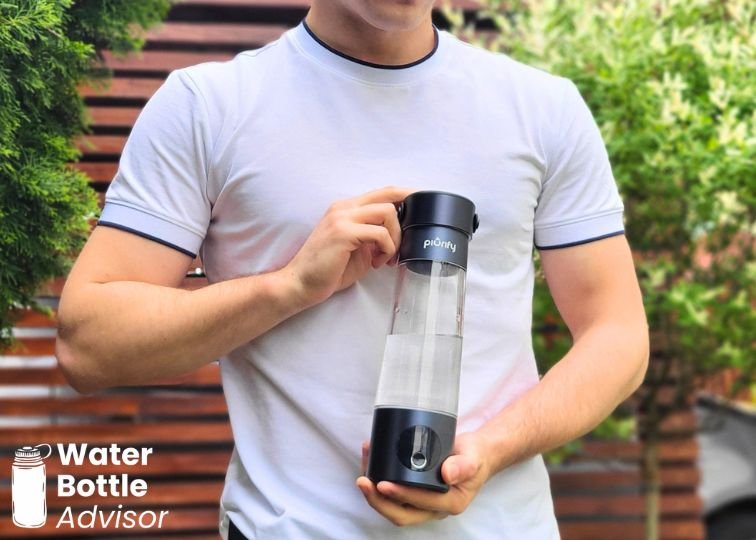
This won’t be a long-winded intro, because there’s not much beating around the bush here – the Piurify Hydrogenator is one of my top-rated hydrogen water bottles right now, and for good reason.
The hydrogen bottle market is flooded with overpriced, copy-paste products that all promise the world and end up feeling exactly the same. This is one of the few bottles that actually stands out once you start using it day to day.
Unironically, my favorite thing about it is the 17 oz (500 ml) capacity. It’s actually pretty rare to see hydrogen bottles this large and what’s impressive is that it still delivers strong hydrogen output without cutting corners on performance.
But of course, there’s more to it than that. Stick around to the end to make a confident purchase decision.
Some of the links on this page are affiliate links. This means that if you click on one of the links and make a purchase, I may earn a small commission at no additional cost to you.
KEY FEATURES
PROS
CONS
Hydrogen Output & Performance
We spend good money on hydrogen bottles for one main reason: they’re supposed to infuse water with molecular hydrogen. So if there’s one thing worth testing, it’s whether the bottle can actually deliver on that promise.
Piurify is pretty upfront about its claimed output. On the box, you get two different modes:
- 10-minute mode → up to 4,240 ppb (tap twice to activate)
- 20-minute mode → up to 6,290 ppb (tap three times to activate)
Those are serious numbers. Hydrogen escapes from water very quickly, so reaching levels like that isn’t easy. What caught my attention is that these aren’t just random marketing claims printed on the packaging. The bottle comes with certification from H2 Analytics Laboratory confirming it was independently tested under lab conditions.
And in this market, that matters A LOT.
There are countless hydrogen bottles online throwing around huge ppb numbers with zero proof behind them. Independent lab certificates are one of the few things that separate a properly tested product from pure guesswork.
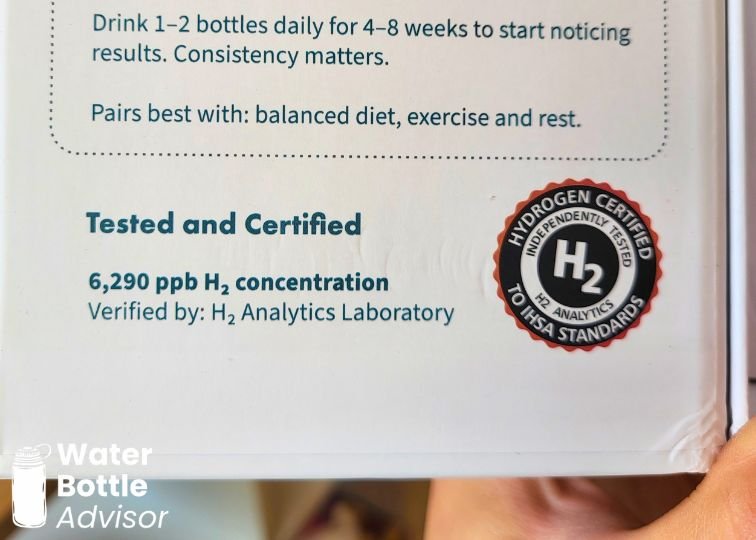
Now, the lab certificate is already a pretty strong piece of evidence that this bottle can reach very high hydrogen levels, but I still wanted to test it myself anyway. At this point, it’s basically a habit of mine whenever I get a new hydrogen bottle.
But the problem is that measuring hydrogen outside a lab is messy. Unless you have access to gas chromatography equipment, you’re mostly left with two options: hydrogen meters or hydrogen reagent drops.
Hydrogen meters do work to a degree, but in my experience they seem to cap out around 1,800 ppb. Beyond that, the readings barely change no matter which bottle I test, which makes them less useful for higher-output devices like this one.
The reagent drops worked better for me. The method is simple: you pour hydrogen-rich water into a testing cup and add drops until the liquid changes color to dark blue. Each drop equals roughly 100 ppb.
That said, the drops seem to have limits too – just a higher ceiling than the meters. I tested several high-output bottles with lab certificates confirming levels well above 3,000 ppb, yet the highest reading I could consistently get with the drops was around the 3,000 ppb mark.
So no, this method isn’t perfectly precise either. But it’s still useful as a practical check to see whether a bottle is producing a decent amount of hydrogen or barely anything at all. Below, you can see my own test using this method.
As you can see, I managed to add 31 drops before the solution finally turned dark blue. But like I mentioned earlier, this seems to happen with every high-output bottle I test – the reagent drops method appears to hit a ceiling somewhere around that point.
Either way, the result still makes one thing pretty clear: this Piurify bottle is far from a scam. If anything, it shows that the bottle is producing a strong amount of hydrogen.
Important Info: Activate the Membrane First
Before you jump in and start using the bottle, there’s one step you really don’t want to skip: activating the membrane. I know the temptation is to unbox it and get going straight away, but here you’ll need to slow down a bit.
The process is simple:
- Fill the bottle with warm water (around 120-140°F / 49-60°C)
- Let it sit for about 2 hours
- Pour it out and give it a good rinse
Piurify actually makes this pretty easy to follow, since the steps are printed right on the box. So even if you tend to skim instructions (like most of us), it’s hard to miss.
Portability
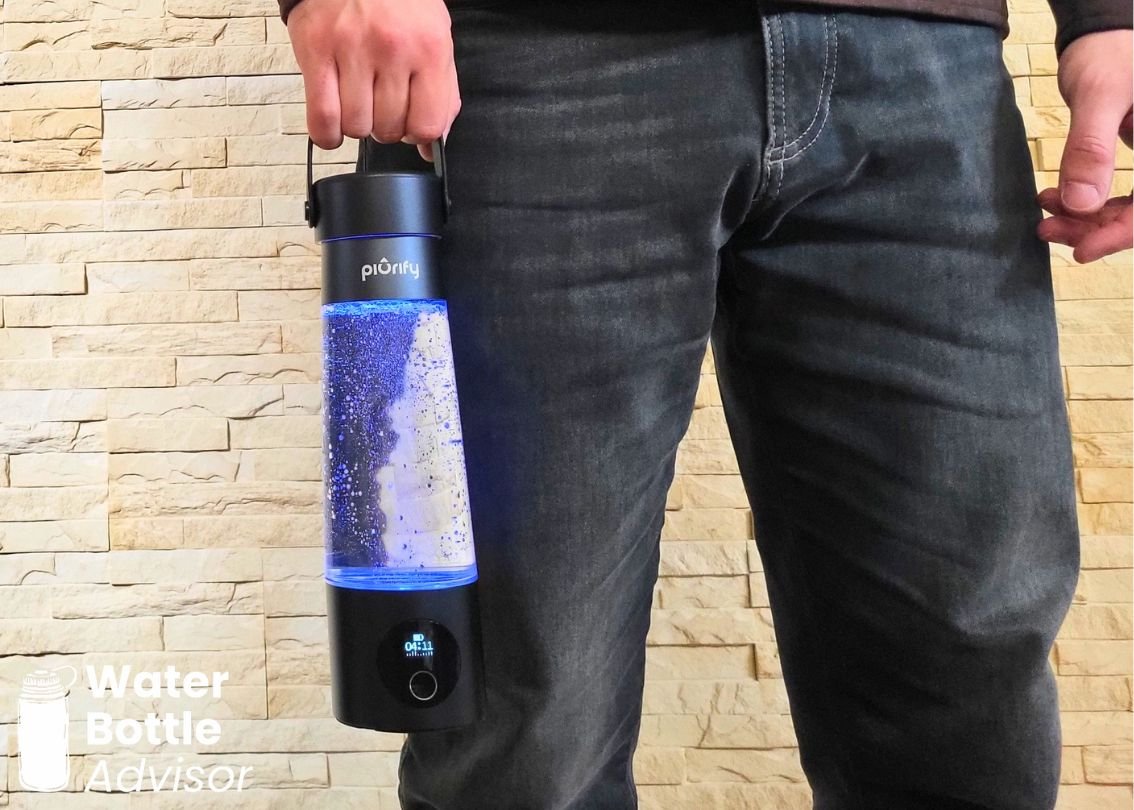
The first thing that stood out to me straight away was the 17 oz (500 ml) capacity. I’ve been waiting ages for hydrogen bottles to move past that tiny 10 oz standard, and this one finally breaks out of that box. It just means fewer refills during the day.
Even with the larger size, it is still a portable bottle. I spend a fair bit of time on the road, so cup holder compatibility is a must for me and thankfully, this bottle slides in without any struggle thanks to its sub-3 inch base diameter.
It’s not featherlight at 19.8 oz when empty, but I’ll take a bit of extra weight any day if it means more capacity and fewer refills.
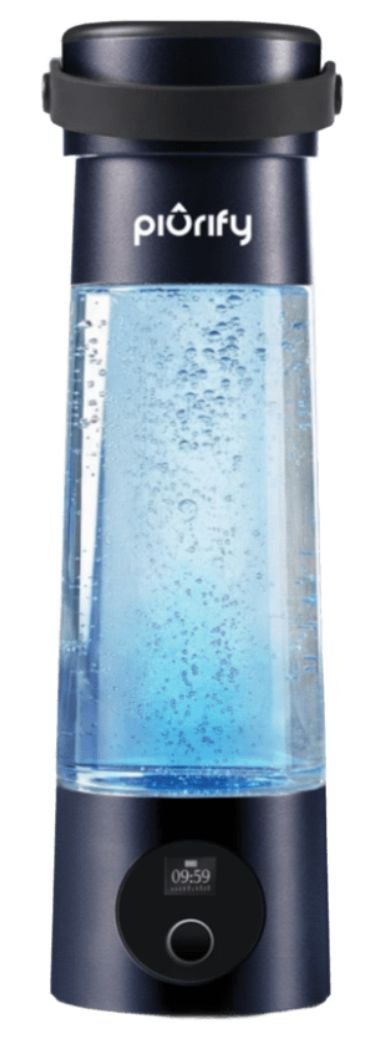
What really improved the experience for me compared to the older version is the soft, flexible carrying handle. It fits comfortably in the hand (even with four fingers) and makes grabbing it on the go much easier. It also takes the sting out of the weight, so it doesn’t feel as bulky as the numbers suggest.
Ease of Cleaning
Cleaning this bottle is pretty straightforward, but hydrogen bottles do come with a few “do not mess this up” rules that are worth sticking to.
First off – don’t throw it in the dishwasher. It’s not built for that kind of heat, and you’re better off not testing your luck here. Hand washing is the way to go. Luckily, it’s simple: you’ve basically got two parts to deal with: the cap and the bottle itself.
A bit of warm water, soap, and a sponge, and you’re done in a few minutes.
The second rule is even more important: never dunk the base in water. That’s where the electronics live, and it’s not waterproof.
For deeper cleaning, I just give the membrane a quick refresh every few weeks with a simple vinegar soak. I usually pour in around 3 oz (about 100 ml) of vinegar, let it sit for an hour, and leave it alone. Don’t turn the device on during this, just let it do its thing. After that, pour it out and rinse everything thoroughly.
If you want a step-by-step breakdown, I’ve covered it in more detail in my guide on how to clean a hydrogen water bottle.
One more thing that makes a big difference over time is the water you use. Stick to purified water whenever possible. Tap water might seem fine at first, but it can leave behind mineral and calcium buildup that slowly clogs the membrane and drags down hydrogen output. I go into that in more detail in my guide on how to use a hydrogen water bottle.
Durability
The bottle is made from food-grade PC (polycarbonate). And while plastic isn’t everyone’s first choice, in the world of hydrogen bottles it actually makes a lot of sense.
Compared to glass, PC is simply more forgiving. I’ve used both glass and plastic hydrogen bottles, and the difference is pretty clear – the glass ones always make you think twice before setting them down or tossing them in a bag, while the plastic ones let you get on with it without that constant worry in the back of your head.
To be fair, this isn’t Tritan, which you’ll often see in regular reusable bottles, but that doesn’t automatically make it a downgrade. High-quality PC is still BPA-free, FDA-approved for food contact, and widely used in premium hydrogen devices for a reason.
In day-to-day use, this feels like one of the sturdier bottles in its category. It’s not something you need to baby, but at the same time, it’s still a piece of tech, not a rugged outdoor flask.
The base is where the electronics sit, so it’s worth treating that part with a bit of care and not knocking it around.
Other Features
Beyond the core features I’ve already covered, the Hydrogenator Bottle comes with a few more extras. Some of them actually matter in day-to-day use, while others are more of a nice bonus that simply adds to the overall experience.
Byproduct release system
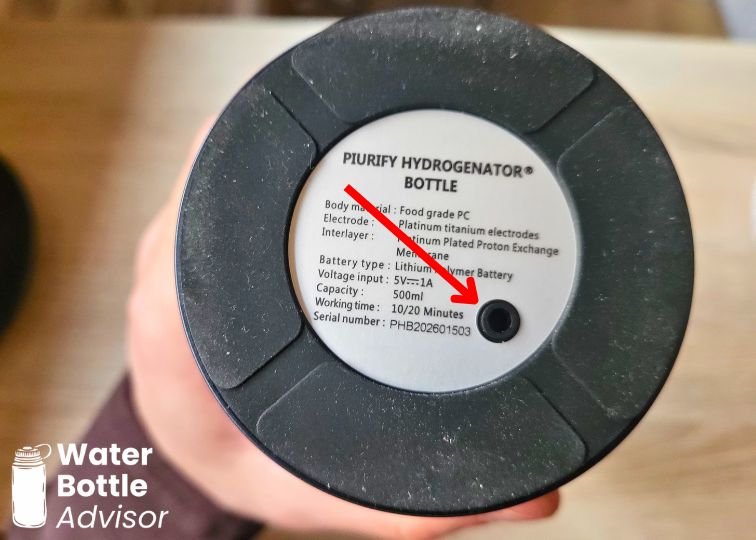
One thing that shouldn’t be overlooked is how the bottle deals with byproducts like chlorine, ozone, and hydrogen peroxide. Piurify handled this in a straightforward way – there’s a small vent at the base that releases them during operation.
Pressure relief mechanism
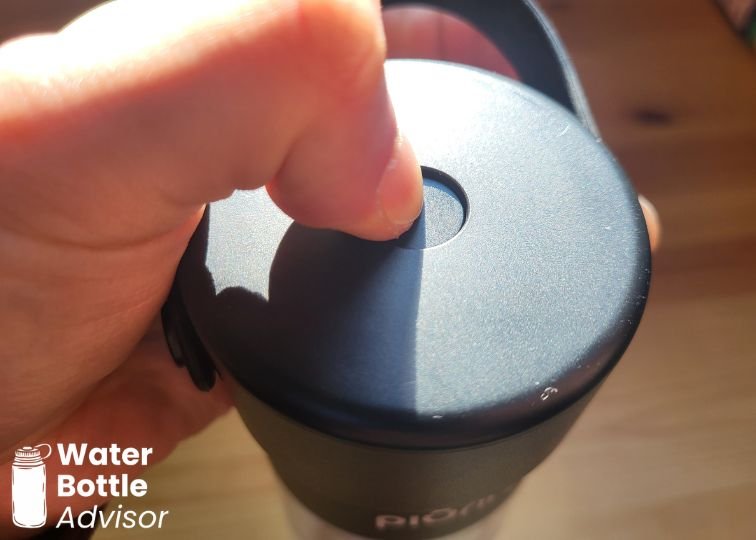
Hydrogen generation builds up pressure inside the chamber, and if it’s not managed properly, things can get messy – leaks, lid stress, or in worst-case scenarios, the lid popping up unexpectedly.
Piurify added a dedicated pressure release button in the lid, which lets you safely let off steam once the cycle is done. Simple idea, but it shows they’ve actually spent time thinking through real-world use rather than just ticking boxes.
OLED display & controls
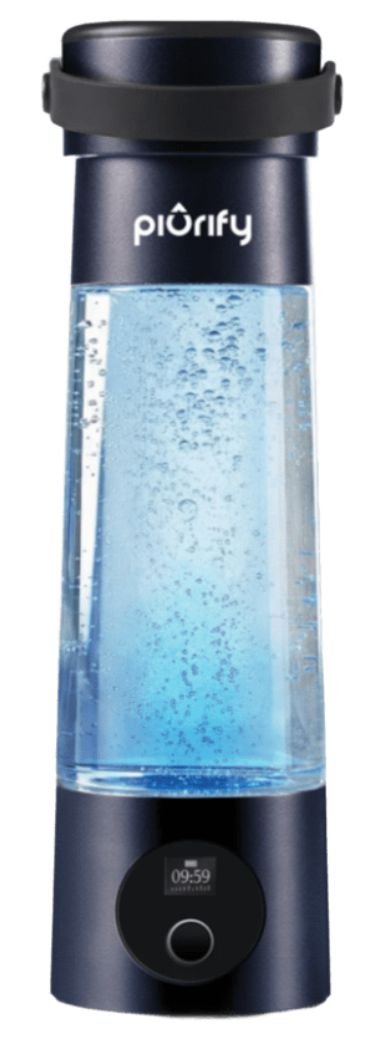
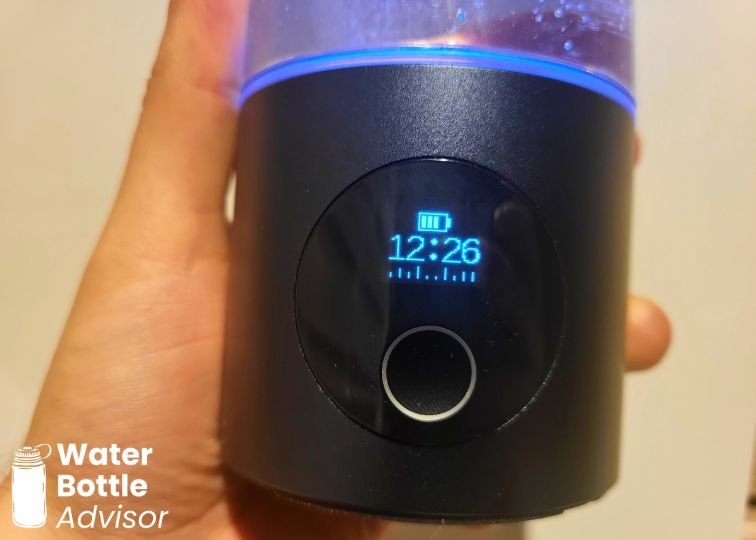
The OLED screen gives the bottle a modern, almost high-tech feel. It mainly shows battery level and remaining cycle time, so it’s not doing anything groundbreaking, but it does make the bottle feel more premium than most competitors.
There’s also a touch-style control underneath the screen. At first, it threw me off because I expected a physical button. You actually need to double-tap it fairly quickly to switch it on (slow taps won’t do anything). Once you get used to it, it’s second nature, but it’s not immediately obvious.
As much as I like this bottle, there’s one small gripe I have with this newer Piurify version. The older model actually showed the hydrogen level building up during the cycle, while this one doesn’t. You still get the different modes and timings, but I liked having that live readout before. It was useful if you wanted to stop the cycle early and still know roughly where you stood.
Battery life
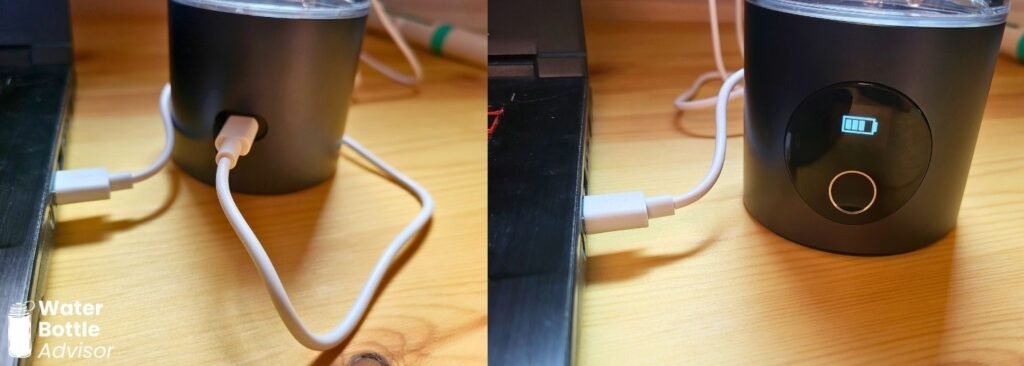
The 2200 mAh battery sits in a comfortable sweet spot. I’ve used bottles with much smaller cells, and constantly having to top them up gets old fast. Here, you’re not babysitting the charger. For normal daily use, it just gets the job done.
Hydrogen cycle visuals
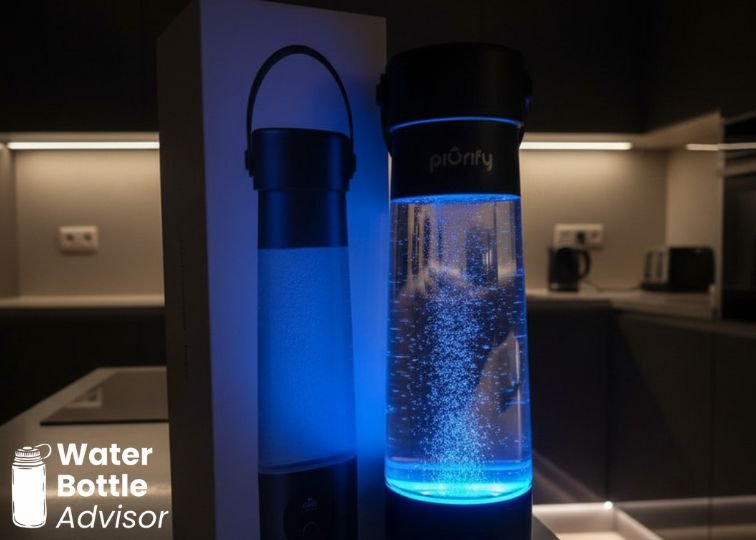
When it’s running, the turquoise glow is surprisingly enjoyable to watch. It gives off a calm, almost hypnotic vibe, a bit like a mini lava lamp sitting on your desk.
I’ve had bottles with multiple lighting modes, but this single soft glow actually feels more relaxing and less gimmicky. It’s the kind of thing you catch yourself staring at without meaning to.
Design & color options
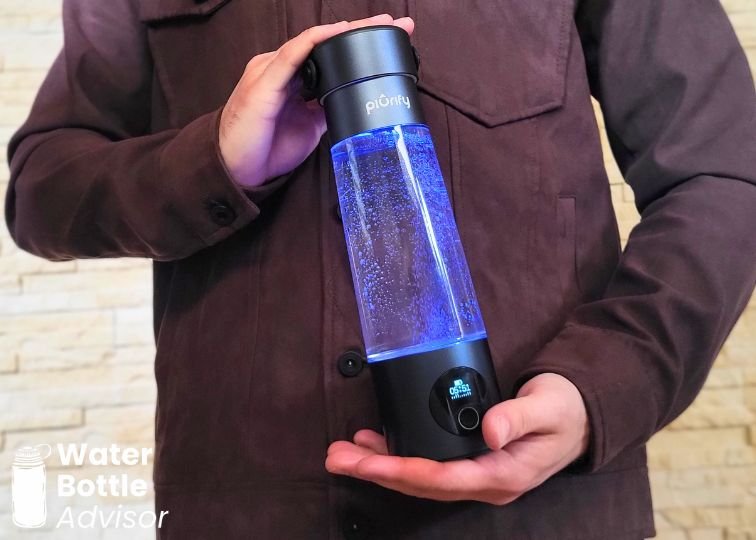
The bottle comes in two finishes: dark blue (the one I have) and a brown variant. Both look clean and understated, with a more premium feel than most of the generic bottles floating around.
That said, the overall design is what really sets it apart. A lot of hydrogen bottles look like they were copied from the same blueprint, but this one stands out. It has its own identity, and you can tell straight away it’s not just another rebranded OEM shell.
I’ve even had a few people ask about it when I’ve used it outside, which says a lot in this niche!
Price/Value Ratio
Hydrogen water bottles sit at the premium end of the spectrum, so seeing price tags north of $100 isn’t anything out of the ordinary if you’re after decent build quality and real performance.
The upgraded Piurify Hydrogenator Bottle comes in at around $171, though I’ve spotted it dropping to roughly $144 during Amazon promos, which is easily the best time to pick it up if you’re trying to save a bit.
Even at full price, I think it holds its ground. It sounds steep at first glance, but once you stack it up against competitors like the Echo Flask, which sits closer to the $300 mark, it suddenly doesn’t look so crazy anymore, especially since the performance is on par, and in some areas arguably better.
You’re getting reliable hydrogen output, strong ppb/ppm levels that comfortably hit the range people actually aim for, plus a solid build, a very practical carrying handle, and a design that doesn’t feel like an afterthought.
It’s the kind of bottle you don’t mind taking out in public, which sounds trivial but does add to the overall experience.
But what really tips the scale for me is the lifetime warranty. Most brands in this space don’t even go near that (or they hide behind vague terms) so seeing it here is a pretty strong signal that they actually stand behind the product.
On top of that, their customer support has been responsive in my experience, which matters more than people think. A lifetime warranty only means something if the company actually shows up when you need them, and Piurify seems to do exactly that. Just make sure you register the product after purchase to activate it.
Verdict
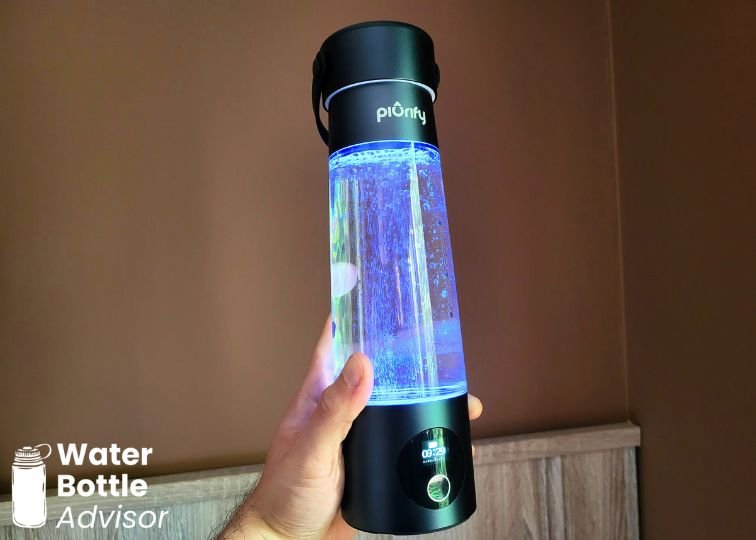
It’s hard to pick holes in the Piurify Hydrogenator Bottle, even if I try to be picky. The only real downside is that it’s a bit on the heavy side, but in day-to-day use, that’s more of a minor gripe than a dealbreaker.
What stands out most is that this bottle just does its job well. No quirks, no reliability issues, no gimmicky feel. It simply works, and that’s where a lot of other hydrogen bottles tend to fall short.
If you’re thinking about getting into hydrogen water, this is one of my top recommendations this year. You’re getting proper tech under the hood, all the useful features you’d expect, and most importantly, strong hydrogen output – which is the whole point in the first place.
Piurify Hydrogenator Bottle |
|---|
 |
My Score: 4.7/5 |

Jeremiah Kowalski
Jeremiah Kowalski is a drinkware product researcher who has personally tested 50+ reusable water bottles, tumblers, mugs, and filtration systems from leading brands. He focuses on real-world performance, durability, and safety to help readers choose drinkware that actually fits their daily hydration needs.