
Table of contents11 sections
Lead in water bottles went from a niche manufacturing detail to an internet panic almost overnight, mostly thanks to viral videos of people swabbing Stanley cups for lead.
The problem is that finding lead somewhere in a bottle is not the same as finding lead in the water you drink from it.
That distinction gets lost surprisingly quickly once headlines, TikToks and product warnings enter the picture.
So I went deeper. I reviewed 56 scientific records, 23 safety and regulatory records, and now use my 150-brand chemical safety transparency audit for current public lead claims from reusable bottle brands.
My take is this: I found no convincing evidence that intact modern stainless-steel bottles routinely expose people to dangerous amounts of lead.
Put simply, if your beloved Stanley Quencher isn’t badly damaged and the base is still intact, I wouldn’t panic.
If you want complete peace of mind, you can also choose a bottle from a brand that says it uses lead-free construction – I keep the current claims, scope and sources in my 150-brand chemical safety transparency audit.
By the end of this article, you’ll know what actually matters and why most of the scary social-media clips leave out half the story.
Can lead actually get into your drink?
Yes. It can. But the direct bottle research is surprisingly small.
Only four of the 56 scientific records I reviewed directly tested reusable bottles or closely related drinking flasks.
Considering how much noise this topic generated online, I expected more than that.
What the bottle studies found
The most useful reusable-bottle study I found came from 2021. Researchers tested 20 bottle types, 40 bottles in total, and repeatedly filled and rinsed them over 28 days.
Lead ranged from below the detection limit to a maximum of 3.26 µg/L.
That tells me measurable lead transfer can happen.
What it does not tell me is that “stainless-steel bottles release 3.26 µg/L.”
The researchers did not identify which specific bottle or material produced the maximum, so attaching that number to stainless steel would be guesswork.
A smaller 2009 study is almost the opposite. Two stainless-steel bottle brands produced average lead concentrations of just 0.0083 and 0.024 µg/L after 13 days with high-purity water.
Tiny numbers. The obvious catch is that two bottles sitting with high-purity water do not recreate years of drops, dishwasher cycles, lemon water, scratches and everything else we do to bottles in real life.
Then there is the oddball: a 2024 study of six reusable metal hip flasks. Lead ranged from 13 µg/L to as high as 23,000 µg/L under different test conditions. The worst result came from one flask exposed to citric acid for 24 hours at 40°C, and the researchers suspected lead-containing solder.
That number looks terrifying on its own. With the context, it tells a much narrower story: one product, one aggressive test and a likely construction component. It does not mean stainless steel somehow turns into a lead fountain.
For scale, current WHO and EU drinking-water values are 10 µg/L, while the U.S. FDA bottled-water standard is 5 µg/L.
Those are not reusable-bottle migration limits, but they give the numbers some context.
Those are regulatory reference points, not a magic line below which lead becomes harmless. Lower exposure is still better, especially for children.
Lead in the bottle isn’t the same as lead in your drink
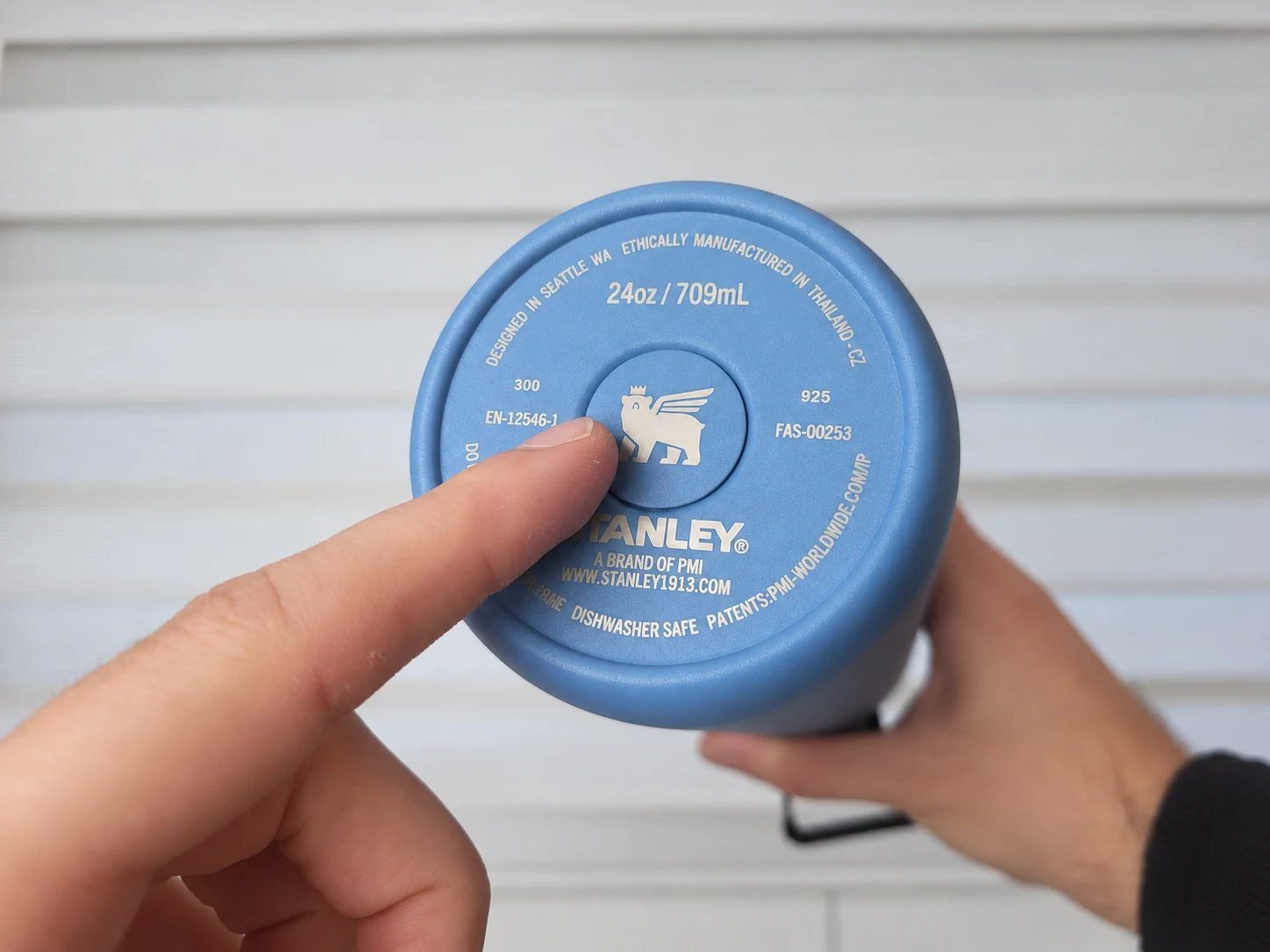
A vacuum-insulated bottle has an inner steel wall, an outer steel wall and a vacuum between them. That vacuum has to be sealed during manufacturing. Some companies use, or historically used, a small lead-containing pellet, solder or sealing bead near the bottom.
In this controversy, the main concern is not the stainless-steel body itself but the separate component used to seal the vacuum. Lead-containing solder has historically been a practical way to do that, although lead-free alternatives now exist.
Picture that tiny component hidden under the steel base while your water sits inside the inner chamber above it.
Finding lead in the hidden component proves the component contains lead. It does not automatically prove the water ever touches it.
For exposure to happen, there has to be a path: the lead has to be present, become accessible, reach the beverage, and then be ingested.
That is why a simple “lead detected” headline tells me a lot less than where the lead was found and how the bottle is built.
I test insulated bottles all the time, and you cannot look at the outside of one and magically know what sealed the vacuum inside. Two bottles can look almost identical on a shelf and use completely different construction methods underneath.
What the Stanley scare actually showed
Stanley became the face of this issue in early 2024 after home lead-swab videos went viral. The company acknowledges using a sealing pellet containing some lead near the base of its vacuum-insulated products.
Stanley says that pellet is covered by stainless steel and does not touch the drink or the consumer during normal use.
So yes, Stanley uses lead in its manufacturing process. That still does not give us evidence that an intact Stanley normally puts that lead into the water.
Once you understand the construction, the viral swabs become much less dramatic. A swab changing color somewhere on a product is not the same as measuring lead in the drink.
The U.S. Consumer Product Safety Commission has also found serious reliability problems with consumer lead kits, including false negatives and false positives.
I would treat a home swab as a clue, not a verdict.
Damage is where I stop being relaxed about it. In 2022, the CPSC recalled about 10,500 Green Sprouts stainless-steel toddler bottles and cups because the bottom could break or come off and expose a solder dot containing lead. Seven incidents had been reported.
That recall did not prove the drink was contaminated. It did show that “sealed away” and “exposed after the base breaks” are two very different situations.
If the bottom of one of my insulated bottles came off and exposed something that was never meant to be exposed, I would replace the bottle.
By “damaged,” I do not mean ordinary dents or scratches. I mean the bottom cap or base plate cracking, separating or coming off enough to expose what is underneath.
I checked 150 bottle brands
Stanley made me wonder whether it was unusual or just the brand that happened to get all the headlines, so I widened the search.
For current brand-claim statistics, I use a fixed panel of 150 prominent and relevant reusable water bottle brands. It is not a market-share study. The point is to apply the same claim rules to the same companies across lead, BPA, PFAS, phthalates and the other topics in my 150-brand chemical safety transparency audit.
Four numbers are worth remembering:
23 of 150 brands made an explicit first-party lead-free claim for at least some product, material, component or bottle line.
3 of 150 published a tested-not-detected lead statement.
30 of 150 had some bottle-relevant first-party lead statement.
114 of 150 had no qualifying public lead claim that I could find.
That last number bothers me most. It does not mean 114 brands use lead. It means I could not find qualifying public information about lead under the same audit rules.
For current manufacturer information, I use the 150-brand chemical safety transparency audit, where I keep the latest public lead claims, their scope and the source behind each claim.
“Lead-free” gets messy fast
The 150-brand audit makes the scope problem obvious. Twenty-three brands made an explicit first-party lead-free claim, but those claims did not all mean the same thing. Some applied to a specific product, material, component or bottle line rather than everything the company sells.
That difference matters. “This bottle is lead-free” and “everything we make uses a lead-free vacuum seal” are not interchangeable statements.
I also found 3 brands with tested-not-detected lead statements. That is useful information, but it is still different from a broad lead-free promise. A test result depends on what was tested, where it was sampled and how sensitive the method was.
If you want to check a specific brand, I keep the current wording, scope and source in my 150-brand chemical safety transparency audit rather than maintaining another long brand list here.
And I still would not treat a manufacturer claim as independent proof. XRF can tell you whether a tested component contains lead, while migration or leaching testing is more relevant to whether lead reaches the drink. Those are different questions.
What seems to raise the risk
The material label on the product page is not enough. Construction looks more useful.
The highest direct result I found was linked to suspected solder, while the dedicated stainless-bottle study measured very small amounts. Acidic liquids also increased lead release in parts of the wider food-contact literature, and the extreme hip-flask result happened with citric acid.
I still would not turn that into “never put lemon water in a stainless bottle.” We simply do not have enough direct bottle-specific evidence to say that.
Heat, scratches, corrosion, repeated washing and years of use are even fuzzier. They are sensible questions, especially if you keep a bottle for years like I do, but the current reusable-bottle research does not give clean answers.
The scenario I take most seriously is much simpler: a bottle has a lead-containing component and the part that keeps it sealed away gets damaged. We have a real recall showing that can happen. That is enough for me to treat an exposed base differently from an intact one.
What I’d actually do with my own bottles
I would not stop using stainless-steel bottles based on what I found. I saw no convincing evidence of widespread lead contamination from intact modern reusable stainless-steel bottles during normal use.
If I were choosing between two otherwise similar bottles and one company clearly used a lead-free vacuum seal, though, I would pick that one. I do not see an upside to putting lead into the construction if the same job can be done without it.
I would also look for specific wording. “We use a lead-free glass bead to seal the vacuum” tells me something useful. “Made with safe materials” mostly tells me someone in marketing had a keyboard.
Independent lab reports are a plus (although it’s very rare).
And if the bottom cap ever breaks off and exposes something that was meant to stay enclosed, I would retire the bottle instead of spending the next week wondering whether it is still fine.
My take
After going through the science, recalls and the current 150-brand claim audit, I am less worried about the idea that every stainless-steel bottle is secretly leaching lead than I am annoyed by how badly this topic is explained.
The internet version is too simple: lead was detected, therefore the bottle is dangerous.
The manufacturer version can be too simple in the other direction: the food-contact surface is safe, so apparently there is nothing else worth explaining.
Reality is messier. Lead can migrate from some reusable drinking vessels. Some major brands use lead-containing construction components. But we do not have good evidence that intact modern stainless-steel bottles are routinely exposing users to dangerous amounts of lead.
What I keep coming back to is transparency. In the current 150-brand audit, 114 had no qualifying public lead claim I could find, while only 23 made an explicit first-party lead-free claim within some stated scope. That does not tell me which bottle is safe. It tells me how hard it still is for a buyer to get a clear public answer.
Manufacturers can make this much easier. If a bottle uses a lead-free seal, say so. If it uses lead, explain where it is and what keeps it away from the drink. And if you advertise a bottle as lead-free, publish the test report.
That is the information I want before I buy another bottle.
Methodology
About this review & methodology
I reviewed scientific literature, government and product-safety records, manufacturer disclosures, consumer testing and current bottle-brand information through October 24, 2026.
The research database includes 56 scientific records, including four direct reusable-bottle or closely related flask studies, plus 23 separate regulatory and product-safety records. Current manufacturer-claim statistics come from the separate fixed 150-brand chemical safety transparency audit.
I kept migration studies separate from recalls, manufacturer claims, XRF testing and other evidence because they answer different questions. The rule I used throughout was simple: lead somewhere in the construction is not automatically lead in the drink.
Sources & bibliography
Sources & bibliography
The full source list includes all 56 scientific records reviewed, the 23 separate regulatory and product-safety records, independent XRF and laboratory testing, and the WHO, EU, FDA, EPA and CPSC references used in this article. Current manufacturer-claim records are maintained in the 150-brand chemical safety transparency audit.
For readability, the complete bibliography is placed at the end of the page rather than cited after every sentence.
ADDITIONAL AUTHORITATIVE SOURCES
- A01. World Health Organization. Lead in drinking-water fact sheet. https://cdn.who.int/media/docs/default-source/wash-documents/water-safety-and-quality/chemical-fact-sheets-2022/lead-fact-sheet-2022.pdf
- A02. European Union. Directive (EU) 2020/2184 on the quality of water intended for human consumption. https://eur-lex.europa.eu/legal-content/EN/TXT/?uri=CELEX:32020L2184
- A03. U.S. Food and Drug Administration. Lead in Food and Foodwares. https://www.fda.gov/food/environmental-contaminants-food/lead-food-and-foodwares
- A04. U.S. Environmental Protection Agency. National Primary Drinking Water Regulations / Lead and Copper Rule information. https://www.epa.gov/ground-water-and-drinking-water/national-primary-drinking-water-regulations
- A05. U.S. Consumer Product Safety Commission. CPSC Staff Study: Home Lead Test Kits Unreliable. https://www.cpsc.gov/Newsroom/News-Releases/2008/CPSC-Staff-Study-Home-Lead-Test-Kits-Unreliable-0
- A06. Reuters. Maker of Stanley tumblers prevails in lawsuit over lead scare, April 6, 2026. https://www.reuters.com/sustainability/boards-policy-regulation/maker-stanley-tumblers-prevails-lawsuit-over-lead-scare-2026-04-06/
SCIENTIFIC REFERENCES
- S01. Astolfi; Castellani; Avino; Antonucci; Canepari; Protano; Vitali (2021). Reusable Water Bottles: Release of Inorganic Elements, Phthalates, and Bisphenol A in a “Real Use” Simulation Experiment. Separations. https://doi.org/10.3390/separations8080126
- S02. Kawamura; Tsuji; Sugita; Yamada (1997). Migration of Metals from Stainless Steel Kitchenware and Tableware. Food Hygiene and Safety Science. https://doi.org/10.3358/shokueishi.38.3_170
- S03. Pereira; Leroux; Luz; Batista; Olympio (2022). Study of controlled migration of cadmium and lead into foods from plastic utensils for children. Environmental Science and Pollution Research. https://doi.org/10.1007/s11356-022-19433-2
- S04. Sarah von Leliwa; Roman Schmidt; Svetlana Andrievskih; Thomas Tietz; Stefan Merkel; Andreas Luch; Oliver Kappenstein (2024). Element release from lead crystal ware and metallic hip flasks. Food Additives & Contaminants: Part A. https://doi.org/10.1080/19440049.2024.2406002
- S05. Anderson; Garnick; Fung; Gaffney et al. (2017). A pilot study to assess lead exposure from routine consumption of coffee and tea from ceramic mugs. International Journal of Food Contamination. https://doi.org/10.1186/s40550-017-0049-7
- S06. Mandal; Das (2018). Leachable lead and cadmium in microwave-heated ceramic cups. Environmental Science and Pollution Research. https://doi.org/10.1007/s11356-018-2944-8
- S07. Norita Mohamed; Y.M. Chin; F.W. Pok (1995). Leaching of lead from local ceramic tableware. Food Chemistry. https://doi.org/10.1016/0308-8146(95)00035-H
- S08. Andrew Turner (2025). Migration kinetics of cadmium and lead from ceramic mugs. Journal of Hazardous Materials. https://doi.org/10.1016/j.jhazmat.2025.139204
- S09. Nunamaker; Otto; Artwohl; Fortman (2013). Leaching of Heavy Metals from Water Bottle Components into the Drinking Water of Rodents. Journal of the American Association for Laboratory Animal Science. https://doi.org/10.30802/AALAS-JAALAS-12-00041
- S10. Fernando Falcone (1991). Migration of Lead into Alcoholic Beverages During Storage in Lead Crystal Decanters. Journal of Food Protection. https://doi.org/10.4315/0362-028X-54.5.378
- S11. Ajmal; Khan; Nomani; Ahmed (1997). Heavy metals: Leaching from glazed surfaces of tea mugs. Science of the Total Environment. https://doi.org/10.1016/S0048-9697(97)00244-1
- S12. Rebeniak; Wojciechowska-Mazurek; Mania; Szynal; Strzelecka; Starska (2014). Exposure to lead and cadmium released from ceramics and glassware intended to come into contact with food. Roczniki Państwowego Zakładu Higieny. https://pubmed.ncbi.nlm.nih.gov/25526575/
- S13. Mania; Szynal; Rebeniak; Postupolski (2018). Exposure assessment to lead, cadmium, zinc and copper released from ceramic and glass wares intended to come into contact with food. Roczniki Państwowego Zakładu Higieny. https://doi.org/10.32394/rpzh.2018.0047
- S14. Andrew Turner (2018). High levels of migratable lead and cadmium on decorated drinking glassware. Science of the Total Environment. https://doi.org/10.1016/j.scitotenv.2017.10.164
- S15. Yan Li (2020). Migration of metals from ceramic food contact materials. 1: Effects of pH, temperature, food simulant, contact duration and repeated-use. Food Packaging and Shelf Life. https://doi.org/10.1016/j.fpsl.2020.100493
- S16. Zhou; Zhang; Yan; Shang; Yang; Sui (2024). Investigation on the release of 15 elements from food contact glassware in the Chinese market. Food Packaging and Shelf Life. https://doi.org/10.1016/j.fpsl.2024.101247
- S17. Yan Li; Jianqing Zhang (2021). Exposure to lead and cadmium of the Belgian consumers from ceramic food contact articles. Toxicology Reports. https://doi.org/10.1016/j.toxrep.2021.02.015
- S18. Michael Krachler; William Shotyk (2009). Trace and ultratrace metals in bottled waters: survey of sources worldwide and comparison with refillable metal bottles. Science of the Total Environment. https://doi.org/10.1016/j.scitotenv.2008.10.014
- S19. C. Kubwabo; I. Kosarac; B. Stewart; B.R. Gauthier; K. Lalonde; P.J. Lalonde (2009). Migration of bisphenol A from plastic baby bottles, baby bottle liners and reusable polycarbonate drinking bottles. Food Additives & Contaminants: Part A. https://doi.org/10.1080/02652030802706725
- S20. Adriana Dehelean; Dana-Alina Magdas; Mihnea Tomoiagă; Valentin Mirel; Gabriela Cristea (2026). Migration of potentially toxic elements from drinking cups: Influence of vessel material and beverage type. Journal of Agriculture and Food Research. https://doi.org/10.1016/j.jafr.2026.103237
- S21. Guillaume Lecanuet; Emmanuel Rocca; Patricia Hee; Marie-Alice Skaper; Christophe Rapin (2022). Mechanism of alteration of the surface of lead crystal glass in contact with food: A chemical study of the surface layer. Applied Surface Science. https://doi.org/10.1016/j.apsusc.2021.152281
- S22. L. Brunswic; F. Angeli; S. Gin; E.D. van Hullebusch; M. Tarrago; L. Gautron; et al. (2024). Surface treatments on commercial glasses: durable impact on the retention of lead, barium and boron. npj Materials Degradation. https://doi.org/10.1038/s41529-024-00526-x
- S23. L. Brunswic; F. Angeli; S. Gin; et al. (2024). Comparative study of the structure and durability of commercial silicate glasses for food consumption and cosmetic packaging. npj Materials Degradation. https://doi.org/10.1038/s41529-024-00502-5
- S24. Yujin Han; Keunyoung Ryu; Nanju Song; Jinjong Seo; Insook Kang; Hyun-Jung Chung; Ran Park (2024). Potential Migration and Health Risks of Heavy Metals and Metalloids in Take-Out Food Containers in South Korea. International Journal of Environmental Research and Public Health. https://doi.org/10.3390/ijerph21020139
- S25. Jahid Hasan Shourove; G.M. Rabiul Islam; Shamima Akther Eti; Mohammad Mahbubur Rahman (2025). Migration of heavy metals from disposable food containers to food and potential health risks. Journal of Food Composition and Analysis. https://doi.org/10.1016/j.jfca.2025.107686
- S26. B.M. Khaled; Adda Ann Sina; Md Suman Rana; S.M. Shamiul Alam; Abdullah Al Numan; Maria Tabassum Shammi; Fatima Parvin; Tamanna Naznin; Md Mozaffor Hossain; Refat Pervin Annana (2024). Study on the effect of different contact times on the migration of heavy metals into different foodstuffs served in plastic cups. Heliyon. https://doi.org/10.1016/j.heliyon.2024.e31627
- S27. Chae-Yeon Hwang; Young-Jun Kim (2023). Investigation of Heavy Metal Migration from Food Contact Materials used for Food Delivery Using an Inductively Coupled Plasma–Mass Spectrometer. Journal of Food Hygiene and Safety. https://doi.org/10.13103/JFHS.2023.38.2.37
- S28. Hight et al. (1996). Lead migration from lead crystal wine glasses. Food Additives and Contaminants. https://doi.org/10.1080/02652039609374463
- S29. Graziano; Blum (1991). Lead exposure from lead crystal. The Lancet. https://doi.org/10.1016/0140-6736(91)90803-w
- S30. Appel et al. (1992). Potential lead exposures from lead crystal decanters. American Journal of Public Health. https://doi.org/10.2105/AJPH.82.12.1671
- S31. Barbee; Constantine (1994). Release of lead from crystal decanters under conditions of normal use. Food and Chemical Toxicology. https://doi.org/10.1016/0278-6915(94)90202-X
- S32. Guadagnino et al. (1998). Co-operative study on the release of lead from crystalware. Packaging Technology and Science. https://doi.org/10.1002/(SICI)1099-1522(199803/04)11:2<45::AID-PTS417>3.0.CO;2-2
- S33. Guadagnino et al. (2000). Estimation of lead intake from crystalware under conditions of consumer use. Food Additives and Contaminants. https://doi.org/10.1080/026520300283469
- S34. Henderson; Andrews; Lightsey (1979). Leaching of lead from ceramics. Journal of Food Science. https://doi.org/10.1007/BF01685395
- S35. Aderemi; Adenuga; Oyekunle; Ogunfowokan (2017). High level leaching of heavy metals from colorful ceramic foodwares: a potential risk to human. Environmental Science and Pollution Research. https://doi.org/10.1007/s11356-017-9317-8
- S36. Johnson-Arbor; Vo; Wong; Gajek (2018). Unintentional and Sequential Lead Exposure from a Ceramic Mug and Maca (Lepidium meyenii). Journal of Medical Toxicology. https://doi.org/10.1007/s13181-017-0649-x
- S37. González de Mejía; Craigmill (1996). Lead migration from lead-glazed ceramics to food. Archives of Environmental Contamination and Toxicology. https://doi.org/10.1007/BF00212443
- S38. Bulut; Yolci Omeroglu; Acoglu; Alibasoglu (2021). Migration of lead and cadmium from ceramic kitchenware and estimation of sampling uncertainty. Journal of Food Processing and Preservation. https://doi.org/10.1111/jfpp.15750
- S39. Sun et al. (2024). Determination of 24 elements migration in Yixing clay pottery by ICP-MS. Journal not fully normalized in accessible record. https://doi.org/10.19813/j.cnki.weishengyanjiu.2024.02.018
- S40. Collado-López et al. (2026). Lead leaching during the cooking of traditional recipes in lead-glazed ceramic versus glass pots: a health risk assessment. Journal of Food Composition and Analysis. https://doi.org/10.1016/j.jfca.2026.109548
- S41. Shotyk; Krachler (2007). Lead in bottled waters: contamination from glass and comparison with pristine groundwater. Environmental Science & Technology. https://doi.org/10.1021/es062964h
- S42. Misund et al. (1999). Variation of 66 elements in European bottled mineral waters. Science of the Total Environment. https://doi.org/10.1016/S0048-9697(99)00307-1
- S43. Reimann et al. (2010). Bottled drinking water: Water contamination from bottle materials (glass, hard PET, soft PET), the influence of colour and acidification. Applied Geochemistry. https://doi.org/10.1016/j.apgeochem.2010.04.009
- S44. Reimann et al. (2012). Temperature-dependent leaching of chemical elements from mineral water bottle materials. Applied Geochemistry. https://doi.org/10.1016/j.apgeochem.2012.05.003
- S45. Rowell et al. (2016). Is container type the biggest predictor of trace element and BPA leaching from drinking water bottles?. Food Chemistry. https://doi.org/10.1016/j.foodchem.2016.01.109
- S46. Andrew Turner (2019). Heavy Metals in the Glass and Enamels of Consumer Container Bottles. Environmental Science & Technology. https://doi.org/10.1021/acs.est.9b01726
- S47. Authors not normalized in abstract (2026). Investigation of the effectiveness of point-of-use (POU) water dispensers in reducing lead and nickel levels in drinking water. Water Research X. https://doi.org/10.1016/j.wroa.2025.100458
- S48. E. Guadagnino et al. (1999). Investigation of the parameters affecting lead migration from crystal glass in contact with 4% acetic acid, wine and brandy. Rivista della Stazione Sperimentale del Vetro. https://www.britglass.org.uk/knowledge-base/digital-library-and-information-services/investigation-parameters-affecting-lead
- S49. Zaida Munilla-García; María Ángela Costa-Ferrer; Sara Escrivà-Cerrudo; Alicia Magistris-Sancho; Teresa Rey-Maquieira-Palmer; Cristina Vidal-Coll (2023). Brote familiar de saturnismo asociado al consumo de kombucha fabricada y comercializada en envases cerámicos. Revista Española de Salud Pública, 97, e202305040. https://scielo.isciii.es/scielo.php?pid=S1135-57272023000100142&script=sci_arttext&tlng=es
- S50. Sabouraud et al. (2009). Intoxication environnementale par le plomb liée à la consommation de boisson conservée dans une cruche artisanale en céramique vernissée. La Revue de Médecine Interne. https://doi.org/10.1016/j.revmed.2008.05.010
- S51. Phan; Estell; Duggin; Beer; Smith; Ferson (1998). Lead poisoning from drinking Kombucha tea brewed in a ceramic pot. Medical Journal of Australia. https://doi.org/10.5694/j.1326-5377.1998.tb123448.x
- S52. Marittza E. Flores; Marcela M. Idrovo; Damián V. Flores (2016). Evaluación de la extracción de plomo y cadmio de vajilla cerámica vidriada. Maskana. https://doi.org/10.18537/mskn.07.01.10
- S53. T. D. Matte; D. Proops; E. Palazuelos; J. Graef; M. Hernandez Avila (1994). Acute high-dose lead exposure from beverage contaminated by traditional Mexican pottery. The Lancet. https://doi.org/10.1016/S0140-6736(94)91715-9
- S54. Centers for Disease Control (CDC) (1989). Lead poisoning following ingestion of homemade beverage stored in a ceramic jug—New York. MMWR. Morbidity and Mortality Weekly Report. https://www.cdc.gov/MMWR/preview/mmwrhtml/00001401.htm
- S55. Kyle Rezek; Michael Fisher; Timothy Purvis; Aaron Salzberg; Solomon Minyila; Siddhartha Roy (2026). Quantifying lead (Pb) leaching from galvanized handpump spouts, leaded brass taps, and stainless-steel alternatives using the NSF 61 test protocol: Implications for safe rural water supply. PLOS Water. https://doi.org/10.1371/journal.pwat.0000402
- S56. Elizeu Chiodi Pereira; Lucas Takeshi Shimizu Hossokawa; Isabelle Nogueira Leroux; Aline de Carvalho Elias; Maciel Santos Luz; Kelly Polido Kaneshiro Olympio (2026). Chemical Characterization of Toxic Elements in Plastic Utensils: Key Insights and Health Impacts. CLEAN – Soil, Air, Water. https://doi.org/10.1002/clen.70196
REGULATORY AND PRODUCT-SAFETY SOURCES
- R01. Green Sprouts stainless toddler bottles/cups – Green Sprouts Inc. – U.S. CPSC (2022-11-23). https://www.cpsc.gov/Recalls/2023/Green-Sprouts-Recalls-Toddlers-Stainless-Steel-Bottles-and-Cups-Due-to-Lead-Poisoning-Hazard-Recall-Alert
- R02. Backyard and Beyond metal water bottles – Downeast Concepts Inc. – U.S. CPSC (2008-03-25). https://www.cpsc.gov/Recalls/2008/downeast-concepts-inc-recalls-water-bottles-due-to-violation-of-lead-paint-standard
- R03. Pura Kiki insulated stainless steel baby bottle (pre/mid-2018 versions alleged) – Pura Stainless – SaferProducts.gov consumer-submitted incident report; not a CPSC-confirmed finding (Report submitted 2023-08-26; posted 2023-10-26). https://www.saferproducts.gov/PublicSearch/Detail?ReportId=4358649
- R04. Black/white cow-print glass water bottle – CBI Distributing Corp.; Claire’s named retailer – California Proposition 65 notice database (2024). https://oag.ca.gov/system/files/prop65/notices/2024-04058.pdf
- R05. 20 reusable stainless bottles/tumblers, various brands – Multiple; screened by EcoWaste Coalition – EcoWaste Coalition (NGO, not regulator) (2024-07). https://www.pressenza.com/2024/07/ecowaste-coalition-detects-toxic-lead-in-reusable-stainless-steel-water-bottles-and-tumblers/
- R06. Stanley 1913 vacuum-insulated drinkware (general disclosure) – PMI / Stanley 1913 – Manufacturer statement (Accessed 2026-10-24). https://www.stanley1913.com/pages/faq/help
- R07. Bindle Bottle insulated stainless bottle with bottom storage compartment – Bindle Bottle – CPSC public database complaint/violation report submitted by a public safety entity; not a CPSC determination (Public report submitted 2023-02-09). https://tamararubin.com/wp-content/uploads/2023/02/20230209-8E851-2147350816.pdf
- R08. Pepco Paw Patrol ceramic cup 230 mL, bowl 540 mL and plate 19 cm, batch 020225 – Pepco Poland Sp. z o.o. – Polish State Sanitary Inspection / GIS public warning (based on company-commissioned tests and PZH opinion) (2025-10-01). https://www.gov.pl/web/psse-gniezno/ostrzezenie-publiczne-dotyczace-wyrobu-do-kontaktu-z-zywnoscia-migracja-olowiu-z-wyrobow-do-kontaktu-z-zywnoscia
- R09. Stainless steel tumbler coating and component lead-content test report, product code 46344 – Manufacturer/sample identity not stated in accessible report – SGS laboratory report; client-commissioned product testing, not regulator action (2020-10-12). https://kgstorageprod.blob.core.windows.net/kgsalesassets/Test%20Reports/46344/46344_ProductBlackSilverWhite_1020.PDF
- R10. Market analysis: specific migration of metals for reusable packaging materials – Pack-Lab, Greece – Pack-Lab commercial laboratory white paper; not peer-reviewed and not regulator action (2026-05). https://www.packlab.gr/wp-content/uploads/2026/06/WHITE-PAPER-Specific-Migration-of-Metals-in-Reusable-Packaging-May-2026.pdf
- R11. 2025 municipal market-surveillance sampling of plastic baby bottles (fourth batch) – Linyi Municipal Administration for Market Regulation, China – Local government market-surveillance announcement (2025). https://www.linyi.gov.cn/info/6366/448799.htm
- R12. 2025 national product surveillance of glass cups, bottles and pots (published 2026) – State Administration for Market Regulation of China – National regulator surveillance notice (2025 sampling; announced 2026-01-26). https://www.samr.gov.cn/zw/zfxxgk/fdzdgknr/zljds/art/2026/art_25d845afa6e743728564d3d043bf2fb8.html
- R13. Routine surveillance of lead, cadmium and cobalt migration from decorated Christmas mugs – Bavarian State Office for Health and Food Safety (LGL) – Bavarian government laboratory surveillance (2011-11 to 2011-12). https://www.lgl.bayern.de/produkte/bedarfsgegenstaende/bg_lebensmittelkontakt/ue_2011_gluehweintassen.htm
- R14. 12 children’s stainless-steel vacuum insulated bottles (12 brands) – 12 brands; names reported in source – Guangxi Consumer Council; testing by Guangxi Product Quality Inspection Institute (2020 test; announced 2021-01-05). https://gxxwfb.gxnews.com.cn/article.v2019.php?id=20044053
- R15. 20 children’s stainless-steel vacuum bottles (20 brands) – 20 brands; names and sample table in source – Zhejiang, Jinhua and Wuyi Consumer Councils; reported by China Consumers News (2023). https://zxb.ccn.com.cn/html/zxb/20230609/119478.html
- R16. 5 stainless-steel vacuum thermos batches – Suzhou Municipal Administration for Market Regulation; testing by Suzhou Product Quality Supervision and Inspection Institute (2022). https://scjgj.suzhou.gov.cn/szqts/zlcc/202212/88e9de5e60c0484cbcf8fad42fd3c0ee.shtml
- R17. 20 children’s plastic water bottles and training cups – Shanghai Municipal Bureau of Quality and Technical Supervision (2018). https://www.shsafc.org/xhdt/show-8023.aspx
- R18. 53 stainless-steel vacuum insulated cups – State Administration for Market Regulation of China (2024 sample; notice 2025). https://www.samr.gov.cn/zw/zfxxgk/fdzdgknr/zljds/art/2025/art_25a8f33eb9ed42d6a84ae2b026632f6d.html
- R19. 11 reusable drinking bottles – Verein für Konsumenteninformation (VKI), with Arbeiterkammer Steiermark (2020). https://konsument.at/test-trinkflaschen
- R20. 11 retail drinking bottles – Norwegian Institute for Air Research (NILU), commissioned by Norwegian Consumer Council (2018). https://storage02.forbrukerradet.no/media/2018/08/analyses-of-selected-organic-contaminants-and-metals-in-drinking-bottles-1.pdf
- R21. Stainless-steel bottle XG-2626 – AGC laboratory report commissioned by Favorite Logistics B.V. (2020). https://static.bizay.com/root/PM/ProductContent/Datasheets/6536_C8455.pdf
- R22. 12 reusable drinking bottles – ÖKO-TEST Magazine independent consumer testing (2019). https://www.oekotest.de/freizeit-technik/Trinkflaschen-im-Test-Diese-Flaschen-aus-Edelstahl-Co-sind-sehr-gut_111643_1.html
- R23. Five reusable drinking bottles – ARD Marktcheck / SWR, laboratory work by Prüf- und Forschungsinstitut Pirmasens (2026). https://www.swr.de/leben/verbraucher/ard-marktcheck/trinkflaschen-im-test-100.html
INDEPENDENT VERIFICATION SOURCES
Klean Kanteen – XRF: https://tamararubin.com/2017/02/saferchoices-which-water-bottles-sippy-cups-are-lead-free/
Hydro Flask – XRF: https://tamararubin.com/2017/11/hydro2/ ; https://tamararubin.com/2021/05/saferchoices-which-water-bottles-sippy-cups-are-lead-free/
Simple Modern – XRF: https://tamararubin.com/2022/02/simple-modern-12-oz-insulated-stainless-steel-tumbler-galaxy-pattern-lead-free-arsenic-free-mercury-free-antimony-free-in-all-accessible-components/
Blockhütte – DEKRA laboratory reports: https://cdn.shopify.com/s/files/1/0578/9525/6141/files/CPSIA-6274475-3_50QS-Water-Bottles-2026.pdf ; https://cdn.shopify.com/s/files/1/0578/9525/6141/files/CPSIA-6274269-3_50QS-Sports-Bottles-2026.pdf
About the author
Jeremiah Kowalski
Jeremiah Kowalski founded Water Bottle Advisor to make drinkware reviews more useful and less dependent on manufacturer claims. He has personally tested 50+ products, putting them through measuring, cleaning, leak testing, durability testing, and everyday use before sharing his conclusions. It also means occasionally explaining why yet another large box of bottles has arrived at his door.
Leave a Reply