
Table of contents15 sections
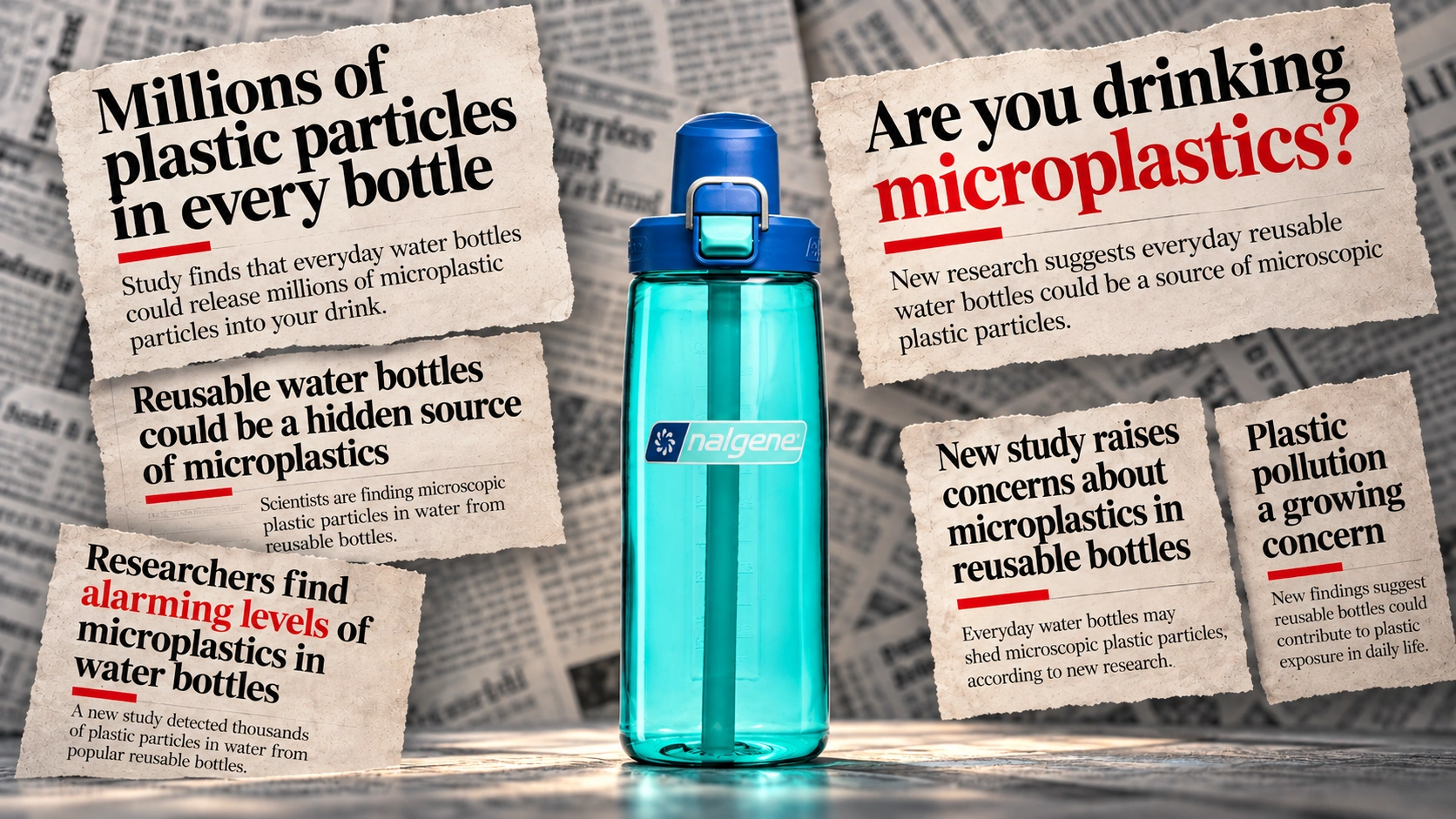
A few headlines about microplastics have stuck with me.
TIME: “Microplastics in Bottled Water at Least 10 Times Worse Than Once Thought.”
The Washington Post: “Here’s what you’re really swallowing when you drink bottled water.”
NPR: “Researchers find a massive number of plastic particles in bottled water.”
If you own a reusable plastic bottle, your brain can connect the dots pretty quickly. Mine did. I remember reading about huge numbers of plastic particles in bottled water and immediately thinking:
Well, if single-use plastic bottles release this stuff, reusable plastic bottles probably do too.
It felt like a pretty safe assumption.
After going through 72 peer-reviewed publications, I’m much less comfortable making it.
Microplastic release is real. Plastic bottles and bottle parts can shed particles. But once I stopped reading headlines and started reading the actual studies (several days of “thrilling” filter-size discussions included), the reusable-bottle story became much less dramatic… and much more complicated.
The quick reality check
| Question | What the research actually says |
|---|---|
| Can plastic bottle parts release microplastics? | Yes. |
| Can opening and closing a cap create particles? | Yes. This is one of the clearest findings. |
| Does hot water always mean more particles? | No. |
| Does an older bottle always shed more? | No. |
| Can sunlight make shedding worse? | Yes, in some studies. |
| Does dishwashing mean more MPs in your next drink? | We don’t know. |
| Do we have strong direct evidence for Tritan bottles? | Surprisingly little. |
| Is a stainless steel bottle automatically plastic-free? | No. The lid still matters. |
The number that changed how I looked at the whole subject was this:
Of the 72 publications in our database, only three reached our highest relevance level for normal reusable plastic water bottles.
There is plenty of microplastics research. There is much less research answering the question most WBA readers actually care about: what happens inside the reusable bottle I drink from every day?
The scary bottled-water study was not a reusable-bottle study
The 2024 study behind that big wave of news stories is a perfect example.
Researchers used a new imaging technique to look for extremely small plastic particles in bottled water. They tested three popular brands and found an average of about 240,000 micro- and nanoplastic particles per liter. Roughly 90% were nanoplastics.
That number is enormous compared with many earlier estimates, and my first reaction was roughly: 240,000? Well, great.
But the researchers were testing commercial single-use bottled water.
They were not testing a Nalgene, a reusable Tritan bottle, a shaker bottle, or something that had been opened, washed and refilled for a year.
Even more interestingly, one of the most common plastics they identified was polyamide, or nylon. Water-treatment filters used during production are one possible source. PET from the bottle was present too, but “particles found in bottled water” does not automatically mean “particles shed from the bottle wall.”
That is a very different story from the one I had constructed in my head after reading the headline.
What I take from this
Do not copy the 240,000-particles-per-liter number onto reusable bottles.
It tells us something important about commercial bottled water and about how many tiny particles modern instruments can detect. It does not tell us that your reusable bottle releases 240,000 particles every time you fill it.
That seems obvious now. It was not the assumption I made before reading the research.
“10 times more particles” does not mean “10 times more dangerous”
There is another trap hiding in the same story.
Newer instruments can see much smaller particles than older instruments could. Once researchers started looking deeper into the nanoscale, they found vastly more particles.
Imagine switching from normal eyesight to a strong magnifying glass and suddenly seeing crumbs you could not see before. You did not necessarily create more crumbs. You got better at finding them.
That matters because “10 times more particles” can easily sound like “10 times more dangerous.” Those are not the same claim.
The study showed that far more very small particles had previously been missed. It did not show that the health risk from bottled water had suddenly become ten times greater.
What I take from this
When you see a huge particle count, ask two things:
How small could the researchers measure?
And:
Did the study detect particles, or did it actually show harm?
Those two questions can completely change how scary the number looks.
The cap may matter more than the bottle body
Before this project, I would have guessed that most bottle-related microplastics came from the big plastic cylinder holding the water.
The research made me pay much more attention to the thing screwed on top.
We found four controlled studies from four independent research groups that repeatedly opened and closed plastic bottle closures. All four pointed in the same direction: rubbing between plastic parts can create particles.
The mechanism is simple. Two surfaces press together, you twist them, they rub, and some material eventually wears away. Anyone with an old bottle whose threads look polished or chewed up has seen the larger version of the same process.
Cap abrasion is one of the best-supported microplastic-release mechanisms in the entire review.
Plastic lids are hard to avoid
That made me wonder how common plastic lids actually are in reusable bottles today. So I checked 200 models.
Plastic was clearly present somewhere in the lid or closure of 171 of them (85.5%). And I was conservative here. If I was not sure, I left the bottle out of the plastic count. So if you are trying to avoid plastic in the lid, the current reusable-bottle market does not give you much choice.
There was another problem: manufacturers did not name the specific lid material or resin for 154 of the 200 models (77.0%). In many cases, I could see that the lid contained plastic, but I still could not tell whether it was polypropylene, Tritan, copolyester or something else.
I also checked this from the brand-transparency side. In my separate 150-brand chemical safety transparency audit, only 1 of 150 brands had a bottle-relevant first-party statement about microplastics or plastic shedding. For 141 of 150 brands, I found no qualifying public claim. This does not mean those bottles shed microplastics, that they are unsafe, or that only one brand avoids microplastics. It means manufacturers provide very little qualifying public information specifically addressing microplastics or plastic shedding.
So the lid may matter a lot, yet it is also one of the hardest parts of the bottle to properly evaluate.
What I take from this
I am now more interested in a badly worn lid than in the mere fact that a bottle body is plastic.
If the cap is cracked, grinding, visibly damaged or heavily worn where pieces rub together, replacing it makes sense.
I am not going to stop opening the bottle. That would solve the abrasion problem rather efficiently, but it would also make the bottle fairly useless.
Heat matters, just not in the simple way I expected
My starting assumption was predictable:
Hotter plastic = more microplastics.
Several experiments do support that. Some found higher release after hot or boiling water exposure.
Then you find studies where temperature makes little difference. One 2026 study, for example, found no significant increase in particle counts at 100°C compared with 20°C under the conditions tested.
And some experiments found release dropping after repeated heating or use.
Researchers sometimes call this conditioning or passivation. The basic idea is much simpler than the name: a new surface may have material that comes off easily at first. Once some of that is gone, later cycles can release less.
So now we have products where heat increases release, products where it does not, and products where repeated use eventually reduces it. Plastics were apparently not interested in giving me a nice clean chart.
What I take from this
I would not routinely put very hot or boiling water into a plastic bottle unless it was designed for it. There is enough evidence that heat can matter for that to be a sensible precaution.
But a bottle touching hot water once does not suddenly turn it into a microplastic fountain.
Heat is a factor. It is not a universal on/off switch.
An older bottle is not automatically a worse bottle
Old plastic gets scratched, washed and beaten up, so I expected older bottles to shed more.
Sometimes they do.
But repeated-use studies show several patterns. Release can rise. It can fall. It can rise first and then fall.
The reason becomes clearer when you stop treating every kind of “aging” as the same thing. Opening a lid 1,000 times creates friction. Leaving a bottle in sunlight creates UV damage. Dishwashing adds heat, water, detergent and mechanical stress.
The research does not show one universal curve where every reusable bottle simply sheds more plastic as it gets older.
What I take from this
I would replace a bottle because it is damaged, not because it has reached an arbitrary age.
Visible cracks, badly worn contact points or a lid that looks like it has survived a small war are good reasons to pay attention. A perfectly functional three-year-old bottle is not something I would replace just because of its birthday.
Constantly replacing reusable bottles to avoid waste from reusable bottles would be a rather circular solution.
The dishwasher research nearly got my Nalgene into trouble
There are studies showing that plastic products release microplastics during mechanical dishwashing. When I first read that, my old Nalgene came surprisingly close to losing its dishwasher privileges.
Then I checked what the researchers were actually measuring.
Dishwasher wastewater.
That tells us something useful: dishwashing can remove plastic particles from plastic products.
But it does not answer the question I actually care about:
I take my bottle out, fill it with fresh water and drink from it. What is now in that water?
In our search, we did not identify a reusable-bottle study that repeatedly ran bottles through a dishwasher and then measured the next fresh drinking-water fill.
Particles going down the drain are not automatically particles going down my throat.
What I take from this
I am not throwing out my Nalgene because of the current dishwasher studies.
If the manufacturer says a bottle is dishwasher safe, the research we found does not give me enough evidence to say that dishwashing it meaningfully increases microplastics in the next drink.
Could it?
Possibly.
Has that specific question been properly answered?
Not yet.
Sunlight is one area where the practical answer is easy
UV light can damage plastic. It can make surfaces more brittle and easier to break apart, and several studies found greater particle release after sunlight or controlled UV exposure.
The exact size of the effect varies because researchers used different plastics, exposure times and measurement methods. So I cannot tell you that three hours in the sun increases shedding by some beautifully precise percentage.
But the practical decision does not require one.
I would not leave a plastic bottle baking in strong sunlight for days if I can easily put it somewhere else.
I am not going to sprint across a parking lot because the bottle has been sitting in the sun for 20 minutes. But long-term UV exposure damages polymers anyway, so volunteering the bottle for extra sunlight seems unnecessary.
Stainless steel helps, but it does not remove every plastic part
A bare stainless steel bottle body cannot release plastic particles. It is steel.
A complete stainless bottle is a different story. The lid may still contain plastic, silicone, a straw, a mouthpiece or moving components.
So if minimizing plastic contact is important to you, stainless steel still makes sense to me, especially because it removes the large plastic bottle wall from the equation.
Just do not forget to look at what is attached to the top.
The biggest surprise is how much we still don’t know
This is where several separate rabbit holes all ended in the same place.
Our database contains 72 peer-reviewed publications, 56 bottle-relevant core records, 71 dataset lineages and 57 independent research programs. That sounds like enough research to answer almost anything about microplastics and bottles.
It isn’t.
Take Tritan, one of the most common materials in reusable plastic bottles. We found zero studies in our highest-relevance category directly testing standard Tritan reusable water bottles under realistic everyday use.
The same problem appears with modern straw lids, flip spouts and push-button systems. These can contain several plastics, silicone parts, flexible straws and multiple surfaces rubbing against each other, yet direct long-term testing of the complete systems is surprisingly sparse.
There is also very little research on complete stainless steel reusable bottles. We know the steel body itself cannot produce plastic particles, but the whole bottle may still contain plastic components. The complete system has barely been studied.
And then there is the dishwasher question. We have evidence for particle release into dishwasher wastewater, but we did not identify the experiment bottle owners actually need: repeated dishwasher cycles followed by testing the next fresh fill of drinking water.
These gaps matter because it is very easy to fill them ourselves with assumptions.
I did that with single-use bottled water. It seemed reasonable to assume reusable bottles would behave similarly.
Sometimes they might.
But “probably” is not the same thing as having the experiment.
If I could choose the next research project, I would skip another neat piece of polymer in a beaker and test actual bottles.
Open them. Close them. Wash them. Refill them. Expose them to normal heat and sunlight. Repeat everything hundreds of times.
Then test the water.
That would answer far more of the questions people actually have.
So, did the internet overhype microplastics in water bottles?
Yes, in one important sense.
Not because microplastics are fake.
Not because plastic does not shed particles.
And not because the studies are worthless.
The problem is that several different questions are often collapsed into one scary story.
A study detects particles.
A headline talks about exposure.
The reader thinks about harm.
Then a study on single-use bottled water gets mentally transferred to the reusable bottle sitting on the desk. I did that last part myself.
After reviewing the evidence, I think we need to keep three questions separate:
1. Are particles present?
Often, yes.
2. How much exposure comes from normal reusable-bottle use?
We know much less.
3. Does that exposure cause meaningful harm?
This review does not answer that.
That distinction is not academic nitpicking.
Detection is not the same as exposure. Exposure is not the same as harm.
What I would actually do with my own bottles
After all 72 papers, I am still using reusable bottles, and my plastic Nalgene survived.
If I wanted to minimize plastic contact as much as reasonably possible, I would choose stainless steel or glass for the main bottle body and still pay attention to how much plastic is in the lid.
I would avoid unnecessary extreme heat and long-term UV exposure with plastic bottles. I would replace bottles or lids that are visibly cracked, heavily worn or grinding at contact points.
I would not replace an otherwise good bottle simply because it is old, and I would not lose sleep because a study found a huge number of particles in a completely different material or test setup.
Methodology
About this review & methodology
About this review
Water Bottle Advisor built a structured research database covering 72 peer-reviewed publications, 71 separate dataset lineages and 57 independent research programs.
We separated direct reusable-bottle evidence from research on single-use bottles, caps, baby bottles, food containers, kettles, straws, silicone products and related materials. We also tracked how researchers counted particles, whether they checked for contamination, whether particles were actually confirmed as plastic, and whether multiple papers reused the same underlying data.
We deliberately did not create one giant particles-per-liter average because the studies test different products, particle sizes and conditions. Combining all of that would produce a satisfyingly precise number with very little meaning.
The literature search was frozen on October 24, 2026.
Methodology
Review design and scope
This project was a structured scoping review and evidence database, not a meta-analysis. The goal was to map what peer-reviewed research can tell us about microplastic and nanoplastic release from reusable water bottles, bottle components, and closely related consumer products, then separate direct evidence from useful analogues.
The review focused on material release and analytical reliability. It was not designed to determine whether a given level of microplastic exposure causes disease, and biological or toxicology findings were not used to judge how reliable a material-release measurement was.
Search process and evidence freeze
Research discovery was iterative and used multiple source routes through October 24, 2026. Candidate records were reconciled by title, DOI, publication status, product type, material, mechanism, and relationship to other papers in the database.
The project did not begin from one single deduplicated database export. Because of that, the historical number of all candidate records encountered during discovery is not reconstructable from the final ledger, and we did not invent a PRISMA-style starting number after the fact.
The frozen v1 database contains 72 unique active peer-reviewed publications after DOI and normalized-title reconciliation. Duplicate DOI count and duplicate title count were both zero at the final QA checkpoint.
Evidence layers and relevance tiers
Each active record was assigned an evidence layer:
- PRIMARY: 57 publications. Direct release experiments used in the main evidence synthesis.
- SUPPORTIVE: 3 publications. Methodological or mechanism evidence useful for interpreting the primary literature.
- SOURCE_CONTEXT: 12 publications. Occurrence, analytical, or contextual studies that help explain the wider evidence base but are not treated as direct reusable-bottle release experiments.
A separate bottle-relevance gate identified 56 bottle-relevant core records.
We also used five publication-level convenience tiers: T1 = 3, T2 = 11, T3A = 16, T3B = 26, and T3C = 16. T1 was reserved for the most directly relevant standard reusable-bottle studies. Lower tiers included increasingly indirect but still useful product, component, material, and mechanism analogues. A publication-level tier is only a summary label; individual experiments within one paper can have different relevance.
Publications, datasets, and independent research programs
We deliberately kept three counts separate:
- 72 publications
- 71 dataset lineages
- 57 independent research programs
Different papers are not automatically independent replications. Author overlap, affiliations, protocols, sample reuse, and explicit control reuse were checked when assigning dataset and research-program relationships. One partial dataset-reuse case was identified in the final ledger.
Corrections and corrigenda were treated as child records and did not increase the publication count.
Reliability extraction
For each publication, the database tracked study-design and QA details that could change how much confidence we place in the reported release result. The strict audit used 35 critical QA fields, including procedural blanks, sample or field blanks, blank correction, air-contamination controls, filtered reagents, use of non-plastic labware, replicate structure, recovery validation, quantification method and floor, filter area analyzed, extrapolation, polymer-identification method and coverage, source attribution, baseline and control arms, kinetic and repeated-use designs, isolated and combined stressors, transfer to water, and several artifact-control fields.
Values were kept explicit as YES, NO, NOT_REPORTED, NOT_VERIFIED, or NOT_APPLICABLE where appropriate. Missing information was never silently converted into NO.
At the final research-ready checkpoint, 23 of 57 PRIMARY records had every field resolved under the strict 35-field definition, while 34 retained at least one unresolved critical field. Across the full database, 1,141 field instances remained unresolved and 17 active publications had no unresolved fields. Those unresolved entries are mainly reporting, access, or applicability gaps; they are not 1,141 separate findings that a study was poor quality.
Analytical rules
Several distinctions were locked before synthesis:
- Total detected particles are not automatically polymer-confirmed microplastics.
- Optical or fluorescent counts were not treated as chemically confirmed polymer particles unless the study actually performed that confirmation.
- Bulk polymer mass from methods such as pyrolysis-GC/MS was kept separate from particle counts.
- Chemical confirmation of a subset was not relabeled as confirmation of every counted particle.
- Partial-filter scans and extrapolated totals were kept separate from whole-filter enumeration.
- A method-limited non-detection was not treated as proof of zero release.
- Release into dishwasher wastewater was not treated as exposure from the next fresh drinking-water fill.
- Results from different products, size cutoffs, analytical methods, or stress conditions were not forced into one universal particles-per-liter value.
Synthesis and denominators
This review did not pool incompatible concentration measurements. Mechanism-level statistics were only used where the underlying experiments were comparable enough for the denominator to mean something.
For example, four controlled repeated-opening studies from four independent research groups were eligible for the closure mechanism comparison and all four showed a positive directional release signal. Their concentrations were not averaged because their products, methods, and endpoints differed.
Heat, UV exposure, and repeated use were synthesized narratively rather than reduced to simple “X out of Y positive” statistics. Those literatures contain different materials, interacting stressors, detection floors, passivation effects, and non-linear responses, so a single positive/negative fraction would hide important differences.
Quality statistics were also handled conservatively. If a QA field could not be verified, it remained unresolved rather than being placed in the negative group.
Main limitations
The largest limitation is directness. Only three publications reached the highest relevance tier for standard reusable plastic water bottles. Much of the broader evidence comes from bottle closures, feeding bottles, food containers, kettles, disposable bottles, straws, silicone products, and other useful analogues.
The studies also use very different detection limits, particle-size ranges, polymer-identification methods, exposure conditions, and reporting standards. Some important QA details were unavailable or simply not reported.
Finally, because the discovery process was iterative rather than a prospectively logged single-database search from day one, this review should be described as a WBA scoping review and structured evidence database, not as a formal meta-analysis or a classical PRISMA review with a reconstructable initial discovery denominator.
Research freeze and reproducibility
The article is based on the reconciled WBA Microplastics Evidence Database v1, frozen on October 24, 2026. The internal source-of-truth includes a master publication inventory, dataset and research-program reconciliation, a row-level reliability matrix, unresolved-field ledger, evidence statistics, and a scoping-review flow.
The final consistency check reconciled to 72 active publications, 56 bottle-relevant core records, 71 dataset lineages, and 57 independent research programs. The research was judged article-ready for the bounded claims made in this article, while unresolved QA fields and evidence gaps were preserved rather than guessed away.
Market census methodology
To add current market context to the literature review, I also conducted a purposive census of 200 currently sold reusable bottle model families. I kept two separate layers. A visual/construction audit used official manufacturer pages and imagery to identify clear conventional plastic in lids and closures; uncertain cases were not counted as plastic. A separate disclosure audit asked whether the manufacturer explicitly named the specific lid/cap material or resin. Named materials such as polypropylene, Tritan, copolyester, PCT resin, stainless steel, or bamboo counted as specific disclosure, while generic descriptions such as “plastic” or “BPA-free plastic” did not. The census describes this 200-model sample and is not a sales-weighted estimate of the entire reusable-bottle market.
Separate brand-claims audit
The microplastics and plastic-shedding disclosure statistic comes from a separate fixed panel of 150 reusable water bottle brands used in the WBA chemical safety transparency project. It is not part of the 200-model lid/material census above. That audit measures qualifying public manufacturer communication; it does not measure actual particle release.
The audit records qualifying first-party claims and their stated scope. “No qualifying public claim found” is a communication finding, not evidence that microplastics are present or absent.
Sources & bibliography
Sources & bibliography
Bibliography
Media coverage referenced in the article
- Baker, A. (2024, January 8). Microplastics in Bottled Water at Least 10 Times Worse Than Once Thought. TIME. https://time.com/6553165/microplastics-in-bottled-water-study/
- The Washington Post. (2024, January 8). Here’s what you’re really swallowing when you drink bottled water. https://www.washingtonpost.com/climate-environment/2024/01/08/microplastics-nanoplastics-bottled-water-study/
- Doubek, J. (2024, January 10). Researchers find a massive number of plastic particles in bottled water. NPR. https://www.npr.org/2024/01/10/1223730333/bottled-water-plastic-microplastic-nanoplastic-study
Peer-reviewed publications in the WBA evidence database
- Ke Song; Runrun Ding; Caiyun Sun; Lunguang Yao; Weicheng Zhang (2021). Microparticles and microplastics released from daily use of plastic feeding and water bottles and plastic injectors: potential risks to infants and children in China. Environmental Science and Pollution Research. DOI: 10.1007/s11356-021-14939-7
- Rumana Hossain; Ayub Ali; Montajar Sarkar; Veena Sahajwalla (2025). Understanding the multiple characteristics of microplastics generated from polypropylene bottles. Environmental Nanotechnology, Monitoring & Management. DOI: 10.1016/j.enmm.2025.101103
- Dian Burhani; Olga Novillo Sanjuan; Nanna Bloch Hartmann; Floris van Lieshout; Vincent S. D. Voet; Rudy Folkersma; Katja Loos (2026). Assessing the release of microplastics from reusable plastic water bottles and their exposure to toddlers. Environmental Pollution. DOI: 10.1016/j.envpol.2026.128743
- Anja Giese; Jutta Kerpen; Felix Weber; Jürgen Prediger (2021). A Preliminary Study of Microplastic Abrasion from the Screw Cap System of Reusable Plastic Bottles by Raman Microspectroscopy. ACS ES&T Water. DOI: 10.1021/acsestwater.0c00238
- Chenqi Yang; Qi Wang; Chuang Ma; Rong Ji; Yu Su; Baoshan Xing (2026). Polymer-specific abrasion and aging govern microplastic release from reusable plastic shaker bottles. Journal of Hazardous Materials. DOI: 10.1016/j.jhazmat.2026.143125
- Seong Hee Kim; Juyang Kim; Seul‐Ah Park; Jaehak Jung; Kyung Soo Kim; Hyun Jin Min (2024). Identification and characterization of microplastics in nasal irrigation fluids: A preliminary study. International Forum of Allergy & Rhinology. DOI: 10.1002/alr.23239
- Kyung Soo Kim; Hyun Jin Min (2024). Measurement of Microplastic Release After the Use of Polypropylene Nasal Irrigation Bottles. Clinical and Experimental Otorhinolaryngology. DOI: 10.21053/ceo.2024.00182
- Kyung Soo Kim; Hyun Jin Min (2024). The Use of Sodium Chloride Powder Sachets May Not Increase the Risk of Microplastic Emissions in Nasal Irrigation Fluids. Journal of Rhinology. DOI: 10.18787/jr.2024.00027
- Anna Winkler; Nadia Santo; Marco Aldo Ortenzi; Elisa Bolzoni; Renato Bacchetta; Paolo Tremolada (2019). Does mechanical stress cause microplastic release from plastic water bottles?. Water Research. DOI: 10.1016/j.watres.2019.115082
- Tvisha Singh (2021). Generation of microplastics from the opening and closing of disposable plastic water bottles. Journal of Water and Health. DOI: 10.2166/wh.2021.025
- Hongwen Xu; Zhilong Yu; Chunlin Dong; Weirong Yao; Yunfei Xie (2025). Cap opening induced microplastic contamination in bottled water revealed by single particle FTIR imaging and analysis. Food Control. DOI: 10.1016/j.foodcont.2025.111508
- Dunzhu Li; Yunhong Shi; Luming Yang; Liwen Xiao; Daniel K. Kehoe; Yurii K. Gun’ko; John J. Boland; Jing Jing Wang (2020). Microplastic release from the degradation of polypropylene feeding bottles during infant formula preparation. Nature Food. DOI: 10.1038/s43016-020-00171-y
- Maria Nadine Gerhard; Darena Schymanski; Ingo Ebner; Melanie Esselen; Thorsten Stahl; Hans-Ulrich Humpf (2022). Can the presence of additives result in false positive errors for microplastics in infant feeding bottles?. Food Additives & Contaminants: Part A. DOI: 10.1080/19440049.2021.1989498
- Yunhong Shi; Dunzhu Li; Liwen Xiao; Daragh Mullarkey; Daniel K. Kehoe; Emmet D. Sheerin; Sebastian Barwich; Luming Yang; Yurii K. Gun’ko; Igor V. Shvets; Matthias E. Möbius; John J. Boland; Jing Jing Wang (2022). Real-world natural passivation phenomena can limit microplastic generation in water. Chemical Engineering Journal. DOI: 10.1016/j.cej.2021.132466
- Yunhong Shi; Dunzhu Li; Liwen Xiao; Emmet D. Sheerin; Daragh Mullarkey; Luming Yang; Xue Bai; Igor V. Shvets; John J. Boland; Jing Jing Wang (2022). The influence of drinking water constituents on the level of microplastic release from plastic kettles. Journal of Hazardous Materials. DOI: 10.1016/j.jhazmat.2021.127997
- Dunzhu Li; Emmet D. Sheerin; Yunhong Shi; Liwen Xiao; Luming Yang; John J. Boland; Jing Jing Wang (2022). Alcohol Pretreatment to Eliminate the Interference of Micro Additive Particles in the Identification of Microplastics Using Raman Spectroscopy. Environmental Science & Technology. DOI: 10.1021/acs.est.2c01551
- Dunzhu Li; Peijing Li; Yunhong Shi; Emmet D. Sheerin; Zihan Zhang; Luming Yang; Liwen Xiao; Christopher Hill; Conall Gordon; Manuel Ruether; Joshua Pepper; John E. Sader; Michael A. Morris; Jing Jing Wang; John J. Boland (2025). Stress-induced phase separation in plastics drives the release of amorphous polymer micropollutants into water. Nature Communications. DOI: 10.1038/s41467-025-58898-w
- Dunzhu Li; Varvara Bolikava; Yunhong Shi; Songheng Jin; Richard Unitt; Emmet D. Sheerin; Peiying Kang; Liwen Xiao; Xiaocheng Pan; Christopher Hill; Manuel Ruether; Linfei Zhao; Qidong Yin; Bo Zhao; Qiliang Zhu; Hua Qin; Ming Cheng; John E. Sader; Jing Jing Wang; John J. Boland (2025). Microbubble-induced erosion releases micro- and nanoplastics into water. Science Advances. DOI: 10.1126/sciadv.aea4729
- Ke Shi; Elvis D. Okoffo; Hongrui Fu; Carolin Bapp; Jie Jiang; Cassandra Rauert; Kevin V. Thomas (2025). Release of nanoplastic from polypropylene kettles. npj Emerging Contaminants. DOI: 10.1038/s44454-025-00018-w
- Yet Yin Hee; Keith Weston; Suhaimi Suratman (2022). The effect of storage conditions and washing on microplastic release from food and drink containers. Food Packaging and Shelf Life. DOI: 10.1016/j.fpsl.2022.100826
- Daniel Sol; Andrea Menéndez-Manjón; Sofía Carrasco; Jacinto Crisóstomo-Miranda; Amanda Laca; Adriana Laca; Mario Díaz (2023). Contribution of household dishwashing to microplastic pollution. Environmental Science and Pollution Research. DOI: 10.1007/s11356-023-25433-7
- Elvis D. Okoffo; Ben J. Tscharke; Kevin V Thomas (2025). Release of Micro- and Nanosized Particles from Plastic Articles during Mechanical Dishwashing. ACS ES&T Water. DOI: 10.1021/acsestwater.4c00768
- Estefanía Moreno-Gordaliza; M. Dolores Marazuela; M. Milagros Gomez-Gomez (2023). Risk assessment of silver and microplastics release from antibacterial food containers under conventional use and microwave heating. Food Chemistry. DOI: 10.1016/j.foodchem.2023.136097
- Yu Su; Xi Hu; Hongjie Tang; Kun Lu; Huimin Li; Sijin Liu; Baoshan Xing; Rong Ji (2022). Steam disinfection releases micro(nano)plastics from silicone-rubber baby teats as examined by optical photothermal infrared microspectroscopy. Nature Nanotechnology. DOI: 10.1038/s41565-021-00998-x
- Yu Su; Bin Wang; Xin Tong; Shuchuan Peng; Sijin Liu; Baoshan Xing; Rong Ji (2024). Steam disinfection enhances bioaccessibility of metallic nanoparticles in nano-enabled silicone-rubber baby bottle teats, pacifiers, and teethers. Journal of Environmental Sciences. DOI: 10.1016/j.jes.2022.08.001
- Mikael T. Ekvall; Isabella Gimskog; Egle Kelpsiene; Alice Mellring; Alma Månsson; Martin Lundqvist; Tommy Cedervall (2023). Nanoplastics released from daily used silicone and latex products during mechanical breakdown. PLOS ONE. DOI: 10.1371/journal.pone.0289377
- Miguel Klaiber; Estefanía Moreno-Gordaliza; M. Dolores Marazuela; M. Milagros Gómez-Gómez (2025). Platinum migration and dietary exposure associated to commercial silicone food containers for microwave or oven use. Food Packaging and Shelf Life. DOI: 10.1016/j.fpsl.2025.101552
- M.D. Marazuela; M. Klaiber; E. Moreno-Gordaliza; A. Barata; M.M. Gómez-Gómez (2022). Safety assessment of commercial antimicrobial food packaging: Triclosan and microplastics, a closer look. Food Packaging and Shelf Life. DOI: 10.1016/j.fpsl.2021.100780
- Oluniyi O. Fadare; Bin Wan; Liang-Hong Guo; Lixia Zhao (2020). Microplastics from consumer plastic food containers: Are we consuming it?. Chemosphere. DOI: 10.1016/j.chemosphere.2020.126787
- Fangni Du; Huiwen Cai; Qun Zhang; Qiqing Chen; Huahong Shi (2020). Microplastics in take-out food containers. Journal of Hazardous Materials. DOI: 10.1016/j.jhazmat.2020.122969
- Guoqiang Liu; Jian Wang; Mengjie Wang; Rongrong Ying; Xuwei Li; Zhewei Hu; Ya Zhang (2022). Disposable plastic materials release microplastics and harmful substances in hot water. Science of The Total Environment. DOI: 10.1016/j.scitotenv.2021.151685
- Pei-Ying Lin; I-Hsuan Wu; Chen-Yu Tsai; Rajendranath Kirankumar; Shuchen Hsieh (2022). Detecting the release of plastic particles in packaged drinking water under simulated light irradiation using surface-enhanced Raman spectroscopy. Analytica Chimica Acta. DOI: 10.1016/j.aca.2022.339516
- Carmen Álvarez-Fernández; Elina Matikainen; Kevin G. McGuigan; Jose M. Andrade; Javier Marugán (2024). Evaluation of microplastics release from solar water disinfection poly(ethylene terephthalate) and polypropylene containers. Journal of Hazardous Materials. DOI: 10.1016/j.jhazmat.2023.133179
- Hannah Folarin; Nyiri Hajian; Kirby Hill; Alexander Laskin (2025). Photodegradation-driven microparticle release from commercial plastic water bottles. Soft Matter. DOI: 10.1039/D5SM00469A
- Peixuan Zhou; Kejia Zhang; Tuqiao Zhang; Cheng Cen; Yingying Zheng; Youwen Shuai (2024). Release Characteristics of Small-Sized Microplastics in Bottled Drinks Using Flow Cytometry Sorting and Nile Red Staining. Water. DOI: 10.3390/w16131898
- Mina Ravanbakhsh; Maryam Ravanbakhsh; Hamzeh Ali Jamali; Mehdi Ranjbaran; Saied Shahsavari; Neamat Jaafarzadeh Haghighi Fard (2023). The effects of storage time and sunlight on microplastic pollution in bottled mineral water. Water and Environment Journal. DOI: 10.1111/wej.12829
- Shadi Taheri; Bahareh Shoshtari-Yeganeh; Hamidreza Pourzamani; Karim Ebrahimpour (2023). Investigating the pollution of bottled water by the microplastics (MPs): the effects of mechanical stress, sunlight exposure, and freezing on MPs release. Environmental Monitoring and Assessment. DOI: 10.1007/s10661-022-10697-2
- Weirui Fang; Dandan Wang; Xiaoyuan Ma; Jing Wu; Kunlin Liu; Mingrui Chen; KangJu Lee; Yaowen Liu (2026). Evaluation of the potential toxicity of microplastics released from soft beverages packaging under different storage conditions. Food and Chemical Toxicology. DOI: 10.1016/j.fct.2026.116159
- Aziz Ahmad Rigi; Mehdi Ghayebzadeh; Hassan Taghipour; Aram Dokht Khatibi; Razieh Keikhaee; Nahid Azizi; Hosein Kamani; Laili Mohamadi (2026). Microplastics in small semi-industrial desalination stations and bottled waters: Human exposure and emerging health concerns. Science of The Total Environment. DOI: 10.1016/j.scitotenv.2026.181378
- Darena Schymanski; Christophe Goldbeck; Hans-Ulrich Humpf; Peter Fürst (2018). Analysis of microplastics in water by micro-Raman spectroscopy: Release of plastic particles from different packaging into mineral water. Water Research. DOI: 10.1016/j.watres.2017.11.011
- Barbara E. Oßmann; George Sarau; Heinrich Holtmannspötter; Monika Pischetsrieder; Silke H. Christiansen; Wilhelm Dicke (2018). Small-sized microplastics and pigmented particles in bottled mineral water. Water Research. DOI: 10.1016/j.watres.2018.05.027
- Sherri A. Mason; Victoria G. Welch; Joseph Neratko (2018). Synthetic Polymer Contamination in Bottled Water. Frontiers in Chemistry. DOI: 10.3389/fchem.2018.00407
- Ulrike Braun; Korinna Altmann; Dominik Herper; Markus Knefel; Marius Bednarz; Claus G. Bannick (2021). Smart filters for the analysis of microplastic in beverages filled in plastic bottles. Food Additives & Contaminants: Part A. DOI: 10.1080/19440049.2021.1889042
- Isabella Gambino; Cosimino Malitesta; Francesco Bagordo; Tiziana Grassi; Alessandra Panico; Silvia Fraissinet; Antonella De Donno; Giuseppe Egidio De Benedetto (2023). Characterization of microplastics in water bottled in different packaging by Raman spectroscopy. Environmental Science: Water Research & Technology. DOI: 10.1039/D3EW00197K
- Albert Vega-Herrera; Maria Garcia-Torné; Xavier Borrell-Diaz; Esteban Abad; Marta Llorca; Cristina M. Villanueva; Marinella Farré (2023). Exposure to micro(nano)plastics polymers in water stored in single-use plastic bottles. Chemosphere. DOI: 10.1016/j.chemosphere.2023.140106
- Naixin Qian; Xin Gao; Xiaoqi Lang; Huiping Deng; Teodora Maria Bratu; Qixuan Chen; Phoebe Stapleton; Beizhan Yan; Wei Min (2024). Rapid single-particle chemical imaging of nanoplastics by SRS microscopy. Proceedings of the National Academy of Sciences of the United States of America. DOI: 10.1073/pnas.2300582121
- Oskar Hagelskjær; Frederik Hagelskjær; Henar Margenat; Nadiia Yakovenko; Jereon E. Sonke; Gaël Le Roux (2025). Majority of potable water microplastics are smaller than the 20 μm EU methodology limit for consumable water quality. PLOS Water. DOI: 10.1371/journal.pwat.0000250
- Muneera Al-Mansoori; Mia Stephenson; Stuart Harrad; Mohamed Abou-Elwafa Abdallah (2025). Synthetic Microplastics in UK tap and bottled water; Implications for human exposure. Emerging Contaminants. DOI: 10.1016/j.emcon.2024.100417
- Giuseppina Zuri; Carmen Bedia; Christina S. Spitieri; Vassiliki Vassilatou; Angeliki Karanasiou; Sílvia Lacorte (2025). Quantification of microplastics in bottled water by Pyr-GC-Orbitrap-MS, human exposure, and in vitro hepatotoxicity assessment. Food Control. DOI: 10.1016/j.foodcont.2025.111489
- Megan N. Jamison Hart; John J. Lenhart (2026). What’s in your water? A comparative analysis of micro- and nanoplastics in treated drinking water and bottled water. Science of The Total Environment. DOI: 10.1016/j.scitotenv.2025.181148
- Anna Winkler; Francesco Fumagalli; Claudia Cella; Douglas Gilliland; Paolo Tremolada; Andrea Valsesia (2022). Detection and formation mechanisms of secondary nanoplastic released from drinking water bottles. Water Research. DOI: 10.1016/j.watres.2022.118848
- Jana Weisser; Irina Beer; Benedikt Hufnagl; Thomas Hofmann; Hans Lohninger; Natalia P. Ivleva; Karl Glas (2021). From the Well to the Bottle: Identifying Sources of Microplastics in Mineral Water. Water. DOI: 10.3390/w13060841
- Zahra Sobhani; Yongjia Lei; Youhong Tang; Liwei Wu; Xian Zhang; Ravi Naidu; Mallavarapu Megharaj; Cheng Fang (2020). Microplastics generated when opening plastic packaging. Scientific Reports. DOI: 10.1038/s41598-020-61146-4
- Udeshna Changmai; Sahana SK; Unnayana Gogoi; Eshan Abbas; Prangan Duarah; Kundalika Goswami; Koushik Dutta; Manash Ranjan Das; Rituparna Duarah; Mantu Bhuyan; Tridip Phukan (2026). Mechanical stress-induced microplastic release from bottle caps: Insights on material properties and their impact on cellular toxicity. Journal of Hazardous Materials. DOI: 10.1016/j.jhazmat.2026.141894
- Ke Shi; Elvis D. Okoffo; Wei-Cheng Lu; Jie Jiang; Cassandra Rauert; Kevin V. Thomas (2025). Release of Nanoplastics from Polypropylene Food Containers into Hot and Cold Water. Journal of Agricultural and Food Chemistry. DOI: 10.1021/acs.jafc.5c11270
- Long Zhao; Yiying Gu; Hua Cai; Xin Xu; Jianguo Yu; Jing Li; Ying Shen; Leiyan Zhu; Yan Jin; Mei Zhang; Ruihua Dong; Bo Chen (2025). Microplastics release from infant feeding bottles and milk storage bags. Food Control. DOI: 10.1016/j.foodcont.2024.110921
- Shanshan Du; Lei Wu; Ziyan Liu; Fangbiao Tao (2025). Thermal degradation and microplastic emission in polypropylene infant bottles: A laser direct infrared imaging study for exposure risk assessment. Microchemical Journal. DOI: 10.1016/j.microc.2025.115467
- Ying-Jie He; Yan Qin; Tie-Li Zhang; Yan-Yan Zhu; Zhao-Jie Wang; Zhong-Shun Zhou; Tian-Zhen Xie; Xiao-Dong Luo (2021). Migration of (non-) intentionally added substances and microplastics from microwavable plastic food containers. Journal of Hazardous Materials. DOI: 10.1016/j.jhazmat.2021.126074
- Kazi Albab Hussain; Svetlana Romanova; Ilhami Okur; Dong Zhang; Jesse Kuebler; Xi Huang; Bing Wang; Lucia Fernandez-Ballester; Yongfeng Lu; Mathias Schubert; Yusong Li (2023). Assessing the Release of Microplastics and Nanoplastics from Plastic Containers and Reusable Food Pouches: Implications for Human Health. Environmental Science & Technology. DOI: 10.1021/acs.est.3c01942
- Xin Guo; Haochen Dai; Lili He (2024). Migration testing of microplastics from selected water and food containers by Raman microscopy. Journal of Hazardous Materials. DOI: 10.1016/j.jhazmat.2023.132798
- Marco Pallavera; Tiziano Sanvito; Llorenç Cremonesi; Claudio Artoni; Andrea Falqui; Marco A. C. Potenza (2024). Evidence of Sub‐Micrometric Plastic Release When Heating Food Containers Based on Light Scattering Measurements. Particle & Particle Systems Characterization. DOI: 10.1002/ppsc.202400029
- Vicky Caponigro; Cristina Di Fiore; Fabiana Carriera; Alessia Iannone; Antonio Malinconico; Pietro Campiglia; Carlo Crescenzi; Pasquale Avino (2025). Evaluating microplastic emission from takeaway containers: A Micro-Raman approach across diverse exposure scenarios. Food Chemistry. DOI: 10.1016/j.foodchem.2024.141716
- Zhongping Huang; Junhao Zhang; Baoquan Pan; Yilei Fan; Shiyun Xu; Huijun Liu; Keke Wang (2025). Quantification of microplastics released from plastic food containers during rinsing and migration by pyrolysis-gas chromatography/mass spectrometry. Food Chemistry. DOI: 10.1016/j.foodchem.2025.142934
- Can Xu; Jia-ling Hu; Ben Dong; Qin-bao Lin; Si-liang Wu; Jie Chen; Jing Wang; Dan Li; Huai-ning Zhong (2024). Safety assessment of polypropylene self-heating food container: The release of microplastics and volatile organic compounds. Food Packaging and Shelf Life. DOI: 10.1016/j.fpsl.2024.101307
- Bo Kyung Kim; Jihoon Kim; Jung Bin Lee; Jun Bae Hong; Juno Lee; Pahn-Shick Chang (2026). Microplastics released from disposable food containers: characterization by micro-FTIR and estimation of dietary exposure. Journal of Food Science and Technology. DOI: 10.1007/s13197-026-06691-y
- Xueyi Zheng; Qiaocheng Feng; Jingru Chen; Jiaquan Yan; Xiaojing Li; Liangqia Guo (2023). Quantification analysis of microplastics released from disposable polystyrene tableware with fluorescent polymer staining. Science of the Total Environment. DOI: 10.1016/j.scitotenv.2022.161155
- Christopher D. Zangmeister; James G. Radney; Kurt D. Benkstein; Berc Kalanyan (2022). Common Single-Use Consumer Plastic Products Release Trillions of Sub-100 nm Nanoparticles per Liter into Water during Normal Use. Environmental Science & Technology. DOI: 10.1021/acs.est.1c06768
- Jingyu Deng; Mohammed Shahrudin Ibrahim; Li Yang Tan; Xin Yi Yeo; Yong An Lee; Sung Jin Park; Torsten Wüstefeld; June-Woo Park; Sangyong Jung; Nam-Joon Cho (2022). Microplastics released from food containers can suppress lysosomal activity in mouse macrophages. Journal of Hazardous Materials. DOI: 10.1016/j.jhazmat.2022.128980
- Bangyuan Peng; Shengwang Yu (2025). A Study on Microplastic Emission from Disposable Straws and Its Dietary Relevance. Microplastics. DOI: 10.3390/microplastics4030042
- Kazi Albab Hussain; Haoyu Dong; Alex Tamayo-Aguilar; Seulki Kim; Cesar Augusto Gomez Pena; Silvia Foss; Lucia Fernandez-Ballester; Yongfeng Lu; Yusong Li (2026). Everyday storage and handling of PET bottled water increase human exposure to nano- and microplastics: Influence of socio-economic factors. Water Research. DOI: 10.1016/j.watres.2026.125569
- Inbo Park; Wonseok Yang; Dong-Kwon Lim (2022). Current Status of Organic Matters in Bottled Drinking Water in Korea. ACS ES&T Water. DOI: 10.1021/acsestwater.1c00435
- Coral Jeffries; Cassandra Rauert; Kevin V. Thomas (2026). Nanoplastic and microplastic contamination in Australian carbonated beverages: Measurement by pyrolysis-GC-MS and the challenge of poly(ethylene terephthalate) oligomer interference. Journal of Hazardous Materials: Plastics. DOI: 10.1016/j.hazmp.2025.100035
About the author
Jeremiah Kowalski
Jeremiah Kowalski founded Water Bottle Advisor to make drinkware reviews more useful and less dependent on manufacturer claims. He has personally tested 50+ products, putting them through measuring, cleaning, leak testing, durability testing, and everyday use before sharing his conclusions. It also means occasionally explaining why yet another large box of bottles has arrived at his door.
Leave a Reply