
Table of contents17 sections
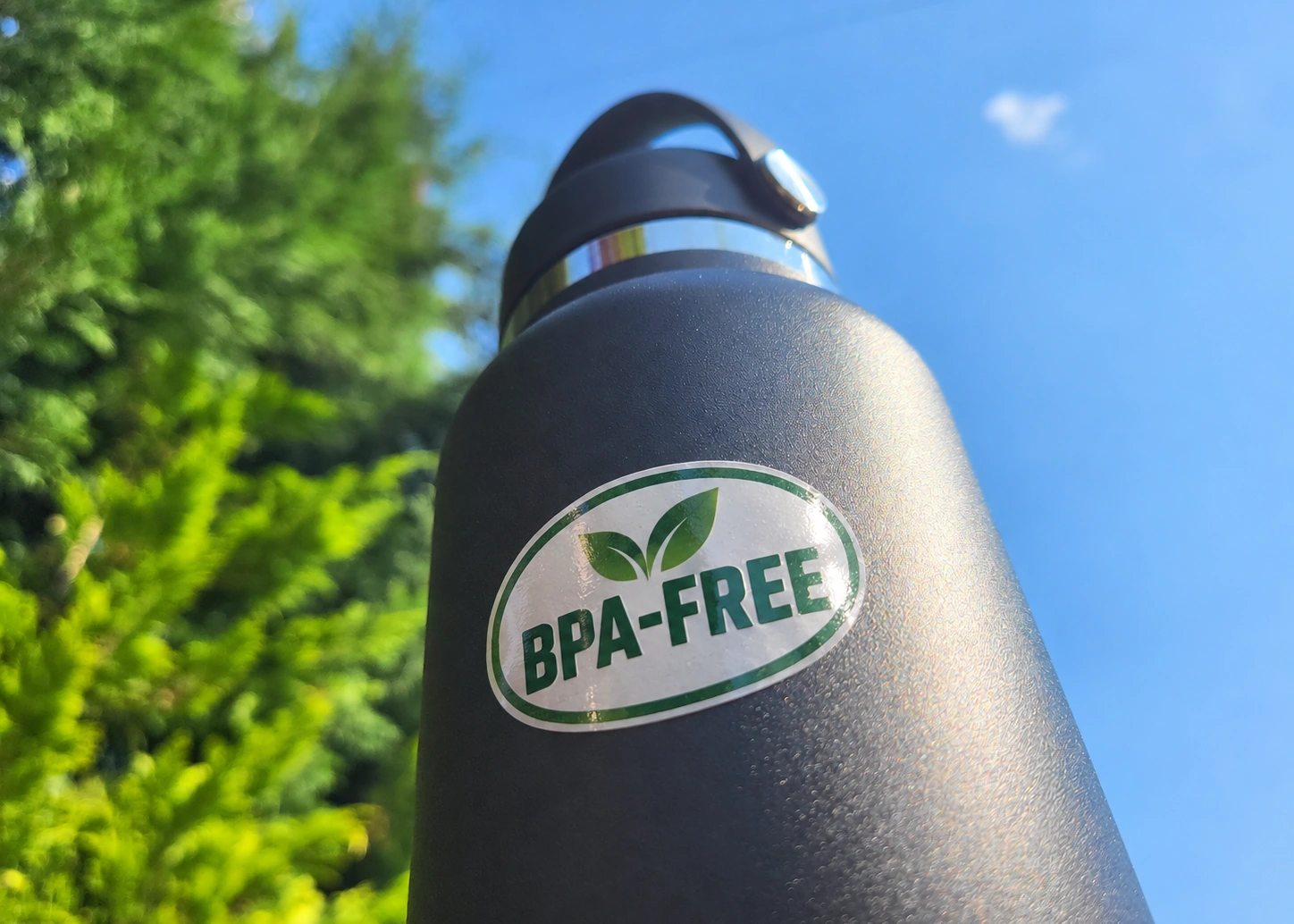
If your water bottle says BPA-free, that is a good thing. I used to read that badge almost like a full stop: BPA gone, question answered, move on. After this project, I do not read it that way anymore.
BPA is only one member of a much larger family called bisphenols. To see what that means in real life, I reviewed 167 scientific reports related to bisphenols and drinking containers, then compared the research with what 150 water bottle brands publicly say about chemical safety.
I wanted a practical answer: what should I actually look for when buying, using or replacing a bottle?
I know chemistry may not be your strongest subject so I have translated the research into normal language. By the end you will understand BPA, the other bisphenols, what bottle claims actually mean and how to choose a bottle more consciously.
I also collected the key studies I relied on at the end of this article. If you are curious, I genuinely encourage you to open a few and look at them yourself.
Key takeaways
- BPA-free is still useful. I would not throw away a good bottle just because the label stops at BPA.
- If I were buying a new bottle, I would prefer the one that clearly tells me what the body, lid, straw, liner and other water-contact parts are made from.
- A broader claim is a plus, not proof of safety. BPA/BPS/BPF-free or broad bisphenol wording gives me more information, but it is still a manufacturer claim.
- Older polycarbonate bottles plus very high heat are the situation I would take more seriously. That combination has much better direct evidence behind it than internet worries about a few scratches.
- For scratches and dishwashers, the direct reusable-bottle evidence is surprisingly thin. I would follow the manufacturer’s care instructions, but I would not invent a scientific rule that the research does not support.
Why should I care about BPA at all?
Why does BPA get so much attention?
Part of the concern is that BPA can migrate from some food-contact materials and can interact with hormone signaling. Hormones are chemical messengers that help coordinate processes throughout the body, which is why scientists pay attention when a chemical can interfere with those signals.
That still does not mean a BPA detection in a bottle equals a health problem. The amount, the route of exposure, how often the exposure happens and the conditions all matter. I think that distinction is important, because it is very easy to jump from “a study found an effect” to “this bottle is dangerous”, and the research usually does not justify that shortcut.
This part gets messy fast. Europe has taken a much stricter approach than the United States. EFSA sharply lowered its tolerable daily intake for BPA in 2023, and the EU later adopted a broad ban on BPA in food-contact materials, with transition periods and limited exceptions. The U.S. FDA still says currently approved uses are safe at current exposure levels.
I came away from that disagreement with a fairly boring but useful rule: reduce unnecessary exposure when it is easy to do so, and keep the risk in proportion. I do not treat every BPA detection or every plastic bottle as a reason to panic.
So BPA is worth paying attention to. The next question is what a “BPA-free” label actually promises.
What “BPA-free” actually tells you
Before this project, I probably gave the words “BPA-free” more weight than I do now. Today I read them literally: the manufacturer is making a claim about BPA.
It does not automatically mean “free from every bisphenol”. And if a brand says nothing about BPS or BPF, I do not assume those chemicals must be hiding in the bottle. That would be more certainty than the evidence gives me.
So I avoid that shortcut.
So I now read “BPA-free” as: good, that answers my BPA question. If I want to know about BPS, BPF or bisphenols more broadly, I need more information.
Why should I care about other bisphenols?
BPA gets most of the attention, but it is only one chemical in a larger family. BPS and BPF are two of its better-known relatives.
Why do I care about them at all? In laboratory and animal research, BPS and BPF have also shown hormonal activity. That gives researchers a reason to keep studying them. It does not tell me that a reusable bottle containing one of these chemicals would expose me to a harmful dose.
My review also found far less direct reusable-bottle evidence on BPS and BPF than on BPA, so I am careful about pretending we know as much. Different from BPA does not automatically mean safer than BPA, but less evidence does not automatically mean more dangerous either.
If a brand says only “BPA-free”, I simply do not know what its claim says about the rest of the bisphenol family. That is why I looked beyond the BPA-free badge in the current 150-brand audit.
So how much information do bottle brands actually give us?
What 150 bottle brands actually tell you
Among the 150 brands in my current chemical safety transparency audit:
- 118 of 150 used explicit first-party BPA-related free-from wording within some stated scope.
- 24 of 150 used BPS-related free-from wording.
- 9 of 150 used BPF-related free-from wording.
- Only 2 of 150 made an explicit full-class bisphenol-free claim.
Those numbers changed how I read product pages. A broader claim still does not prove that a bottle is safer; these are manufacturer statements, not my own laboratory tests. The exact wording, scope and source behind the figures are available in my 150-brand chemical safety transparency audit.
If I am choosing between two otherwise similar bottles, I give a small advantage to the company that answers more of my questions. Silence does not prove danger; it simply leaves me with more unknowns.
Personally, I would rather see a plain materials page that explains the body, lid, straw and seals than a giant “BPA-FREE” badge with nothing else behind it.
The claim may cover less of the bottle than you think
Another simple example: “BPA/BPS-free lid” is not the same sentence as “the whole bottle is BPA/BPS-free”. Both can be accurate. They just answer different questions.
So now I check the scope of the claim, not just the words inside the badge.
What the bottle studies actually show
This is where I expected the research to give me a clean answer. It did not.
Some reusable-bottle studies found BPA migration. Others did not detect BPA under the conditions they tested. Results can change with the material, temperature, liquid, exposure time and test method.
The clearest practical signal I found was around polycarbonate and heat. Several controlled studies found BPA migration from polycarbonate bottles, and hotter conditions sometimes increased it.
One human study also found higher urinary BPA after participants used polycarbonate bottles for a week. That one caught my attention because it involved people actually using bottles rather than only a lab migration setup.
So if I knew I had an old polycarbonate bottle and regularly filled it with very hot water, that is the bottle I would be more inclined to replace.
Newer plastics are less tidy. One Tritan study, for example, detected BPA release from a small number of new bottle types, but the researchers suspected manufacturing-related surface contamination rather than BPA being part of the Tritan polymer itself. A headline like “BPA found in Tritan bottle” would sound dramatic; the paper itself was much more complicated.
That is why I do not turn one positive study into a sweeping verdict about an entire material.
And one point matters throughout this article: detecting a chemical is not the same as proving harm. This distinction gets lost surprisingly easily online.
“Scientists found BPA” is a much simpler headline than “scientists measured BPA, and now we still need to ask how much, for how long and under what conditions”.
Which bottle material would I choose if bisphenols were my main concern?
I expected stainless steel to give me a cleaner answer than it did. The steel body is simple enough, but a finished bottle can still have a plastic lid, straw, valve, liner or seal.
If my goal were simply to reduce uncertainty around bisphenols, I would still lean toward stainless steel or glass for the main bottle body, then inspect the parts that actually touch my drink.
- Stainless steel: think of a typical Hydro Flask or YETI Rambler. The main wall touching the drink is steel, which I like if I am trying to reduce plastic contact. I still check the lid, straw, valve and seals.
- Glass: similar logic. The body is not plastic, but the cap, straw or seal still deserves a look.
- Tritan: a different plastic from polycarbonate. Eastman says Tritan is made without BPA, BPS or other bisphenols. I still check the finished bottle because the material name does not describe every component or possible manufacturing contamination.
- Polypropylene (PP): also a different plastic from polycarbonate. I would not automatically apply old polycarbonate BPA findings to a PP lid or bottle. I still prefer product-specific material and chemical information.
- Polycarbonate: this is the material I would treat with more caution when the bottle is old and regularly exposed to very high heat, because that combination has some of the clearest direct BPA migration evidence in my review.
- Aluminum: I will admit that before this project I barely thought about the liner inside an aluminum bottle. Now I check it. The drink may contact that coating rather than bare aluminum, so the liner can matter more than the outer shell.
The material name is a starting point, not a complete safety score.
How real-life use changes the picture
This was one of the biggest surprises in the whole project. I expected dishwashers, scratches and years of repeated use to be much better studied than they are.
Of the 28 reports most relevant to normal personal reusable bottles, 18 looked at heat. Only 4 looked at repeated use, 1 directly looked at scratching or wear, and I found 0 that isolated dishwasher effects as its own condition.
That is almost backwards compared with real bottle life. My bottles get washed, bumped around, scratched by brushes, dropped and used for years.
If I am dealing with an old polycarbonate bottle, very high heat gets my attention because that combination has direct evidence behind it. BPA-free, by itself, also does not mean a bottle is designed for boiling water. I would only use boiling water if the manufacturer says the bottle is made for it.
A hot car is murkier. It is not the same thing as a boiling-water laboratory test, so I would not invent an exact temperature where a bottle suddenly becomes unsafe. Still, I avoid unnecessary high-temperature exposure when the material is uncertain or not designed for heat.
Say my own bottle has picked up a few scratches from a cleaning brush after a year or two. I would not throw it away for that alone. The direct reusable-bottle evidence on scratching and wear is too thin for me to invent a “scratch count” where a bottle suddenly becomes unsafe.
And the dishwasher? If the bottle is dishwasher-safe according to the manufacturer, I follow those instructions. I did not find strong direct evidence for a universal rule that dishwasher use creates a major bisphenol problem in reusable bottles.
None of that proves scratches or dishwashers are harmless. It means the evidence is not strong enough for the kind of confident universal rules that circulate online.
If I were buying a bottle today
Imagine two bottles sitting next to each other on a store shelf.
Bottle A says only “BPA-free”. Bottle B tells me what the body and lid are made from, says the whole product is free from BPA, BPS and BPF, and clearly explains which parts touch my drink.
If the price, design and performance were otherwise similar, I would pick Bottle B. That choice does not prove Bottle A is unsafe. Bottle B simply leaves me with fewer unanswered questions.
My buying checklist is now pretty simple:
- Check the main bottle material.
- Check the lid, straw, liner, valve and seals.
- Read “BPA-free” literally rather than treating it as a complete chemical safety label.
- Look for broader bisphenol information when it is available.
- Check whether the claim covers the whole product or only one part.
- Prefer the more transparent brand when two products are otherwise similar.
If these were my bottles, here is what I would do
- A modern stainless-steel bottle with a plastic lid: I would keep using it. I would check what the lid and other water-contact parts are made from, but this research would not make me throw the bottle away.
- A new BPA-free Tritan bottle from a reputable brand: I would not panic. I would see whether the company gives any broader BPS, BPF or bisphenol information, and I would check whether the claim applies to the whole bottle or only one part.
- An old bottle that I know is polycarbonate and that I regularly use with very hot liquids: this is the one I would seriously consider replacing.
- A bottle with a few cosmetic scratches: I would not replace it because of the scratches alone. If it is badly cracked, deformed or difficult to clean, that is a separate practical and hygiene reason to replace it.
- A dishwasher-safe bottle that goes through the dishwasher often: I would follow the brand’s instructions. I would not assume the dishwasher has made it unsafe just because it has been washed many times.
- Two otherwise similar bottles, but one brand clearly lists every water-contact material and gives a broader bisphenol claim: I would choose the more transparent one.
The rule I use now
After all of this, I have not become afraid of my water bottles. I have just become harder to impress with a BPA-free badge.
I look at the bottle body, then the lid, straw, valve, liner and seals. I check whether the chemical claim applies to the whole product or just one part. If two bottles are otherwise similar, I prefer the company that tells me more.
And I keep the risk in proportion. This research gives me a reason to be more cautious with old polycarbonate plus high heat. It does not give me a reason to panic about every modern reusable bottle in my kitchen.
I still like seeing “BPA-free”. I just ask one more question now: what else can this brand tell me?
That covers what I would do in practice. A few useful questions do not fit naturally into that main story, so I have answered them below.
More questions about BPA and water bottles
Are BPS and BPF safer than BPA?
I would not call them safer just because they are less famous. My bottle review found far less direct evidence on BPS and BPF than on BPA. The honest answer is that we know less about them in reusable bottles, not that they are automatically safer or more dangerous.
Does BPA-free mean BPS-free, phthalate-free, PFAS-free or microplastic-free?
No. These are separate claims about different chemicals or particles. A BPA-free bottle can still tell you nothing about BPS, BPF, phthalates, PFAS or microplastic shedding unless the manufacturer addresses those questions separately.
How do I know if my old bottle is polycarbonate?
Start with the exact model name and the manufacturer’s material page. Polycarbonate is usually a hard, clear plastic, but appearance alone is not enough for me to identify it confidently. If I cannot confirm the material, I would not assume every old clear plastic bottle falls under the polycarbonate research.
What does a recycling code #7 mean?
Code 7 is an “other plastics” category. Polycarbonate can carry it, but so can unrelated plastics such as Tritan, nylon and some bioplastics. So a #7 mark can be a clue, but it is not proof that a bottle contains BPA.
Does “food-safe” or “FDA compliant” mean bisphenol-free?
No. A food-contact compliance statement and a bisphenol-free claim answer different questions. A material can comply with rules for its intended use without that statement meaning “free from every bisphenol”.
Why do Europe and the United States sound different on BPA?
Because regulators can review the same broad field of evidence and use different risk-assessment approaches. Europe has taken a much stricter position, while the FDA still says currently approved BPA uses in food containers and packaging are safe at current exposure levels.
For me, that is another reason not to reduce this topic to “BPA is safe” or “BPA is poison”. The more useful questions are how much exposure there is, what material I am using and under what conditions.
Does detecting BPA mean the bottle is dangerous?
No. Detection means an analytical method measured BPA. Whether that amount creates a meaningful health risk is a separate question involving dose and exposure.
Does a broader bisphenol claim prove a bottle is safer?
No. It tells me more about what the manufacturer is claiming. I see broader, clearer disclosure as a transparency advantage, not as an independent safety certification.
Should I trust a BPA-free badge on Amazon or another retailer?
I would use the manufacturer’s own product page, FAQ or technical material as the source of truth whenever possible. Retailer copy can be shortened, outdated or copied between listings. That is why this article relies on qualifying first-party manufacturer sources, with the central audit preserving the exact wording and scope.
What if the manufacturer says nothing about BPS or BPF?
I treat that as missing information, not evidence that BPS or BPF are present. If two otherwise similar bottles are available, I may prefer the more transparent brand, but I would not label the quieter brand unsafe without chemical evidence.
See the brands behind the numbers
I did not want to give you a few percentages and ask you to take my word for it. The accordions below show the brands behind the current 150-brand audit and the scope of the claims I found. For the source wording and current classifications, see my 150-brand chemical safety transparency audit.
One important note: this shows what the brands publicly say about their bottles. It does not prove what is actually in the bottle, and it is not a safety ranking.
Brands by specific bisphenol claim
The memberships below follow the current audit’s topic classifications. A BPS- or BPF-related record may also appear in the full-class group when the same wording names those chemicals and makes a broader bisphenol claim. Component-, material-, product- and family-specific wording applies only within the scope shown.
BPA-related qualifying first-party claims — 118 records
The current table has 116 records classified as first-party free-from statements and two manufacturer-reported no-detection statements. Scope labels follow the audit; a product, component or material claim applies only within the scope shown.
- 24Bottles (scope: Specific product)
- adidas (scope: Product family)
- Air Up (scope: Specific product)
- Amphipod (scope: Specific product)
- Asobu (scope: Brand-wide)
- b.box (scope: Brand-wide — status: reported no detectable BPA)
- Bentgo (scope: Brand-wide)
- BergHOFF (scope: Specific product)
- Bink (scope: Specific product)
- Bivo (scope: Bottle range)
- bkr (scope: Component-specific)
- Black+Blum (scope: Product family)
- BlenderBottle (scope: Brand-wide)
- Bodum (scope: Brand-wide)
- BrüMate (scope: Broad drinkware range)
- Bubba (scope: Bottle range)
- CamelBak (scope: Specific product)
- Chilly’s (scope: Product family)
- Cirkul (scope: Product family)
- Columbia (scope: Specific product)
- Contigo (scope: Broad drinkware range)
- Corkcicle (scope: Brand-wide)
- Decathlon (scope: Specific product)
- Dopper (scope: Bottle range)
- Elite (scope: Bottle range)
- Engel (scope: Component-specific)
- Equa (scope: Specific product)
- Fabric (scope: Specific product)
- Fellow (scope: Specific product)
- Ferrino (scope: Specific product)
- Frank Green (scope: Brand-wide)
- Gatorade (scope: Specific product)
- Giant (scope: Specific product)
- Grayl (scope: Specific product)
- Gregory (scope: Specific product)
- GSI Outdoors (scope: Specific product)
- Haers (scope: Product family)
- HidrateSpark (scope: Bottle range)
- Hydaway (scope: Specific product)
- Hydra Cup (scope: Product family)
- HydraPak (scope: Brand-wide)
- Hydrapeak (scope: Product family)
- Hydro Cell (scope: Component-specific)
- Hydro Flask (scope: Component-specific)
- HydroBlu (scope: Specific product)
- HydroJug (scope: Brand-wide)
- Igloo (scope: Specific product)
- Ion8 (scope: Material-specific)
- Iron Flask (scope: Product family)
- JoyJolt (scope: Specific product)
- Kambukka (scope: Brand-wide)
- Katadyn (scope: Component-specific)
- KeepCup (scope: Specific product)
- Kinto (scope: Specific product)
- L.L.Bean (scope: Specific product)
- Laken (scope: Brand-wide)
- Lifefactory (scope: Specific product)
- LifeStraw (scope: Brand-wide)
- LocknLock (scope: Product family)
- Mammut (scope: Specific product)
- memobottle (scope: Specific product)
- Mepal (scope: Brand-wide)
- MiiR (scope: Brand-wide)
- Mijia (scope: Specific product)
- Mizu (scope: Brand-wide)
- Muji (scope: Specific product)
- Munchkin (scope: Specific product)
- Nalgene (scope: Bottle range)
- Nathan (scope: Bottle range)
- Nike (scope: Specific product)
- Ninja (scope: Specific product)
- NUK (scope: Specific product)
- Ocean Bottle (scope: Material-specific)
- One Green Bottle (scope: Bottle range)
- Owala (scope: Material-specific)
- Philips Avent (scope: Bottle range)
- Platypus (scope: Brand-wide)
- Portland Design Works (scope: Specific product)
- Pottery Barn Kids (scope: Specific product)
- Promixx (scope: Bottle range)
- Puma (scope: Specific product)
- Pura (scope: Brand-wide — status: reported no detectable BPA)
- Purifyou (scope: Product family)
- Qwetch (scope: Specific product)
- Rapha (scope: Specific product)
- Retap (scope: Component-specific)
- Ritchey (scope: Specific product)
- Rivers (scope: Specific product)
- S’well (scope: Brand-wide)
- Salomon (scope: Specific product)
- Sawyer (scope: Component-specific)
- SIGG (scope: Brand-wide)
- Silca (scope: Specific product)
- Simple Modern (scope: Brand-wide)
- Sistema (scope: Product family)
- Skip Hop (scope: Specific product)
- Smartshake (scope: Specific product)
- Source (scope: Specific product)
- Specialized (scope: Specific product)
- Stanley 1913 (scope: Component-specific)
- Syncros (scope: Specific product)
- Takeya (scope: Brand-wide)
- Tatonka (scope: Specific product)
- ThermoFlask (scope: Specific product)
- Thermos (scope: Product family)
- Tommee Tippee (scope: Brand-wide)
- Trek (scope: Specific product)
- Tupperware (scope: Region-specific)
- Tyeso (scope: Brand-wide)
- Ultimate Direction (scope: Bottle range)
- Under Armour (scope: Bottle range)
- Vapur (scope: Bottle range)
- Waterdrop (scope: Specific product)
- YETI (scope: Broad drinkware range)
- Zak Designs (scope: Brand-wide)
- Zefal (scope: Bottle range)
- Zojirushi (scope: Broad drinkware range)
- Zoku (scope: Specific product)
BPS-related free-from claims — 25 first-party records
The table has 25 first-party BPS free-from records. One, from Bivo, also states that the products are free of bisphenols as a broader class; the article’s headline figure of 24 counts the partial/named group. This accordion preserves that overlap.
- 24Bottles (scope: Specific product)
- Bivo (scope: Bottle range)
- bkr (scope: Component-specific)
- Black+Blum (scope: Product family)
- BrüMate (scope: Product family)
- CamelBak (scope: Specific product)
- Equa (scope: Specific product)
- Frank Green (scope: Brand-wide)
- HydraPak (scope: Brand-wide)
- Hydrapeak (scope: Product family)
- JoyJolt (scope: Specific product)
- Kambukka (scope: Bottle range)
- KeepCup (scope: Specific product)
- LifeStraw (scope: Brand-wide)
- Mammut (scope: Specific product)
- memobottle (scope: Specific product)
- Nalgene (scope: Bottle range)
- One Green Bottle (scope: Bottle range)
- Platypus (scope: Brand-wide)
- SIGG (scope: Bottle range)
- Stanley 1913 (scope: Component-specific)
- Tommee Tippee (scope: Brand-wide)
- Trek (scope: Specific product)
- Vapur (scope: Bottle range)
- YETI (scope: Product family)
BPF-related free-from claims — 10 first-party records
The table has 10 first-party BPF free-from records. Bivo’s broader wording also appears in the full-class group; the article’s headline figure of 9 counts the partial/named group. This accordion preserves that overlap.
- Bivo (scope: Bottle range)
- BrüMate (scope: Component-specific)
- CamelBak (scope: Specific product)
- Equa (scope: Specific product)
- HydraPak (scope: Brand-wide)
- Hydrapeak (scope: Product family)
- Nalgene (scope: Bottle range)
- One Green Bottle (scope: Bottle range)
- SIGG (scope: Bottle range)
- YETI (scope: Product family)
Full-class bisphenol-free claims — 2 brands
These are the two first-party records classified by the audit as explicit claims covering the full named bisphenol class. The scope is shown for each claim.
- Bivo (scope: Bottle range)
- Qwetch (scope: Material-specific)
No public bisphenol-related claim found across all four topics — 23 brands
These brands are marked “No public claim found” for BPA, BPS, BPF and the all-bisphenol topic in the current audit table. This reports what was found publicly; it is not evidence that a chemical is present or absent.
- AquaFlask
- Asvel
- Berghaus
- Carl Oscar
- Coleman
- Fidlock
- Fuguang
- High Sierra
- Jack Wolfskin
- Larq
- Millet
- Mosh!
- MSR
- Osprey
- Peacock
- Reebok
- RTIC
- Skater
- Supor
- Tacx
- Tafuco
- Tiger Corporation
- Vaude
How I did this research
Scientific literature review
I started with a broad literature search on bisphenols and reusable drinking containers rather than searching only for papers that already supported a particular conclusion. The final publication-locked corpus contains 167 included reports.
I then classified the evidence by how directly it answered the reusable-bottle question. Fifty-eight reports qualified as direct Tier 1 evidence involving reusable drinking bottles or containers, and 28 reports made up the stricter personal reusable-bottle core used for the main consumer-facing counts in this article.
A “report” is a publication or research record, not necessarily a completely independent experiment. I tracked likely study families separately so that related publications would not automatically be treated as new experiments. Some family relationships remain unresolved, which is why I use the locked report counts of 167, 58 and 28 here rather than presenting one overly precise number of independent studies.
For every included record, I extracted the bottle or container type, material, bisphenols tested, liquid or food simulant, temperature, exposure time, washing or aging conditions when available, analytical method, detection or quantification limits where reported, and the result. Positive findings, null findings and contradictory findings were all retained.
I also separated realistic water migration from food-simulant testing, aggressive solvent extraction, finished-water occurrence studies, large refillable carboys and indirect evidence such as baby bottles. Carboys and other indirect evidence were not allowed to inflate the 28-report personal-bottle core.
For source verification, I used the strongest accessible source available: full primary text first, then supplements or publisher material, then PubMed/PMC abstracts, and only then secondary sources when a primary source could not be recovered. Exact quantitative values were locked separately. Values that could not be tied back to a sufficiently precise source location were either caveated or removed from article use.
I deliberately did not calculate a pooled “percent of studies that detected BPA”. The studies are too heterogeneous for that number to be meaningful.
A room-temperature water test of a personal bottle is not equivalent to 70°C food-simulant testing, an acetonitrile extraction, a 20-liter carboy survey or a human exposure intervention. Instead, I aggregated things that can be compared more defensibly, such as which bisphenols were studied, which conditions were studied, and how much of the literature directly applies to personal reusable bottles.
150-brand disclosure methodology
This manufacturer-claims analysis is separate from the scientific literature review and uses the same fixed panel of 150 prominent and relevant reusable water bottle brands used across the WBA chemical safety transparency project.
For each brand, I record qualifying wording from official first-party manufacturer sources, along with the exact wording, source and product, component or material scope. Retailer wording, general policy statements, testing references and cases where no qualifying public claim was found are kept separate from qualifying product claims.
Scope matters: a product-, component- or material-specific statement is not automatically treated as brand-wide. The 118 of 150 BPA-related, 24 of 150 BPS-related, 9 of 150 BPF-related and 2 of 150 full-class findings describe public manufacturer communication. They are not evidence of chemical composition, migration or safety, and no qualifying public claim found does not mean the chemical is present.
The 150 brands form a fixed research panel selected using multiple market-presence signals, not a statistically representative census of every bottle brand. Manufacturer pages and wording can change by country or product. Manufacturer claims are not independent proof of safety.
Limitations
The scientific literature is uneven. Polycarbonate and BPA are much better represented than many modern bottle materials and other bisphenols, test conditions vary widely, and some older or obscure papers were only available at abstract or secondary-source level.
The publication lock therefore excludes pooled detection rates, keeps large carboys separate from personal bottles, and avoids exact independent-study counts while a small number of study-family relationships remain uncertain.
The brand analysis has different limitations. The 150 brands form a fixed research panel selected using multiple market-presence signals, not a statistically representative census of every bottle brand in the world.
Manufacturer websites change, wording may differ by country or product, and a claim is not a substitute for independent laboratory testing. These limitations are why I describe the results as findings within this fixed panel rather than as estimates for the entire market.
Sources
Key scientific sources
[1] Le HH, Carlson EM, Chua JP, Belcher SM. “Bisphenol A is released from polycarbonate drinking bottles and mimics the neurotoxic actions of estrogen in developing cerebellar neurons”. Toxicology Letters. 2008;176(2):149-156. DOI: 10.1016/j.toxlet.2007.11.001. https://doi.org/10.1016/j.toxlet.2007.11.001
[2] Carwile JL, Luu HT, Bassett LS, et al. “Polycarbonate Bottle Use and Urinary Bisphenol A Concentrations”. Environmental Health Perspectives. 2009;117(9):1368-1372. DOI: 10.1289/ehp.0900604. https://pmc.ncbi.nlm.nih.gov/articles/PMC2737011/
[3] Holmes, Ma, Andra, Wang. “Effect of common consumer washing methods on BPA release in Tritan drinking bottles”. Chemosphere. 2021. DOI: 10.1016/j.chemosphere.2021.130355. https://pmc.ncbi.nlm.nih.gov/articles/PMC8351615/
[4] Kovačič A, Gys C, Gulin MR, Kosjek T, Heath D, Covaci A, Heath E. “Migration of bisphenols from beverage cans and reusable sports bottles”. Food Chemistry. 2020;331:127326. DOI: 10.1016/j.foodchem.2020.127326. https://pubmed.ncbi.nlm.nih.gov/32674069/
[5] Guart A, Wagner M, Mezquida A, Lacorte S, Oehlmann J, Borrell A. “Migration of plasticisers from Tritan™ and polycarbonate bottles and toxicological evaluation”. Food Chemistry. 2013;141(1):373-380. DOI: 10.1016/j.foodchem.2013.02.129. https://doi.org/10.1016/j.foodchem.2013.02.129
[6] Rochester JR, Bolden AL. “Bisphenol S and F: A Systematic Review and Comparison of the Hormonal Activity of Bisphenol A Substitutes”. Environmental Health Perspectives. 2015;123(7):643-650. DOI: 10.1289/ehp.1408989. https://pubmed.ncbi.nlm.nih.gov/25775505/
These are the key papers directly cited or discussed in the article, not the complete scientific corpus. The WBA evidence database contains 167 included reports, with source-verification status and study-level extraction recorded for each one. Before publication, I plan to make the underlying research table available alongside the article so readers can inspect the full evidence base rather than only the examples above.
Regulatory and material sources
[7] European Food Safety Authority. “Re-evaluation of the risks to public health related to the presence of bisphenol A (BPA) in foodstuffs”. 2023. https://www.efsa.europa.eu/en/plain-language-summary/re-evaluation-risks-public-health-related-presence-bisphenol-bpa-foodstuffs
[8] European Commission. “Commission adopts ban of Bisphenol A in food contact materials”. 19 December 2024. https://food.ec.europa.eu/food-safety-news/commission-adopts-ban-bisphenol-food-contact-materials-2024-12-19_en
[9] U.S. Food and Drug Administration. “Questions & Answers on Bisphenol A (BPA) Use in Food Contact Applications”. https://www.fda.gov/food/food-packaging-other-substances-come-contact-food-information-consumers/questions-answers-bisphenol-bpa-use-food-contact-applications
[10] Eastman. “Frequently Asked Questions | Tritan and Tritan Renew”. https://www.eastman.com/en/products/brands/tritan/about/faqs
Manufacturer sources
Current manufacturer claim wording, scope and source URLs are maintained in my separate 150-brand chemical safety transparency audit. That central database is the source of truth for the brand-claim statistics used in this article.
First-party sources include manufacturer product pages, FAQs, material pages, help centers and technical or safety pages. Retailer statements do not establish qualifying manufacturer claims. The central audit records exact wording, source URLs and claim scope.
The searchable audit preserves the exact qualifying wording, scope and source for the current brand-level findings. These public claims measure transparency and communication; they are not independent proof of product safety.
How we test products
Every product we review is tested using the same structured process, with dozens of measurements and checks covering areas such as thermal performance, lid usability, cleaning, durability, portability, and everyday use. Those results feed into the WBA Score, which helps us compare bottles using consistent criteria instead of relying only on manufacturer claims.
You can read our full product testing protocol, learn more about Water Bottle Advisor and how we test products, or see how the WBA Score works.
About the author
Jeremiah Kowalski
Jeremiah Kowalski founded Water Bottle Advisor to make drinkware reviews more useful and less dependent on manufacturer claims. He has personally tested 50+ products, putting them through measuring, cleaning, leak testing, durability testing, and everyday use before sharing his conclusions. It also means occasionally explaining why yet another large box of bottles has arrived at his door.
Leave a Reply