
Table of contents12 sections
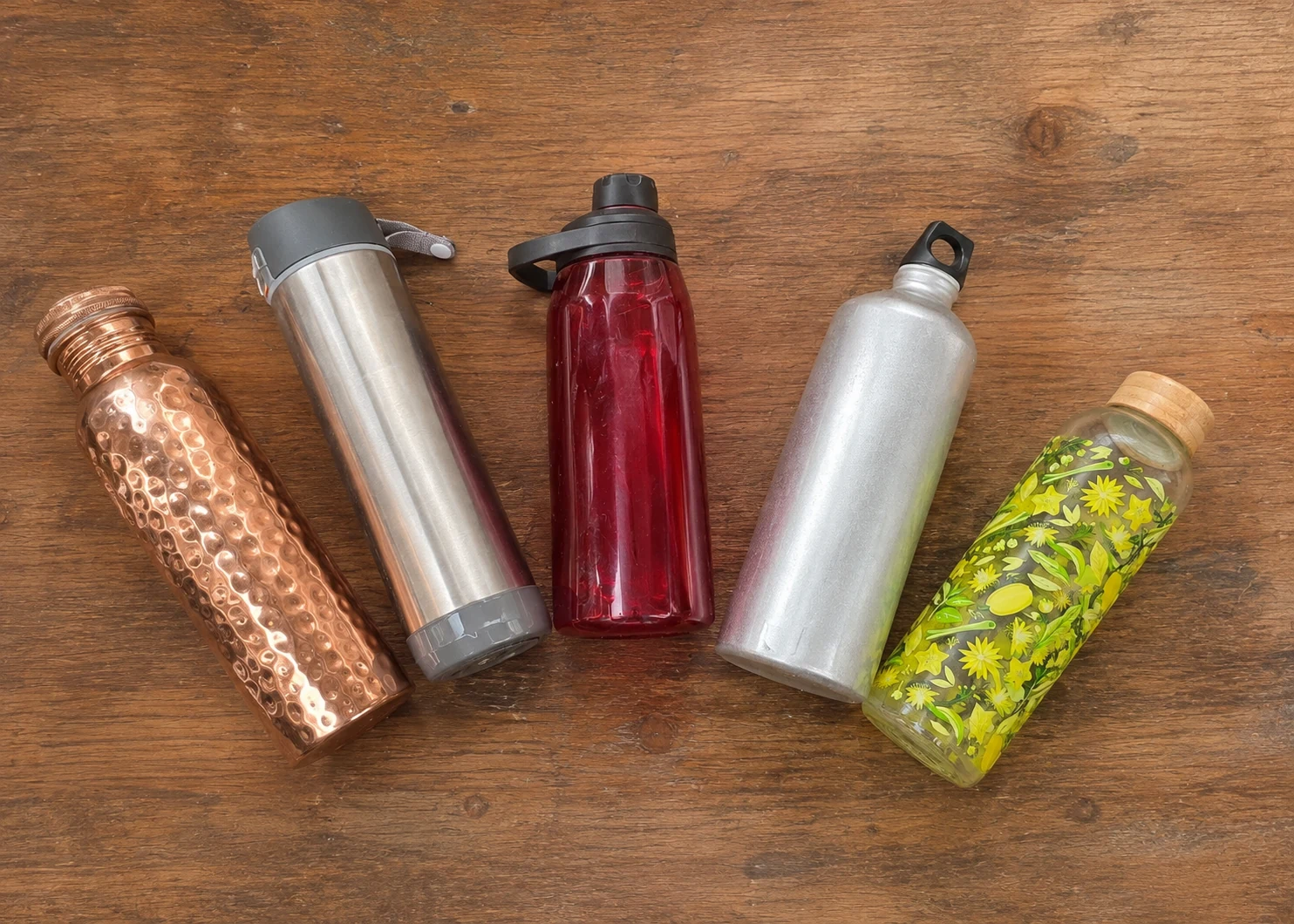
I started this project with a simple question: what are reusable water bottles actually made of?
Stainless steel seems to be everywhere right now. It is also my personal favorite material, so I expected it to come out on top.
And it did.
After screening more than 2,000 product leads, I ended with 1,296 reusable water bottle configurations from 470 brands that met my inclusion rules.
Stainless steel was the most common body material, followed by plastic.
But the project also uncovered some things I did not expect, especially around price, weight, and how rarely brands tell us exactly what type of plastic or stainless steel they use.
The biggest findings
- 38.73% of the bottles I analyzed had stainless-steel bodies.
- 33.02% had plastic bodies.
- Stainless steel and plastic together accounted for 71.76% of the dataset.
- Stainless steel had a median recorded price of $30, compared with $16.99 for plastic.
- Titanium was the most expensive major material, with a median price of $78.
- Among bottles with a verified empty weight, plastic had a median of 3.5 oz (100 g), stainless steel 13.3 oz (376.5 g), and glass 16.0 oz (455 g).
- I could identify the exact body polymer for only 29.44% of plastic bottles.
- I could identify an exact reported steel type for only 9.76% of stainless-steel bottles.
Those last two numbers bothered me almost as much as the material ranking interested me.
A bottle can spend years touching your drinking water, so I want to know more than just “plastic” or “stainless steel”. Our collected evidence often did not identify the exact material subtype.
What are reusable water bottles made of?
The chart shows the full breakdown of the 1,296 bottles in the dataset.
Bottle materials in our dataset
Dataset proportions, not U.S. sales market share.
The first thing that stands out is how dominant stainless steel and plastic are.
Together, they made up nearly 72% of all bottles I analyzed.
Everything else forms a much smaller long tail.
Glass came in third at 6.79%, followed by copper at 5.32% and titanium at 4.32%.
Aluminum, which I still think many people associate with reusable bottles because of older lightweight designs, represented only 1.70% of the dataset.
That surprised me.
I was less surprised by stainless steel finishing first.
After trying bottles made from almost every major material, stainless steel is still the one I personally reach for most often.
It gives me a good balance of durability, insulation, and everyday practicality.
What do these materials mean in everyday use?
If you are choosing your first reusable bottle, here is the practical version of the material differences:
- Stainless steel: A solid all-rounder for durability and cold or hot drinks, especially in insulated designs. The tradeoffs are usually weight and price.
- Plastic: Often the lightest and most affordable choice in this dataset. Check the exact plastic, temperature restrictions, and whether the lid is easy to clean.
- Glass: A good option if you enjoy drinking directly from glass, particularly at home or at a desk. Its biggest drawbacks for me are weight and breakage.
- Titanium: Worth considering when every gram matters, such as on a long hike, and the budget allows it. Many designs are not directly comparable to insulated steel bottles.
- Aluminum: Can be lightweight and relatively inexpensive. Check whether the interior is lined and what the drink actually touches.
These are practical tradeoffs, not a safety ranking. A lid, liner, or coating can matter just as much as the body material.
What kinds of plastic are reusable bottles made from?
I expected it to be easier to find the precise type of plastic in product documentation. The evidence we collected told a different story.
Out of 428 plastic bottles, I could identify a specific, conflict-free body polymer for only 126, or 29.44%.
For the other 302, the available evidence did not support a more specific identification.
That does not mean those bottles are unsafe. It simply means I could not responsibly turn a vague claim like “BPA-free plastic” into polypropylene, Tritan, HDPE, or another material without evidence.
The treemap shows the 126 bottles where I could identify the body polymer.
Identified plastic types
Area shows 126 identified body polymers, not all plastic bottles.
- Tritan45
- TPU19
- HDPE16
- Tritan Renew12
- LDPE11
- Polypropylene (PP)8
- Polyethylene, subtype unspecified6
- Copolyester, subtype unspecified6
- PET2
- PCTG1
Tritan is a branded copolyester, which is a type of plastic. TPU is a flexible polyurethane plastic. HDPE and LDPE are both types of polyethylene, with HDPE generally being stiffer. PP means polypropylene, PET is another widely used plastic, and PCTG is a type of copolyester.
You do not need to memorize the names. The point is that “plastic” covers many different materials.
I kept standard Tritan and Tritan Renew separate in the dataset. Combined, they represented 57 of the 126 bottles where I could identify the exact body polymer, or 45.24%. So among bottles with a known plastic type, the Tritan family was by far the largest group I found.
I also found zero bottles with an explicitly identified polycarbonate body.
That wording matters. It does not prove that polycarbonate reusable bottles do not exist. About 70% of the plastic bottles in the dataset did not have a specific body polymer identified.
This is also why “BPA-free” never feels like the end of the conversation to me.
I want to know what the bottle is made from, not only one chemical it does not contain. Still, the 302 unknown body polymers are gaps in our collected evidence, not proof that their manufacturers never disclosed the material.
How often could I verify the exact type of stainless steel?
Stainless steel was the largest category in the dataset, but specific steel-type disclosure was surprisingly weak.
I found a specific steel designation in the available product evidence for just 49 of 502 stainless-steel bottles, or 9.76%. These were reported labels, not laboratory-confirmed alloy grades.
Among those 49:
| Reported steel type | Bottles | Share of known-type subset |
|---|---|---|
| 18/8 | 41 | 83.67% |
| 304 | 5 | 10.20% |
| Multiple explicit claims | 3 | 6.12% |
There is an important detail here: 18/8 and 304 usually describe essentially the same stainless steel, not two fundamentally different grades.
18/8 is shorthand for roughly 18% chromium and 8% nickel.
Type 304 is a formally defined grade, commonly described as 18/8 or 18/10.
The shorthand is useful, but it is not as precise as a confirmed grade specification.
18/8 is widely used in reusable drinkware. Brands such as Hydro Flask, Klean Kanteen and other popular names in the indsutry explicitly identify it as their bottle material, so I can understand why shoppers might assume that “stainless steel” means 18/8.
But there are other stainless-steel grades too. They show up in drinkware, but in my experience they are extremely rare. After several years of running this website, I could count on one hand the bottles I have personally come across that used something other than the usual 18/8 or 304.
If you want to know more about these less common grades, or stainless steel in drinkware in general, I have written a separate guide that goes into more detail.
Plastic bottles are much cheaper than stainless steel
I had a usable current standalone-bottle price for 976 of the 1,296 bottles. The chart compares median prices for the main materials.
Median bottle price by material
Seven selected material groups; 899 eligible listings. Prices are observed retail prices, not manufacturing costs.
The difference between plastic and stainless steel is already noticeable.
The median stainless-steel bottle cost about $13 more than the median plastic bottle.
Titanium sits in another price bracket entirely. Its median price was $78, or about 2.6 times the stainless-steel median.
Bottle size could distort a comparison like this, so I also compared similar capacities.
Among 20 to 25.9 fl oz (591–766 mL) bottles:
- plastic median: $17.99
- stainless steel median: $29.99
Stainless steel was about 67% more expensive.
Plastic is much lighter than stainless steel
Weight needs a bigger warning label because I could verify it for fewer bottles. I accepted a weight only when I could confirm that it referred to the empty bottle with its normal lid.
I excluded shipping weights, package weights, body-only weights, and values that were too ambiguous.
That left 306 bottles, or 23.61% of the dataset. The chart shows six main materials; the other 20 verified weights belonged to smaller or unknown material categories.
Bottle weight by material
Median verified empty weights, including the standard lid.
Among bottles with verified empty weights, the differences are striking. The median plastic bottle weighed 3.5 oz (100 g), compared with 13.3 oz (376.5 g) for stainless steel. Titanium was much lighter at 5.5 oz (155 g), while glass was the heaviest at 16.0 oz (455 g).
But I’ve always cared more about weight relative to capacity than weight alone.
If you tell me a bottle weighs 10.6 oz, that means very little until I know whether it holds 12 fl oz or 40 fl oz. That’s why I added the “Weight per fl oz” option to the chart above. It lets you make a fairer comparison by accounting for how much water each bottle can hold.
This also helps explain why I understand the appeal of titanium, despite its high price. At a median of just 5.5 oz (155 g), it was considerably lighter than stainless steel in my dataset. I love lightweight bottles, especially when hiking, because after a few hours on the trail, every extra gram starts to matter.
Of course, bottle size, construction, and insulation also affect weight, so these figures don’t tell us how much of titanium’s price premium comes from the material itself.
Glass is at the opposite end. Its median empty weight was 16.0 oz (455 g), making it the heaviest material in my comparison. Many glass bottles also come with protective sleeves, which add extra weight and bulk. And while those sleeves can help protect against impacts, they don’t guarantee the bottle won’t break.
I actually love drinking from glass, but since 2023, I’ve bought five glass bottles and managed to break four of them.
So while I appreciate glass as a material, it’s definitely not my personal favorite when it comes to durability.
What about aluminum bottles?
Aluminum was a small category in this dataset, with only 22 bottles.
For 10 of those 22, I found explicit evidence of an interior liner or coating. For the other 12, liner status remained unknown.
This matters because an aluminum bottle body does not automatically mean your drink is touching bare aluminum.
Some aluminum bottles use a protective internal coating between the drink and the metal body.
I would not turn the 10-out-of-22 result into a claim that a certain percentage of all aluminum bottles are lined. The dataset here is small, and more than half of the aluminum records still had unknown liner status.
It is simply a useful reminder that body material and liquid-contact surface are not always the same thing.
The bottle body is only part of the story
After several years of testing bottles, I have become less impressed by body material as a complete description of a product.
I sometimes joke that 90% of a bottle is the lid and 10% is the body. Obviously, that is not a scientific ratio.
The point is that two bottles made from the same stainless steel can feel completely different.
One can have a simple screw cap. The other can have a straw, button, spring, hinge, lock, and several silicone gaskets.
The same problem appears with materials.
A stainless-steel bottle can still have plastic and silicone touching the water in the lid. A glass bottle can use a plastic cap. An aluminum bottle can have an internal coating.
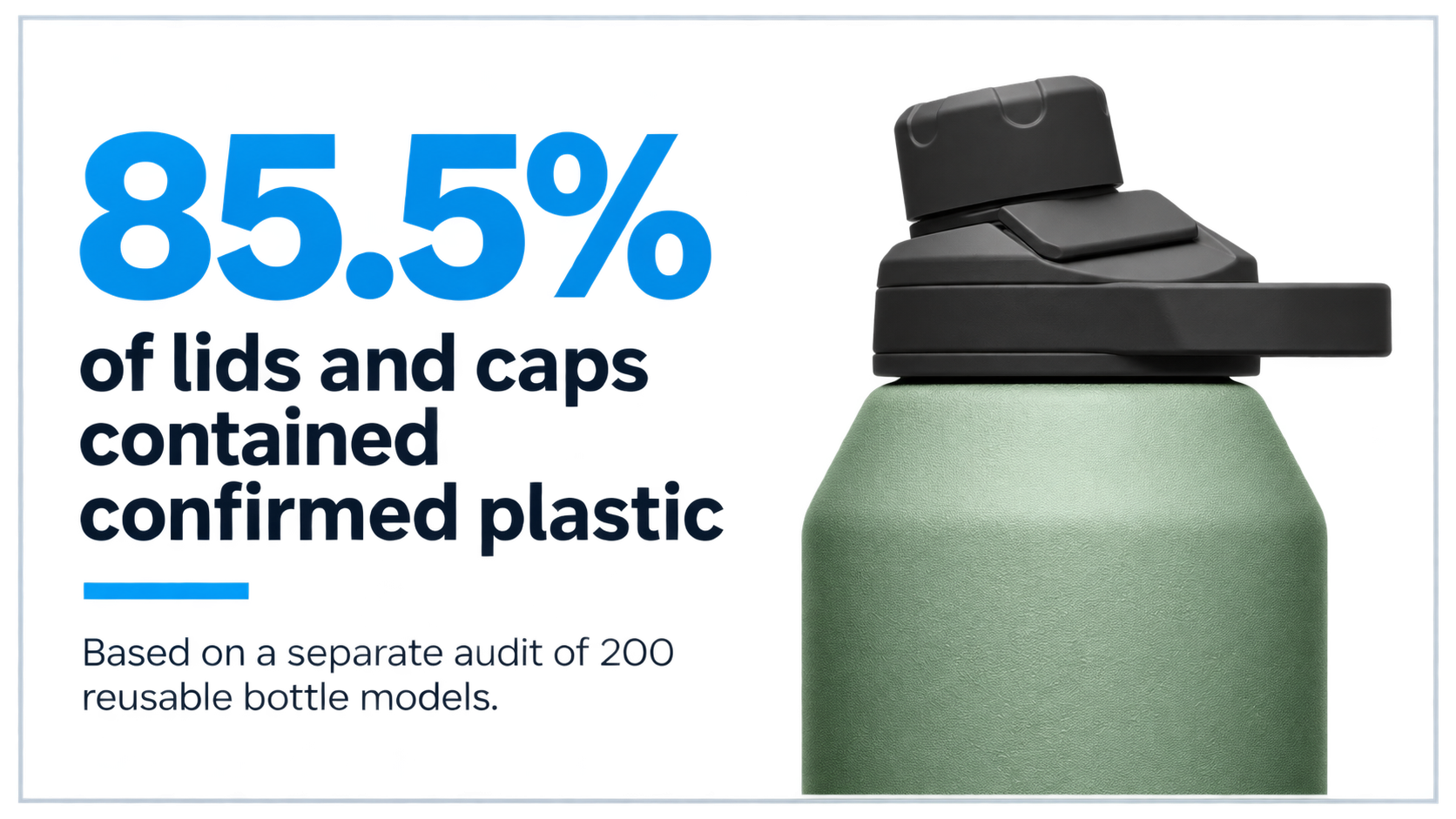
I checked how common plastic closures are in a separate 200-model audit for my microplastics research. Plastic was clearly present somewhere in the lid or closure of 171 models, or 85.5%. I left uncertain cases out of that count.
It is a good reminder that a metal or glass body does not necessarily mean a plastic-free bottle.
What I would take from all of this
If you ask me what reusable water bottles are made from, the simplest answer from this dataset is:
Mostly stainless steel and plastic. Together, they accounted for almost 72% of the 1,296 bottles I analyzed.
Stainless steel was the largest category at 38.73%, followed by plastic at 33.02%. Plastic was generally much cheaper and lighter.
Titanium was dramatically more expensive, but also much lighter than stainless steel in the verified-weight subset.
Glass was the heaviest major material I tracked.
And perhaps the finding I care about most: exact material disclosure is still much weaker than I would like.
After all of this research, stainless steel is still my personal favorite.
Methodology
I wanted to document which body materials were used in reusable water bottles offered to U.S. shoppers, then compare recorded prices, empty weights, and the material details I could verify. The research was completed in November 2026.
I screened 2,021 candidate product leads and accepted 1,296 bottle configurations from 470 brands. You can inspect every accepted record, including the product name, body material, recorded price or weight when available, and source links.
Browse all 1,296 bottle records in the research spreadsheet.
Which bottles did I include?
The study focused on reusable water bottles with current or sufficiently recent evidence of U.S.-market availability. I used manufacturer product pages, retailer listings, specialty sellers, and other product-specific records. A listing alone was not a unit-sales observation.
I searched stainless steel, plastic, glass, aluminum, copper, titanium, silicone-body, composite, ceramic, and other materials separately. I continued the searches until additional discovery attempts were bringing in very few new eligible products. This is practical discovery saturation, not proof that I found every bottle on the market.
The dataset was built deliberately, not by randomly sampling stores or consumers. It is not representative of U.S. unit sales, revenue, or market share with a statistical margin of error.
What counted as one bottle?
A record represents an accepted configuration of a reusable bottle. Different capacities or meaningful product setups can have separate rows, even when they share a model name. Color-only changes were not counted separately.
That matters for interpretation. A brand offering five sizes of one model can contribute more configurations than a brand selling only one size. Throughout the article, I use the shorter word “bottles”, but every headline material percentage uses the same 1,296-configuration denominator.
I compared candidate names, sizes, source pages, and model details to resolve duplicates. Products that did not meet the scope were excluded. Another 40 candidates remained pending because information such as identity, U.S. availability, or material was unresolved; none entered the 1,296 accepted records.
How did I classify the bottle materials?
The primary classification describes the material of the bottle body, not every part of the assembled product. A steel bottle with a plastic lid is recorded as stainless steel. Copper inside the insulation of a steel bottle does not make the bottle a copper-body product.
When the evidence could not support a reliable primary body material, I recorded UNKNOWN rather than guessing. This applies to 76 accepted configurations. I also kept coatings, inner liners, lids, and silicone seals separate from the primary body material when the source allowed it.
Exact plastic and metal types required explicit evidence linked to the body. I identified an exact, conflict-free body polymer for 126 of 428 plastic bottles. I kept Tritan and Tritan Renew separate, and did not assign a lid polymer to the bottle body.
For stainless steel, I found an explicit grade-related label for 49 of 502 configurations: 41 used 18/8, five used 304, and three had multiple claims.
These are the original source labels, not separate laboratory-confirmed grades. Because 18/8 commonly refers to the 304 family, I preserved the labels for traceability rather than counting them as fundamentally different alloys. Glass subtype was identified for 16 of 88 bottles. An exact numerical titanium grade was established for 7 of 56; another 18 stated pure titanium without giving a grade.
For aluminum, I found explicit evidence of an internal liner or coating for 10 of 22 bottles. The remaining 12 have an unknown liner status, not a confirmed absence of lining.
I also reviewed all copper and titanium classifications more closely. The stored evidence supported 68 of 69 copper-body assignments and 55 of 56 titanium-body assignments. One record in each category remained unclear and is flagged in the spreadsheet rather than silently removed.
How were the prices calculated?
Of 1,296 accepted configurations, 979 had a recorded normalized current price. I excluded three price observations for reusable bottles originally sold as filled-water multipacks. This left 976 prices eligible for the standalone-bottle comparisons.
Where an eligible pack contained identical empty bottles, I used the documented per-bottle equivalent instead of the total pack price. Prices were recorded in U.S. dollars from the linked listing, including promotional prices where applicable. They are snapshots, not prices guaranteed to be available today.
I used the median, or middle observed price, because it is less affected by very expensive bottles than a simple average. I also compared 20 to 25.9 fl oz (591–766 mL) and 26 to 32.9 fl oz (769–973 mL) capacity bands to reduce obvious size differences.
These are comparisons between observed product groups. I did not separately control for vacuum insulation, double walls, the lid, the brand, or other features. So the price differences cannot be interpreted as the extra manufacturing cost caused by the body material alone.
How were empty weights calculated?
Weight evidence was much more limited. I used only values explicitly suitable for the empty bottle with its normal standard lid. Package weight, shipping weight, body-only weight, and unclear scopes were excluded.
That produced 306 usable weights out of 1,296 bottles. They are recorded manufacturer or retailer specifications, not a claim that I personally put all 306 bottles on a scale.
The source weights were standardized to grams and converted to ounces for US readers. For capacity-adjusted comparisons, I calculated each empty bottle’s weight relative to its capacity, then reported the median as ounces of bottle weight per fluid ounce of capacity (with grams per 100 mL in parentheses).
The article’s main weight chart shows six material groups, covering 286 of the 306 qualifying observations. The other 20 are in smaller or unknown material categories and are retained in the spreadsheet.
Where can I check the sources and records?
Each of the 1,296 spreadsheet rows has a configuration ID, a product/source URL, and material classification. Price and weight source URLs and check dates are included where publication-eligible values were available. The spreadsheet also flags the two unresolved copper/titanium classifications.
The final analysis went through a separate cleanup and validation process. All 20 publication-ready checks passed, including accepted-row uniqueness, material totals, eligible-price count, and strict-weight count. The frozen original V2 dataset remained unchanged.
The linked spreadsheet is a public-facing extract of all accepted bottle records. It is not the complete internal archive of every search attempt, rejected lead, source quote, or audit file. Some linked retailer pages may change after the date checked.
What are the limitations of this study?
The percentages in this article describe configurations in my research dataset, not the share of reusable bottles sold in the United States. Deliberate search coverage, differing numbers of sizes per model, incomplete online listings, and missing material specifications can all affect the results.
Likewise, “not identified in my evidence” does not mean a manufacturer never disclosed the material. The exact-subtype percentages describe what I could confirm from the retained evidence, not a complete industry disclosure audit.
Price and especially weight results use smaller, potentially nonrandom subsets. I have shown their denominators so readers can see how much evidence supports each comparison.
How we test products
Every product we review is tested using the same structured process, with dozens of measurements and checks covering areas such as thermal performance, lid usability, cleaning, durability, portability, and everyday use. Those results feed into the WBA Score, which helps us compare bottles using consistent criteria instead of relying only on manufacturer claims.
You can read our full product testing protocol, learn more about Water Bottle Advisor and how we test products, or see how the WBA Score works.
About the author
Jeremiah Kowalski
Jeremiah Kowalski founded Water Bottle Advisor to make drinkware reviews more useful and less dependent on manufacturer claims. He has personally tested 50+ products, putting them through measuring, cleaning, leak testing, durability testing, and everyday use before sharing his conclusions. It also means occasionally explaining why yet another large box of bottles has arrived at his door.
Leave a Reply